Department of Ophthalmology, West China Hospital, Sichuan University, Chengdu, 61000, Sichuan, China.
Department of Optometry and Visual Sciences, West China Hospital, Sichuan University, Chengdu, 61000, Sichuan, China.
BMC Ophthalmol. 2022 May 6;22(1):208. doi: 10.1186/s12886-022-02435-6.
Paediatric traumatic cataracts are an important but preventable cause of acquired blindness. Understanding the epidemiology of paediatric traumatic cataracts is a prerequisite for prevention. This study aimed to characterize the epidemiological profile of paediatric traumatic cataracts in southwest China.
The medical records of children (age range, 0-14 years old) who developed traumatic cataracts following open-globe injuries and were hospitalized at the Department of Ophthalmology at West China Hospital, between January 2011 and December 2020 were retrospectively analyzed. The demographic data, causes of injuries, posttraumatic complications, and visual acuity were recorded and analysed.
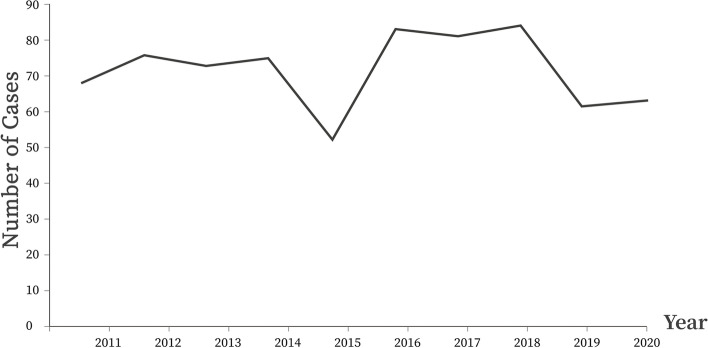
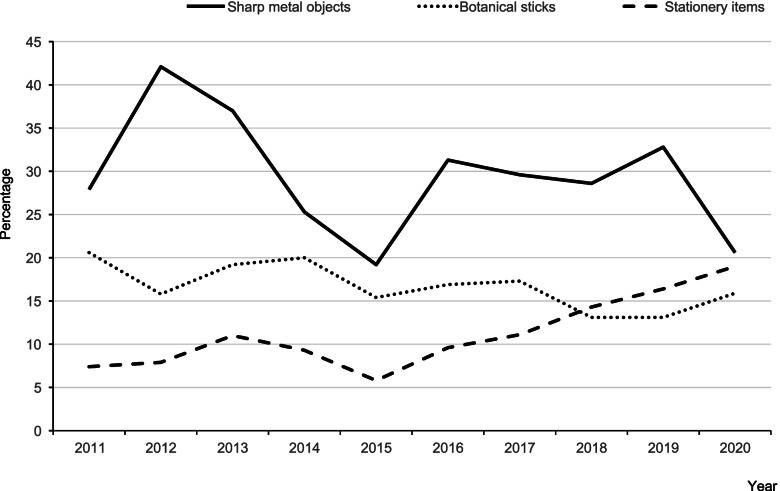
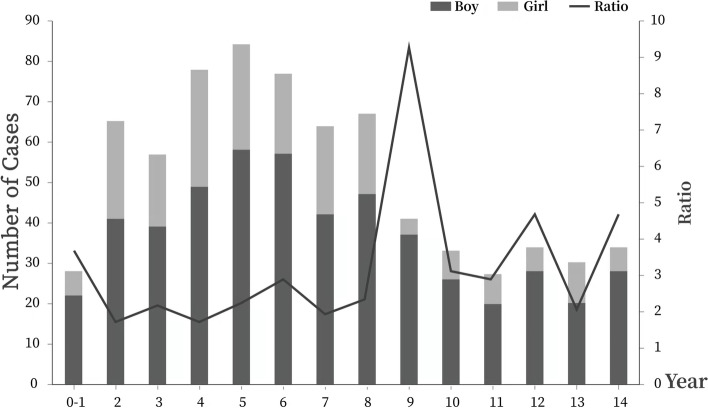
A total of 716 eyes from 716 patients were analysed in this study, including 521 (72.8%) males and 195 females in a gender ratio of 2.67:1; 117 of the patients were of ethnic minorities. Paediatric traumatic cataracts occurred more frequently in winter (32.5%). Sharp metal objects (scissors/knives/needles/sheet metal/nails/darts) - induced ocular injuries accounted for the highest proportion, followed by botanical sticks (wooden sticks /bamboo sticks /bamboo skewers)-induced injuries, and then stationery items (pencils/pens/rulers/paper)-induced injuries. The majority (68.7%) of the patients were aged 2-8 years, and the peak range of age was 4 - 6 years. The injuries were a result of penetrating trauma in 64.9% of patients, and blunt force trauma in the remainder (35.1%). Additionally, 131 (18.3%) cases developed posttraumatic infectious endophthalmitis after injuries. Patients with eye injuries caused by needles (P < 0.001), wooden sticks (P = 0.016), and bamboo skewers (P = 0.002) were at a greater risk of developing infectious endophthalmitis. The most common identified foreign organism was Streptococcus, which accounted for 42% (21/50) of all culture-positive specimens and was sensitive to vancomycin. Among the children who were younger than 5 years, 44.4% (55/124) of those with traumatic cataracts presented a corrected distance visual acuity less than or equal to 0.1 after undergoing cataract surgery, but among the children who were older than 5 years, this proportion was significantly smaller, just 20.4% of children aged 6-10 years (P < 0.001) and 18.4% of children aged 11-14 years (P < 0.001).
The main causative agents of paediatric traumatic cataracts in southwest China were sharp metal objects, botanical sticks, and stationery items. Specific preventive measures are essential to reduce the incidence of paediatric traumatic cataract.
小儿外伤性白内障是导致后天性盲的一个重要但可预防的原因。了解小儿外伤性白内障的流行病学情况是预防的前提。本研究旨在描述中国西南部小儿外伤性白内障的流行病学特征。
回顾性分析 2011 年 1 月至 2020 年 12 月期间在华西医院眼科因开放性眼球损伤住院的年龄在 0-14 岁之间的外伤性白内障患儿的病历。记录并分析了患儿的人口统计学资料、损伤原因、外伤后并发症和视力情况。
本研究共分析了 716 例患者的 716 只眼,其中男性 521 只(72.8%),女性 195 只(27.2%),男女比例为 2.67:1;117 例患者为少数民族。小儿外伤性白内障多发生于冬季(32.5%)。锐器(剪刀/刀/针/金属片/指甲/飞镖)致伤占比最高,其次是植物性棍棒(木棍/竹棍/竹签)致伤,然后是文具(铅笔/钢笔/尺子/纸)致伤。68.7%的患儿年龄在 2-8 岁,峰值年龄为 4-6 岁。64.9%的患儿为穿透性损伤,其余为钝性损伤(35.1%)。此外,131 例(18.3%)患儿受伤后发生外伤性感染性眼内炎。与因针(P<0.001)、木棍(P=0.016)和竹签(P=0.002)所致眼外伤的患儿相比,发生感染性眼内炎的风险更高。最常见的病原体为链球菌,占所有培养阳性标本的 42%(21/50),对万古霉素敏感。在年龄小于 5 岁的患儿中,44.4%(55/124)的外伤性白内障患儿在白内障手术后矫正视力≤0.1,但在年龄大于 5 岁的患儿中,这一比例显著较小,仅 6-10 岁患儿的 20.4%(P<0.001)和 11-14 岁患儿的 18.4%(P<0.001)。
中国西南部小儿外伤性白内障的主要致病原因为锐器、植物性棍棒和文具。需要采取具体的预防措施来降低小儿外伤性白内障的发病率。