Francis-Oliviero Florence, Coste Pierre, Lesaine Emilie, Perez Corinne, Casteigt François, Clerc Jean-Marie, Delarche Nicolas, Hassan Akil, Larnaudie Bernard, Leymarie Jean-Louis, Salmi Louis-Rachid, Saillour-Glenisson Florence
Inserm Bordeaux Population Health, U1219, ISPED, Univ Bordeaux, Bordeaux, France.
Medical Information Department, Bordeaux University Hospital, Bordeaux, France.
Arch Public Health. 2022 May 6;80(1):132. doi: 10.1186/s13690-022-00885-4.
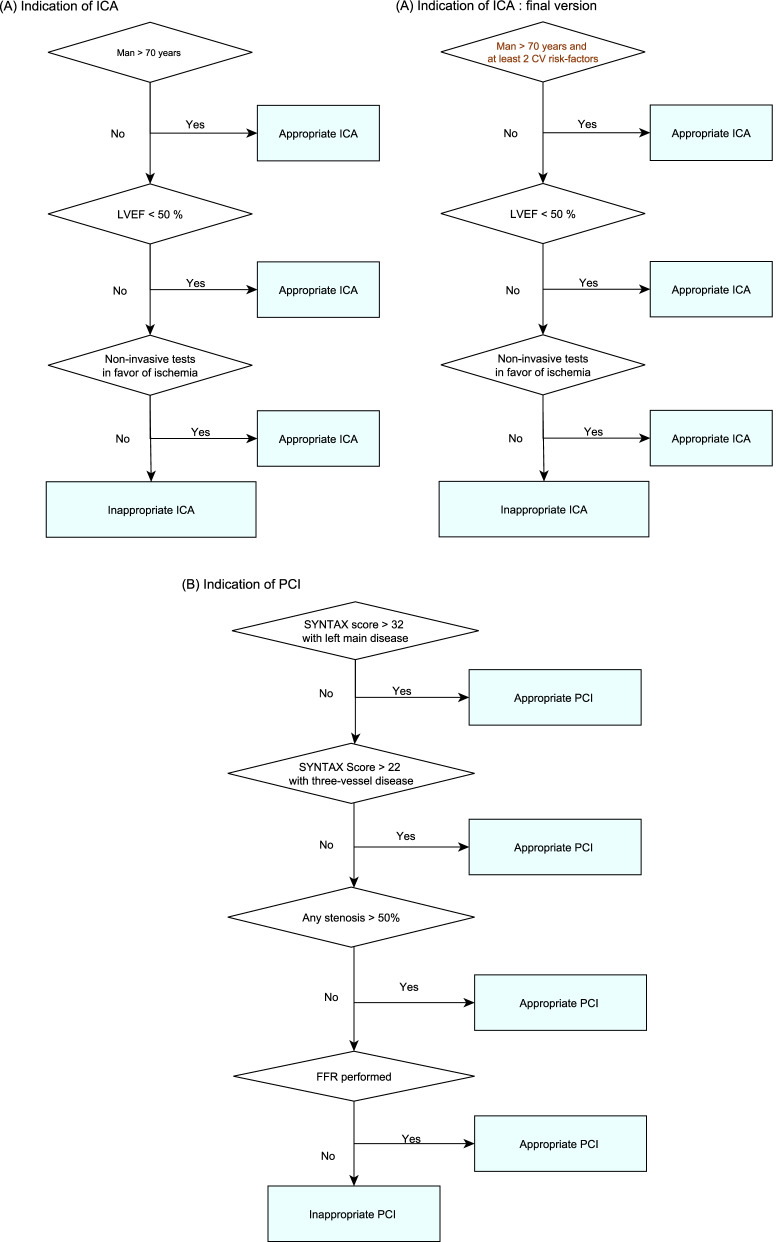
Development of appropriateness indicators of medical interventions has become a major quality-of-care issue, especially in the domain of interventional cardiology (IC). The objective of this study was to develop and evaluate the accuracy of an indicator of the appropriateness of interventional cardiology acts (invasive coronary angiographies (ICA) and percutaneous coronary interventions (PCI)) in patients with coronary stable disease and silent ischemia, automated from a French registry.
All ICA and PCI recorded in a Regional IC Registry (ACIRA) and operated for a stable coronary artery disease or silent ischemia from January 1st to December 31th 2013 in eight IC hospitals of Aquitaine, southwestern France, were included. The indicator was developed to reflect European guidelines. Classification of appropriateness by the indicator, measured on the registry database, was compared to the classification of a reference standard (expert judgment applied through complete record review) on a random sample of 300 interventions. Accuracy parameters were estimated. A second version of the indicator was defined, based on the analysis of false negative and positive results, and its accuracy estimated.
The second indicator accuracy was: sensitivity 63.5% (95% confidence interval CI [51.7-75.3]), specificity 76.0% (95%CI [70.4-81.6]), PPV 43.0% (95% CI [33.0-53.0]) and NPV 88.0% (95% CI [83.4-92.6]). When stratified on the type of act, parameters were better for ICA alone than for PCI.
Accuracy of the indicator should raise with improvement of database quality. Despite its average accuracy, it is already used as a benchmark indicator for cardiologists. It is sent annually to each IC center with value of the indicator at the region level to allow a comparison.
医疗干预适宜性指标的制定已成为医疗质量的一个主要问题,尤其是在介入心脏病学(IC)领域。本研究的目的是开发并评估一项针对冠状动脉稳定疾病和无症状性心肌缺血患者的介入心脏病学操作(有创冠状动脉造影术(ICA)和经皮冠状动脉介入治疗(PCI))适宜性指标的准确性,该指标从法国的一个登记数据库中自动提取。
纳入2013年1月1日至12月31日在法国西南部阿基坦大区的8家IC医院,在区域IC登记处(ACIRA)记录的、因稳定型冠状动脉疾病或无症状性心肌缺血而进行的所有ICA和PCI操作。该指标旨在反映欧洲指南。在登记数据库中通过该指标进行的适宜性分类,与在300例干预措施的随机样本上通过完整记录审查应用的参考标准(专家判断)分类进行比较。估计准确性参数。基于对假阴性和阳性结果的分析,定义了该指标的第二个版本,并估计其准确性。
第二个指标的准确性为:灵敏度63.5%(95%置信区间CI[51.7 - 75.3]),特异度76.0%(95%CI[70.4 - 81.6]),阳性预测值43.0%(95%CI[33.0 - 53.0]),阴性预测值88.0%(95%CI[83.4 - 92.6])。按操作类型分层时,单独ICA的参数优于PCI。
随着数据库质量的提高,该指标的准确性应会提高。尽管其准确性一般,但已被用作心脏病专家的基准指标。每年都会将该指标及其在地区层面的值发送给每个IC中心,以便进行比较。