
二叶式主动脉瓣与三叶式主动脉瓣患者升主动脉壁退行性变。
Ascending aortic wall degeneration in patients with bicuspid versus tricuspid aortic valve.
机构信息
Tampere University Heart Hospital and Tampere University Medical School, SDSKIR, Elämänaukio 1, P.O. Box 2000, 33521, Tampere, Finland.
Department of Pathology, Fimlab Laboratories, Tampere University Hospital and Tampere University Medical School, Tampere, Finland.
出版信息
J Cardiothorac Surg. 2022 May 7;17(1):109. doi: 10.1186/s13019-022-01864-0.
BACKGROUND
The magnitude of ascending aortic degeneration in patients with bicuspid aortic valves (BAV) is controversial.
METHODS
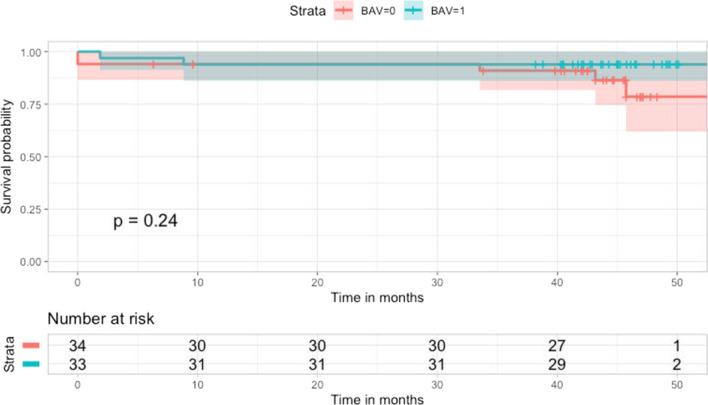
The aim of this study was to investigate ascending aortic wall degeneration in patients with BAV as compared with tricuspid aortic valves (TAV). The ascending aortic wall of 67 consecutive patients was processed for histology and immunohistochemistry. The extent of surgery and wall degeneration were investigated. Unadjusted survival was evaluated by Kaplan-Meier analysis. Median follow-up for patients with BAV and TAV was 3.8 years (interquartile range [IQR] 3.5-4.1) and 3.7 years (IQR 3.4-3.9), respectively.
RESULTS
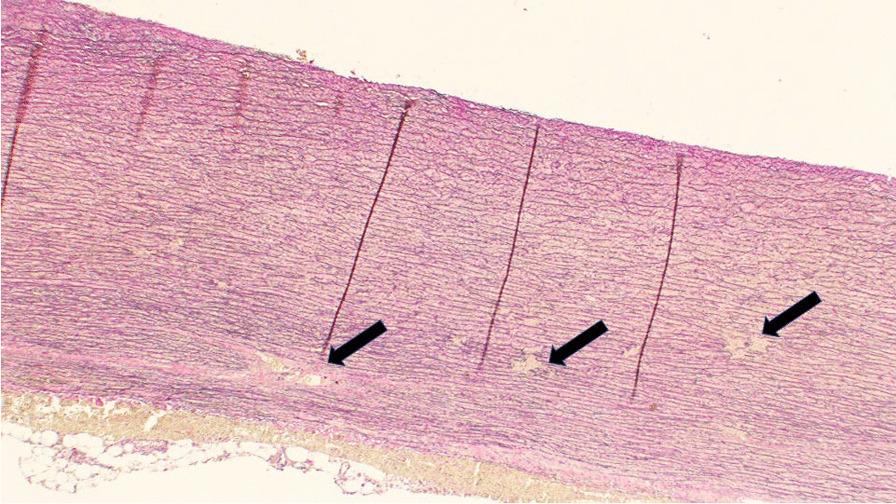
There were 33 patients with BAV and 34 with TAV. Mid-ascending aorta diameter was 54 mm (IQR 50-60). Replacement of the aortic valve, together with an ascending aortic prosthesis, was more frequent in BAV vs TAV patients (24% vs. 3%, P = 0.013). However, medial fibrosis, elastic fiber thinning, incremental medial degeneration and smooth muscle cell nuclei loss were less prominent in BAV vs TAV patients (0.1 ± 0.4 vs. 0.8 ± 1.4, P = 0.016; 0.6 ± 1.4 vs. 1.6 ± 2.0, P = 0.027; 1.7 ± 0.7 vs. 2.2 ± 0.8, P = 0.045 and 2.3 ± 1.5 vs. 3.2 ± 1.3, P = 0.026, respectively).
CONCLUSIONS
Since degeneration of the ascending aortic wall was seldom prominent, histopathology alone may not support the need for surgery of the dilated ascending aorta in BAV patients as compared with TAV patients.
背景
二叶式主动脉瓣(BAV)患者升主动脉退行性变的程度存在争议。
方法
本研究旨在比较二叶式主动脉瓣和三叶式主动脉瓣患者升主动脉壁的退行性变。对 67 例连续患者的升主动脉壁进行组织学和免疫组织化学处理。研究了手术范围和壁退行性变。Kaplan-Meier 分析评估未经调整的生存率。BAV 和 TAV 患者的中位随访时间分别为 3.8 年(IQR 3.5-4.1)和 3.7 年(IQR 3.4-3.9)。
结果
33 例患者为 BAV,34 例为 TAV。升主动脉中段直径为 54mm(IQR 50-60)。BAV 患者主动脉瓣置换联合升主动脉假体置换更为常见(24% vs. 3%,P=0.013)。然而,BAV 患者的中膜纤维化、弹性纤维变薄、中膜进行性退变和平滑肌细胞核丢失较 TAV 患者程度较轻(0.1±0.4 vs. 0.8±1.4,P=0.016;0.6±1.4 vs. 1.6±2.0,P=0.027;1.7±0.7 vs. 2.2±0.8,P=0.045 和 2.3±1.5 vs. 3.2±1.3,P=0.026)。
结论
由于升主动脉壁的退行性变很少明显,单独的组织病理学可能不支持与 TAV 患者相比,对 BAV 患者扩张的升主动脉进行手术。
 Zotero 插件