Abrahams Zulfa, Schneider Marguerite, Honikman Simone, Olckers Patti, Boisits Sonet, Seward Nadine, Lund Crick
Alan J Flisher Centre for Public Mental Health, Department of Psychiatry and Mental Health, University of Cape Town, Building B, 46 Sawkins Road, Rondebosch, Cape Town, 7700, South Africa.
Perinatal Mental Health Project, Alan J Flisher Centre for Public Mental Health, Department of Psychiatry and Mental Health, University of Cape Town, Cape Town, South Africa.
Pilot Feasibility Stud. 2022 May 7;8(1):100. doi: 10.1186/s40814-022-01053-9.
During the perinatal period, common mental disorders (CMDs) such as depression and anxiety are highly prevalent, especially in low-resource settings, and are associated with domestic violence, poverty, and food insecurity. Perinatal CMDs have been associated with several adverse maternal and child outcomes. While the Department of Health in South Africa provides healthcare workers with the tools to detect psychological distress and experiences of domestic violence, few healthcare workers routinely screen pregnant women at clinic visits, citing discomfort with mental health issues and the lack of standardised referral pathways as the key barriers. The aim of this study is to select and evaluate a set of health systems strengthening (HSS) interventions aimed at improving the care and outcomes for perinatal women with CMDs and experiences of domestic violence, attending public healthcare facilities in Cape Town.
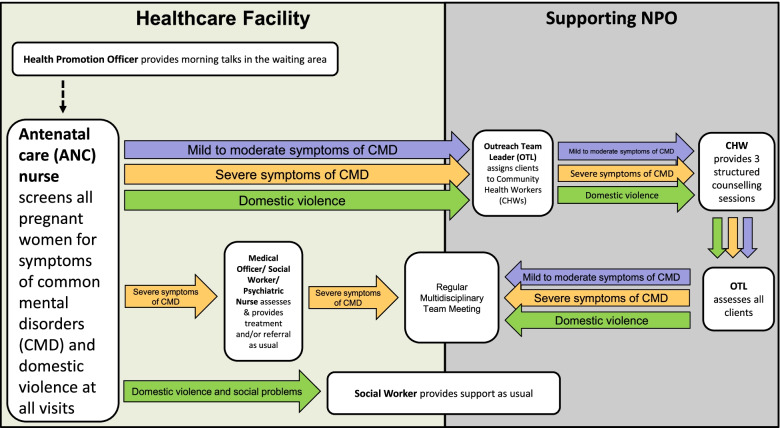
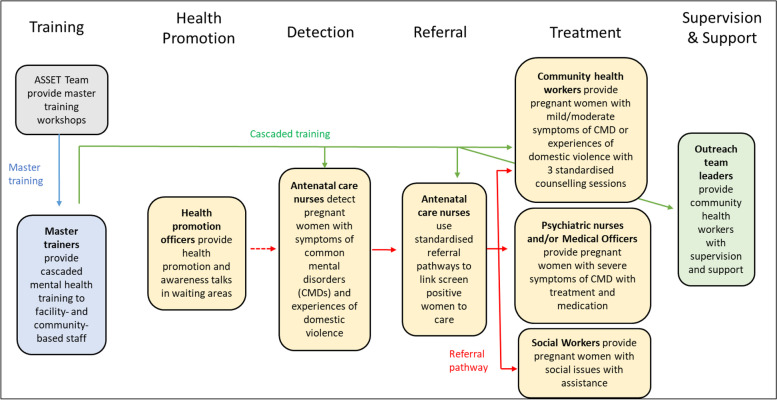
This study consists of a pre-implementation, development, and implementation phase. Contextual barriers identified during the pre-implementation phase included poor patient knowledge and health-seeking behaviour, high levels of stigma, and poor detection, referral, and treatment rates. Implementation science determinant frameworks were applied to findings from the pre-implementation phase to identify determinants and gaps in delivering high-quality evidence-informed care. A participatory Theory of Change workshop was used to design a HSS programme, consisting of awareness raising, detection, referral, and treatment. HSS interventions selected to support the delivery of the HSS programme includes training, health promotion, change to the healthcare environment, task-sharing, audit and feedback, and performance monitoring. The implementation phase will be used to assess several implementation and clinical outcomes associated with the delivery of the HSS programme, which will be piloted at three healthcare facilities. Qualitative and quantitative methods will be used to evaluate the implementation and clinical outcomes.
This pilot implementation study will inform us about a range of implementation and clinical outcome measures that are relevant for assessing HSS interventions for perinatal women with depression, anxiety, or experiences of domestic violence in low-resource settings. Lessons learnt from the pilot study will be incorporated into the design of a cluster randomised control trial for which further funding will be sought.
在围产期,抑郁症和焦虑症等常见精神障碍极为普遍,尤其是在资源匮乏地区,且与家庭暴力、贫困和粮食不安全相关。围产期常见精神障碍与若干不良母婴结局有关。虽然南非卫生部为医护人员提供了检测心理困扰和家庭暴力经历的工具,但很少有医护人员在诊所就诊时对孕妇进行常规筛查,称对心理健康问题感到不适以及缺乏标准化转诊途径是主要障碍。本研究的目的是选择并评估一套卫生系统强化(HSS)干预措施,旨在改善开普敦公共医疗机构中患有常见精神障碍和遭受家庭暴力的围产期妇女的护理及结局。
本研究包括实施前、开发和实施阶段。在实施前阶段确定的背景障碍包括患者知识和就医行为不佳、耻辱感严重以及检测、转诊和治疗率低。将实施科学决定因素框架应用于实施前阶段的研究结果,以确定提供高质量循证护理中的决定因素和差距。举办了一次参与式变革理论研讨会,以设计一个卫生系统强化方案,包括提高认识、检测、转诊和治疗。为支持卫生系统强化方案的实施而选择的卫生系统强化干预措施包括培训、健康促进、医疗环境改变、任务分担、审核与反馈以及绩效监测。实施阶段将用于评估与卫生系统强化方案实施相关的若干实施和临床结局,该方案将在三个医疗机构进行试点。将使用定性和定量方法评估实施和临床结局。
这项试点实施研究将让我们了解一系列与评估资源匮乏地区患有抑郁症、焦虑症或遭受家庭暴力的围产期妇女的卫生系统强化干预措施相关的实施和临床结局指标。从试点研究中吸取的经验教训将纳入整群随机对照试验的设计中,为此将寻求进一步的资金。