Postgraduate Program in Public Health, University of Southern Santa Catarina, Criciúma, Santa Catarina, Brazil.
Postgraduate Program in Health Sciences, Federal University of Rio Grande, Rio Grande, Rio Grande do Sul, Brazil.
Psychiatry Res. 2022 Jul;313:114596. doi: 10.1016/j.psychres.2022.114596. Epub 2022 May 4.
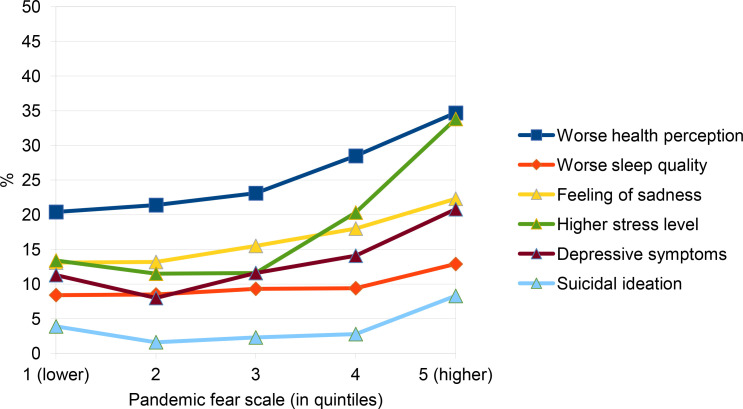
Fear is a reaction that can influence multiple aspects of health and life. During the Covid-19 pandemic, there have been serious pathophysiological, social, behavioral and mental consequences that can be related to fear. This study aimed to assess the fear of Covid-19 and its association with sociodemographic, behavioral and health variables. Data were gathered from two cross-sectional population-based studies conducted in 2020 with adults from two cities from Southern Brazil. The Fear of Covid-19 scale was used to evaluate fear of Covid. Exposure variables were socioeconomic, demographic, health and pandemic-related factors. Adjusted Poisson regression was performed to assess the association between fear of Covid-19 and the exposure variables. A total of 2,152 subjects were assessed. Higher fear of Covid-19 was found among women and in individuals with symptoms of Covid-19. Living alone, being richer, and testing positive for Covid-19 were associated with lower prevalence of fear. Higher prevalence of fear of Covid-19 was related to worse sleep quality, worse health perception, sadness, higher stress, depressive symptoms, and suicidal ideation. There was a linear association between fear of Covid-19 and health outcomes. The results provide evidence that fear of Covid-19 seems to be associated with socioeconomic, demographic, health and pandemic-related factors.
恐惧是一种会影响健康和生活多个方面的反应。在新冠疫情期间,出现了严重的病理生理、社会、行为和心理后果,这些都可能与恐惧有关。本研究旨在评估对新冠的恐惧及其与社会人口学、行为和健康变量的关联。数据来自于 2020 年在巴西南部两个城市进行的两项横断面基于人群的研究,调查了成年人。使用新冠恐惧量表评估对新冠的恐惧。暴露变量包括社会经济、人口统计学、健康和大流行相关因素。采用调整后的泊松回归来评估新冠恐惧与暴露变量之间的关联。共评估了 2152 名受试者。女性和有新冠症状的个体中,新冠恐惧程度更高。独居、更富有以及新冠检测呈阳性与新冠恐惧的低患病率有关。更高的新冠恐惧患病率与睡眠质量差、健康感知差、悲伤、压力大、抑郁症状和自杀意念有关。新冠恐惧与健康结果之间存在线性关联。研究结果表明,对新冠的恐惧似乎与社会经济、人口统计学、健康和大流行相关因素有关。