Rout Madhusmita, Lerner Megan, Blackett Piers R, Peyton Marvin D, Stavrakis Stavros, Sidorov Evgeny, Sanghera Dharambir K
Department of Pediatrics, College of Medicine, University of Oklahoma Health Sciences Center, Oklahoma City, OK 73104, USA.
Department of Surgery, Oklahoma University of Health Sciences Center, Oklahoma City, OK, USA.
Am Heart J Plus. 2022 Jan;13. doi: 10.1016/j.ahjo.2022.100128. Epub 2022 Mar 31.
Hypertriglyceridemia is as an independent risk factor for cardiovascular disease (CVD). Apolipoprotein C-III (ApoC-III) is known to regulate triglyceride (TG) metabolism. However, the causal association between ApoC-III and CVD development is unclear. The objectives were to examine the impact of ApoC-III concentration on TG and lipoproteins and investigate the role of known rare loss-of-function variants for modulating ApoC-III, TG concentrations and CVD risk in different ethnic groups.
Plasma ApoC-III levels were measured in a multiethnic sample of 518 individuals comprising 271 Asian Indians (Sikhs), 87 Caucasians, 80 African Americans, and 80 Hispanics.
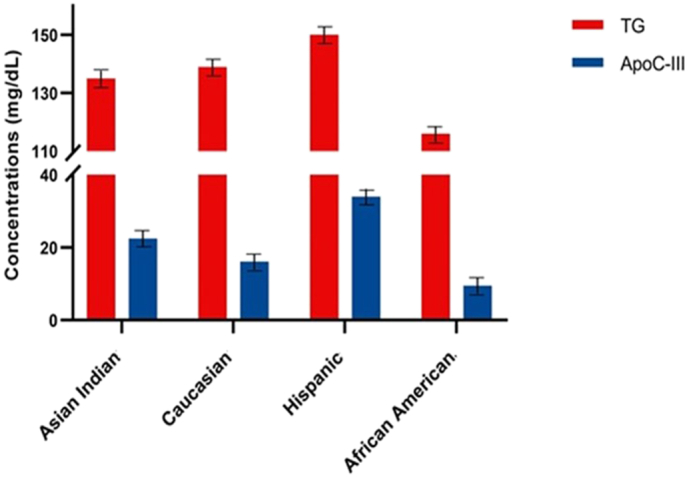
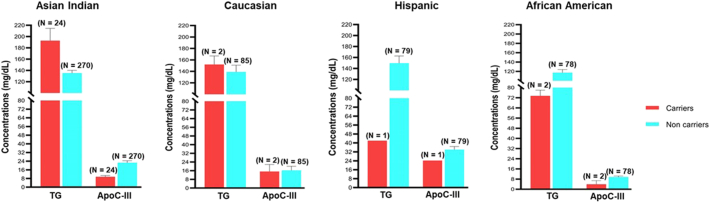
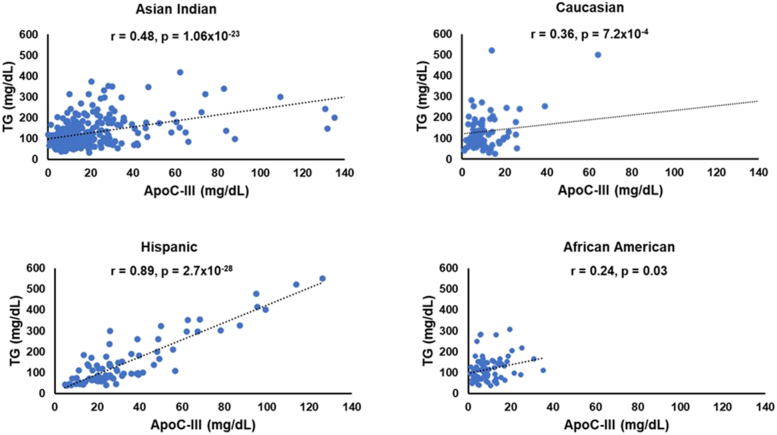
ApoC-III levels showed a robust association with TG in Asian Indians (r = 0.5, p = 1.1 × 10), Caucasians (r = 0.4, p = 7.2 × 10), and Hispanics (r = 0.9, p = 2.7x × 10). African Americans had lowest ApoC-III and TG concentrations and highest (44%) prevalence of coronary artery disease (CAD). ApoC-III levels correlated with fasting blood glucose (r = 0.25, p = 6.1 × 10) in Asian Indians and central adiposity in Hispanics (waist: r = 0.22, p = 0.05; waist-hip ratio: r = 0.24, p = 0.04). The carriers of rare variants IVS1-2G-A (rs373975305); A43T (rs147210663) and IVS3 + 1G-T (rs140621530) showed high TG but not low ApoC-III levels in Asian Indians and Caucasians.
These results highlight the challenges of generalizing antisense ApoC-III inhibition for treating atherosclerotic disease in dyslipidemia that may benefit only specific sub-populations. The observed ethnic differences in ApoC-III concentrations and CAD risk factors, emphasize in-depth genetic and metabolomics evaluations on diverse ancestries.
高甘油三酯血症是心血管疾病(CVD)的独立危险因素。载脂蛋白C-III(ApoC-III)已知可调节甘油三酯(TG)代谢。然而,ApoC-III与CVD发生之间的因果关系尚不清楚。目的是研究ApoC-III浓度对TG和脂蛋白的影响,并探讨已知罕见功能丧失变异在不同种族中调节ApoC-III、TG浓度和CVD风险的作用。
在一个多民族样本中测量了518名个体的血浆ApoC-III水平,该样本包括271名亚洲印度人(锡克教徒)、87名高加索人、80名非裔美国人和80名西班牙裔。
在亚洲印度人(r = 0.5,p = 1.1 × 10)、高加索人(r = 0.4,p = 7.2 × 10)和西班牙裔(r = 0.9,p = 2.7x × 10)中,ApoC-III水平与TG呈强相关。非裔美国人的ApoC-III和TG浓度最低,冠状动脉疾病(CAD)患病率最高(44%)。在亚洲印度人中,ApoC-III水平与空腹血糖相关(r = 0.25,p = 6.1 × 10),在西班牙裔中与中心性肥胖相关(腰围:r = 0.22,p = 0.05;腰臀比:r = 0.24,p = 0.04)。罕见变异IVS1-2G-A(rs373975305)、A43T(rs147210663)和IVS-3 + 1G-T(rs140621530)的携带者在亚洲印度人和高加索人中表现出高TG水平,但ApoC-III水平不低。
这些结果凸显了将反义ApoC-III抑制用于治疗血脂异常中的动脉粥样硬化疾病进行推广的挑战,因为这可能仅使特定亚人群受益。观察到的ApoC-III浓度和CAD危险因素的种族差异,强调了对不同血统进行深入的基因和代谢组学评估的重要性。