Charalambous Christos, Moon James C, Holly Jeff M P, Chaturvedi Nishi, Hughes Alun D, Captur Gabriella
UCL MRC Unit for Lifelong Health and Ageing, University College London, London, United Kingdom.
UCL Institute of Cardiovascular Science, University College London, London, United Kingdom.
Front Cardiovasc Med. 2022 Apr 22;9:863988. doi: 10.3389/fcvm.2022.863988. eCollection 2022.
As people age, circulating levels of insulin-like growth factors (IGFs) and IGF binding protein 3 (IGFBP-3) decline. In rat cardiomyocytes, IGF-I has been shown to regulate sarcolemmal potassium channel activity and late sodium current thus impacting cardiac repolarization and the heart rate-corrected QT (QTc). However, the relationship between IGFs and IGFBP-3 with the QTc interval in humans, is unknown.
To examine the association of IGFs and IGFBP-3 with QTc interval in an older age population-based cohort.
Participants were from the 1946 Medical Research Council (MRC) National Survey of Health and Development (NSHD) British birth cohort. Biomarkers from blood samples at age 53 and 60-64 years (y, exposures) included IGF-I/II, IGFBP-3, IGF-I/IGFBP-3 ratio and the change (Δ) in marker levels between the 60-64 and 53y sampled timepoints. QTc (outcome) was recorded from electrocardiograms at the 60-64y timepoint. Generalized linear multivariable models with adjustments for relevant demographic and clinical factors, were used for complete-cases and repeated after multiple imputation.
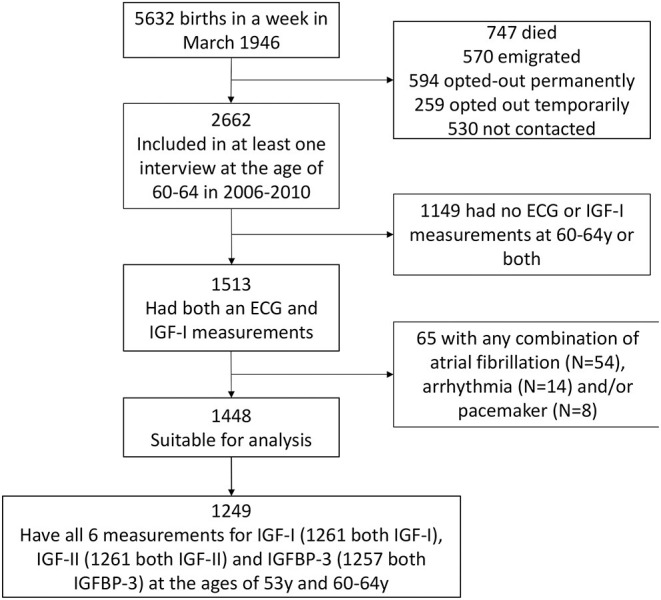
One thousand four hundred forty-eight participants were included (48.3% men; QTc mean 414 ms interquartile range 26 ms). Univariate analysis revealed an association between low IGF-I and IGF-I/IGFBP-3 ratio at 60-64y with QTc prolongation [respectively: β -0.30 ms/nmol/L, (95% confidence intervals -0.44, -0.17), < 0.001; β-28.9 ms/unit (-41.93, -15.50), < 0.001], but not with IGF-II or IGFBP-3. No association with QTc was found for IGF biomarkers sampled at 53y, however both ΔIGF-I and ΔIGF-I/IGFBP-3 ratio were negatively associated with QTc [β -0.04 ms/nmol/L (-0.08, -0.008), = 0.019; β -2.44 ms/unit (-4.17, -0.67), = 0.007] while ΔIGF-II and ΔIGFBP-3 showed no association. In fully adjusted complete case and imputed models (reporting latter) low IGF-I and IGF-I/IGFBP-3 ratio at 60-64y [β -0.21 ms/nmol/L (-0.39, -0.04), = 0.017; β -20.14 ms/unit (-36.28, -3.99), = 0.015], steeper decline in ΔIGF-I [β -0.05 ms/nmol/L/10 years (-0.10, -0.002), = 0.042] and shallower rise in ΔIGF-I/IGFBP-3 ratio over a decade [β -2.16 ms/unit/10 years (-4.23, -0.09), = 0.041], were all independently associated with QTc prolongation. Independent associations with QTc were also confirmed for other previously known covariates: female sex [β 9.65 ms (6.65, 12.65), < 0.001], increased left ventricular mass [β 0.04 ms/g (0.02, 0.06), < 0.001] and blood potassium levels [β -5.70 ms/mmol/L (-10.23, -1.18) = 0.014].
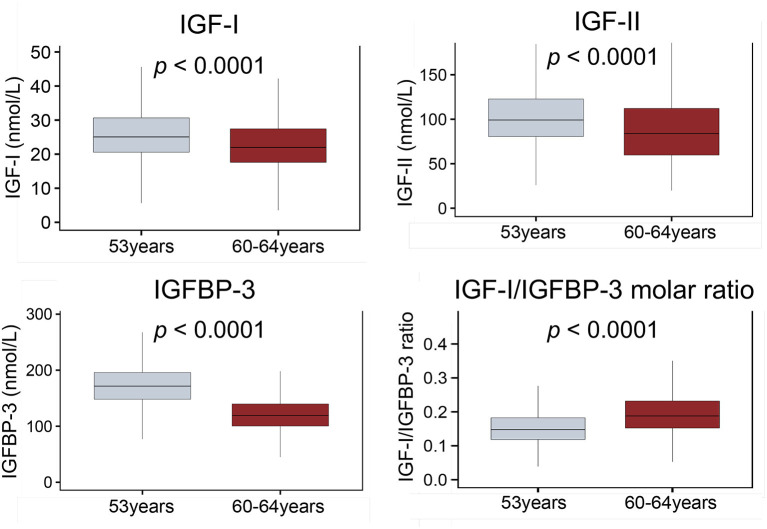
Over a decade, in an older age population-based cohort, declining levels and bioavailability of IGF-I associate with prolongation of the QTc interval. As QTc prolongation associates with increased risk for sudden death even in apparently healthy people, further research into the antiarrhythmic effects of IGF-I on cardiomyocytes is warranted.
随着人们年龄的增长,胰岛素样生长因子(IGFs)和胰岛素样生长因子结合蛋白3(IGFBP - 3)的循环水平会下降。在大鼠心肌细胞中,IGF - I已被证明可调节肌膜钾通道活性和晚期钠电流,从而影响心脏复极化和心率校正QT(QTc)。然而,IGFs和IGFBP - 3与人类QTc间期之间的关系尚不清楚。
在一个以老年人群为基础的队列中,研究IGFs和IGFBP - 3与QTc间期的关联。
参与者来自1946年医学研究理事会(MRC)全国健康与发展调查(NSHD)英国出生队列。53岁以及60 - 64岁(y,暴露因素)时血液样本中的生物标志物包括IGF - I/II、IGFBP - 3、IGF - I/IGFBP - 3比值以及60 - 64岁和53岁采样时间点之间标志物水平的变化(Δ)。QTc(结局指标)在60 - 64岁时间点通过心电图记录。采用广义线性多变量模型,并对相关人口统计学和临床因素进行调整,用于完整病例分析,并在多次插补后重复分析。
纳入了1448名参与者(48.3%为男性;QTc均值414 ms,四分位间距26 ms)。单因素分析显示,60 - 64岁时低IGF - I和低IGF - I/IGFBP - 3比值与QTc延长相关[分别为:β - 0.30 ms/nmol/L,(95%置信区间 - 0.44, - 0.17),P < 0.001;β - 28.9 ms/单位( - 41.93, - 15.50),P < 0.001],但与IGF - II或IGFBP - 3无关。53岁时采集的IGF生物标志物与QTc无关联,然而,ΔIGF - I和ΔIGF - I/IGFBP - 3比值均与QTc呈负相关[β - 0.04 ms/nmol/L( - 0.08, - 0.008),P = 0.019;β - 2.44 ms/单位( - 4.17, - 0.67),P = 0.007],而ΔIGF - II和ΔIGFBP - 3无关联。在完全调整的完整病例模型和插补模型(报告后者)中,60 - 64岁时低IGF - I和低IGF - I/IGFBP - 3比值[β - 0.21 ms/nmol/L( - 0.39, - 0.04),P = 0.017;β - 20.14 ms/单位( - 36.28, - 3.99),P = 0.015]、ΔIGF - I更陡峭的下降[β - 0.05 ms/nmol/L/10年( - 0.10, - 0.002),P = 0.042]以及十年间ΔIGF - I/IGFBP - 3比值更平缓的上升[β - 2.16 ms/单位/10年( - 4.23, - 0.09),P = 0.041],均与QTc延长独立相关。其他先前已知的协变量与QTc的独立关联也得到证实:女性[β 9.65 ms(6.65,12.65),P < 0.001]、左心室质量增加[β 0.04 ms/g(0.02,0.06),P < 0.001]和血钾水平[β - 5.70 ms/mmol/L( - 10.23, - 1.18),P = 0.014]。
在一个以老年人群为基础的队列中,十年间IGF - I水平和生物利用度的下降与QTc间期延长相关。由于即使在看似健康的人群中QTc延长也与猝死风险增加相关,因此有必要进一步研究IGF - I对心肌细胞的抗心律失常作用。