Nassif Ali Bou, Elnagar Ashraf, Elgendy Omar, Afadar Yaman
Department of Computer Engineering, University of Sharjah, P.O. Box: 27272, Sharjah, UAE.
Western University, London, ON N6A 3K7 Canada.
Neural Comput Appl. 2022;34(18):16019-16032. doi: 10.1007/s00521-022-07206-4. Epub 2022 May 3.
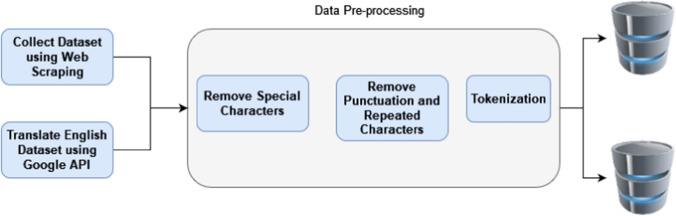
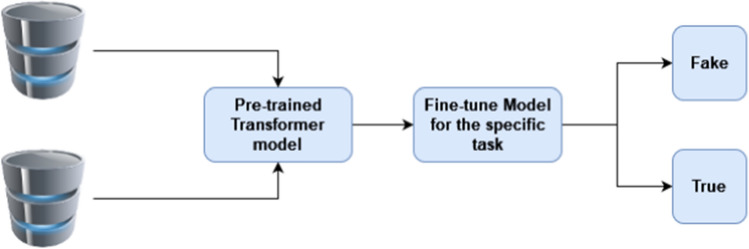
Social media is becoming a source of news for many people due to its ease and freedom of use. As a result, fake news has been spreading quickly and easily regardless of its credibility, especially in the last decade. Fake news publishers take advantage of critical situations such as the Covid-19 pandemic and the American presidential elections to affect societies negatively. Fake news can seriously impact society in many fields including politics, finance, sports, etc. Many studies have been conducted to help detect fake news in English, but research conducted on fake news detection in the Arabic language is scarce. Our contribution is twofold: first, we have constructed a large and diverse Arabic fake news dataset. Second, we have developed and evaluated transformer-based classifiers to identify fake news while utilizing eight state-of-the-art Arabic contextualized embedding models. The majority of these models had not been previously used for Arabic fake news detection. We conduct a thorough analysis of the state-of-the-art Arabic contextualized embedding models as well as comparison with similar fake news detection systems. Experimental results confirm that these state-of-the-art models are robust, with accuracy exceeding 98%.
社交媒体因其使用的便捷性和自由性,正成为许多人获取新闻的来源。因此,假新闻得以迅速且轻易地传播,而不论其可信度如何,尤其是在过去十年间。假新闻发布者利用诸如新冠疫情和美国总统大选等关键事件对社会产生负面影响。假新闻会在包括政治、金融、体育等诸多领域严重影响社会。许多研究致力于帮助检测英文假新闻,但针对阿拉伯语假新闻检测的研究却很少。我们的贡献有两方面:其一,我们构建了一个庞大且多样的阿拉伯语假新闻数据集。其二,我们开发并评估了基于Transformer的分类器,在利用八个最先进的阿拉伯语上下文嵌入模型的同时识别假新闻。这些模型中的大多数此前并未用于阿拉伯语假新闻检测。我们对最先进的阿拉伯语上下文嵌入模型进行了全面分析,并与类似的假新闻检测系统进行了比较。实验结果证实,这些最先进的模型很强大,准确率超过98%。