Scholz David, Xie Jingwei, Kröcher Oliver, Vogel Frédéric
Paul Scherrer Institute 5232 Villigen PSI Switzerland
École Polytechnique Fédérale de Lausanne 1015 Lausanne Switzerland.
RSC Adv. 2019 Oct 18;9(57):33525-33538. doi: 10.1039/c9ra07668a. eCollection 2019 Oct 15.
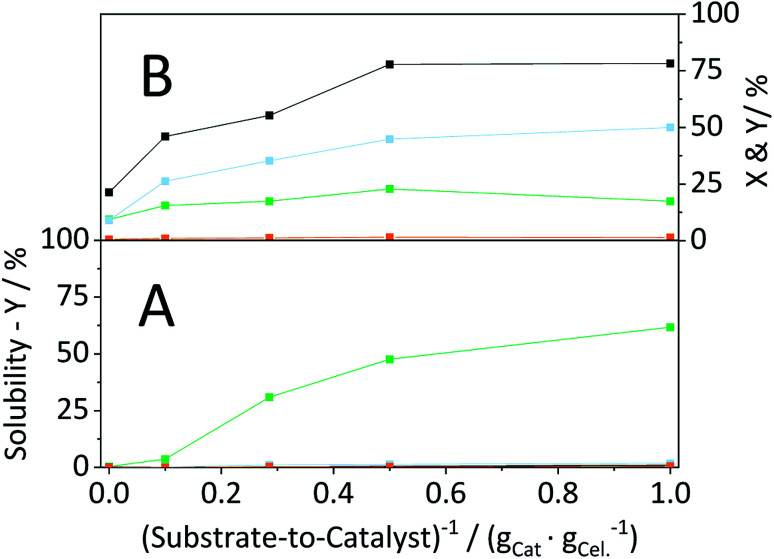
The hydrolysis of lignocellulose is the first step in saccharide based bio-refining. The recovery of homogeneous acid catalysts imposes great challenges to the feasibility of conventional hydrolysis processes. Herein, we report a strategy to overcome these limitations by using stable sulfonated carbons as solid acid catalysts in a two-step process, composed of mechanocatalytic pretreatment and secondary hydrolysis in a semi-batch reactor. Without mechanocatalytic pre-treatment the hydrolysis of the insoluble substrate largely occurs through homogeneously catalyzed reactions. Ball-milling induced amorphization promotes a substantially higher substrate reactivity, because homogeneous hydrolysis occurs preferentially from less ordered structural domains in cellulose. In contrast, concerted ball-milling (CBM) of cellulose with the sulfonated carbon promotes a heterogeneously catalyzed hydrolysis to soluble oligosaccharides. By performing an in-depth physicochemical characterization of cellulose subjected to CBM treatment with different carbons, we reveal the crucial role of strong Brønsted acid sites in facilitating mechanocatalytic depolymerization. Recyclability experiments confirmed that despite being subject to profound structural changes during repeated pre-treatment/semi-batch hydrolysis cycles, the sulfonated carbon retained its catalytic activity. The combination of mechanocatalytic pretreatment with strong solid acids and hydrolysis in the semi-batch reactor was successfully extrapolated for the first time to the hydrolysis of real lignocellulose to achieve quantitative yields in C and high yields in C derived products.
木质纤维素的水解是基于糖类的生物精炼的第一步。回收均相酸催化剂给传统水解工艺的可行性带来了巨大挑战。在此,我们报告了一种策略,通过在两步法中使用稳定的磺化碳作为固体酸催化剂来克服这些限制,该两步法包括机械催化预处理和在半间歇反应器中的二次水解。没有机械催化预处理时,不溶性底物的水解主要通过均相催化反应发生。球磨诱导的非晶化促进了更高的底物反应性,因为均相水解优先发生在纤维素中结构较无序的区域。相比之下,纤维素与磺化碳的协同球磨(CBM)促进了向可溶性低聚糖的非均相催化水解。通过对用不同碳进行CBM处理的纤维素进行深入的物理化学表征,我们揭示了强布朗斯特酸位点在促进机械催化解聚中的关键作用。可回收性实验证实,尽管在重复的预处理/半间歇水解循环中磺化碳经历了深刻的结构变化,但其仍保留催化活性。机械催化预处理与强固体酸以及在半间歇反应器中的水解相结合,首次成功地外推至实际木质纤维素的水解,以实现碳的定量产率和碳衍生产品的高产率。