Department of Neurology, Seoul Hospital Ewha Womans University College of Medicine, Seoul, Republic of Korea.
Department of Molecular Medicine, College of Medicine, Graduate Program in System Health Science and Engineering, Ewha Womans University, Seoul, Republic of Korea.
PeerJ. 2022 May 3;10:e13327. doi: 10.7717/peerj.13327. eCollection 2022.
Osteoprotegerin (OPG), also known as osteoclastogenesis inhibitory factor, is a tumor necrosis factor receptor superfamily component. There is an established relationship between OPG and cardiovascular disease. We hypothesized that plasma OPG levels are associated with functional outcomes in acute ischemic stroke patients who have undergone endovascular thrombectomy (EVT).
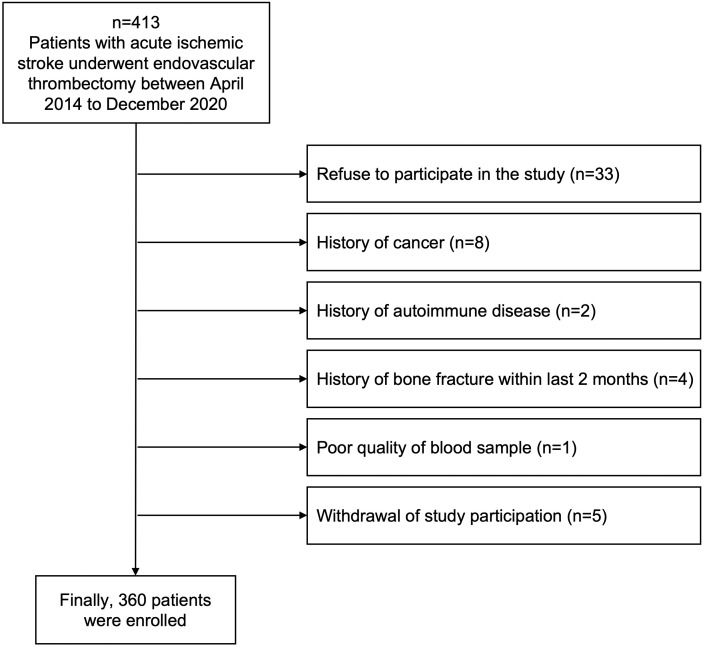
From April 2014 through December 2020, a total of 360 acute ischemic stroke patients who underwent EVT were prospectively included in this retrospective observational study. Plasma OPG was measured after fasting for 12 postoperative hours after EVT. A modified Rankin Scale (mRS) was used to assess functional outcomes 3 months after index stroke occurrence. Univariate and multivariate binary logistic regression and ordinal logistic regression analyses were performed to investigate the association of plasma OPG levels with poor functional outcomes.
Overall, 145 (40.2%) patients had poor (mRS > 2) outcomes. The mean ± standard deviation plasma OPG level was 200.2 ± 74.4 pg/mL. Multivariate analysis after adjusting for sex, body mass index, and variables with < 0.1 in the preceding univariate analysis revealed high plasma OPG levels were independently associated with poor functional outcomes (highest tertile vs. lowest tertile of OPG; odds ratios (OR) 2.121, 95% confidence interval (CI) [1.089-4.191], = 0.037 in binary logistic regression, OR 2.102, 95% CI [1.301-3.412], = 0.002 in ordinal logistic regression analysis).
This study demonstrated that higher plasma OPG levels were associated with poor functional outcomes in acute ischemic stroke patients who underwent EVT.
骨保护素(OPG),也称为破骨细胞生成抑制因子,是肿瘤坏死因子受体超家族的一个组成部分。OPG 与心血管疾病之间存在明确的关系。我们假设,接受血管内血栓切除术(EVT)的急性缺血性脑卒中患者的血浆 OPG 水平与功能结局相关。
从 2014 年 4 月到 2020 年 12 月,共有 360 名接受 EVT 的急性缺血性脑卒中患者前瞻性纳入本回顾性观察研究。在 EVT 后 12 小时空腹后测量血浆 OPG。采用改良 Rankin 量表(mRS)评估指数性脑卒中发生后 3 个月的功能结局。采用单因素和多因素二项逻辑回归及有序逻辑回归分析,探讨血浆 OPG 水平与不良功能结局的相关性。
总体而言,145 名(40.2%)患者存在不良(mRS>2)结局。平均(±标准偏差)血浆 OPG 水平为 200.2±74.4 pg/mL。在调整性别、体重指数和单因素分析中 <0.1 的变量后进行多因素分析,结果显示高血浆 OPG 水平与不良功能结局独立相关(最高三分位组与最低三分位组 OPG;比值比(OR)2.121,95%置信区间(CI)[1.089-4.191],=0.037 在二项逻辑回归中,OR 2.102,95%CI[1.301-3.412],=0.002 在有序逻辑回归分析中)。
本研究表明,接受 EVT 的急性缺血性脑卒中患者的血浆 OPG 水平较高与功能结局不良相关。