Department of Nursing, The First Affiliated Hospital of Nanchang University, Nanchang 330006, China.
Nursing School, Nanchang University, Nanchang 330006, China.
Dis Markers. 2022 Apr 28;2022:7056517. doi: 10.1155/2022/7056517. eCollection 2022.
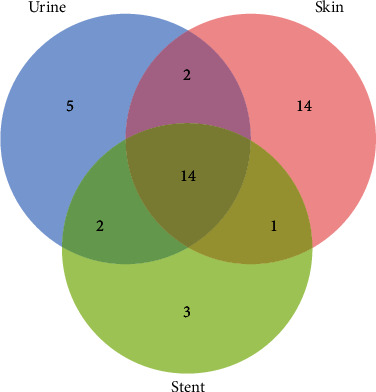
To investigate the clinical diagnostic value of differential flora as biomarkers in patients with symptomatic urinary tract infection (UTI) and asymptomatic bacteriuria (ASB) undergoing cutaneous ureterostomy based on metagenomic next-generation sequencing and construct predictive models to provide a scientific reference for clinical diagnosis and treatment. . According to standard procedures, samples were taken from each patient for routine tests (urine, ureteral stent, and skin swab around the stoma). Cytokine levels in the blood were also detected. Urinary microflora were measured by mNGS, and potential biomarkers for distinguishing UTI and ASB were identified by differential flora. Finally, we generated the predictive models for ASB and UTI using the Lasso method and cytokine levels.
Urine culture was performed for 50 patients with cutaneous ureterostomy; 44 of these patients developed bacteriuria. The incidence of symptomatic bacteriuria was 54.55%. Biomarker analysis showed that , , , , and all had good predictive performance and were combined in a single model. The predictive model exhibited good prediction performance (area under the curve (AUC) = 0.8729, sensitivity = 80%, specificity = 83.3%, and cutoff = 1.855). We also identified a significant negative correlation between the weight sum of the abundance for these five characteristic pathogens (Sum_weighted_Reads) and levels of the cytokine IL-6 and IL-1 ( < 0.05).
mNGS had a higher positive detection rate for pathogens in urine samples. The selected differential bacteria can be used as biomarkers of ASB and UTI, and the prediction model has good predictive performance. Analysis also showed that the occurrence of symptoms was related to individual immunity. Combined with the Sum_weighted_Reads cutoff and cytokine levels (IL-6 and IL-1) of differential flora, it was possible to judge the severity of symptoms in cutaneous ureterostomy patients with bacteriuria and provide new insights for the treatment and intervention of ASB and UTI.
基于宏基因组下一代测序技术,探讨基于宏基因组下一代测序技术的差异菌群作为生物标志物在接受皮输尿管造口术的有症状尿路感染(UTI)和无症状菌尿(ASB)患者中的临床诊断价值,并构建预测模型,为临床诊治提供科学参考。按照标准程序,从每位患者身上采集样本进行常规检查(尿液、输尿管支架和造口周围皮肤拭子),并检测血液中的细胞因子水平。通过 mNGS 测量尿液微生物群,通过差异菌群鉴定区分 UTI 和 ASB 的潜在生物标志物。最后,我们使用 Lasso 方法和细胞因子水平生成 ASB 和 UTI 的预测模型。
对 50 例皮输尿管造口术患者进行尿液培养,其中 44 例患者发生菌尿,症状性菌尿发生率为 54.55%。生物标志物分析表明, 、 、 、 和 均具有良好的预测性能,并组合成一个单一模型。该预测模型具有良好的预测性能(曲线下面积(AUC)=0.8729,灵敏度=80%,特异性=83.3%,截断值=1.855)。我们还发现,这五种特征病原体丰度的加权总和(Sum_weighted_Reads)与细胞因子 IL-6 和 IL-1 的水平之间存在显著负相关( < 0.05)。
mNGS 对尿液样本中病原体的阳性检出率较高。所选差异细菌可作为 ASB 和 UTI 的生物标志物,预测模型具有良好的预测性能。分析还表明,症状的发生与个体免疫有关。结合 Sum_weighted_Reads 截断值和差异菌群的细胞因子(IL-6 和 IL-1)水平,有可能判断皮输尿管造口术患者菌尿的症状严重程度,为 ASB 和 UTI 的治疗和干预提供新的思路。