Vector-Borne Disease Section, California Department of Public Health, Sacramento, California, United States of America.
Department of Pathology, Microbiology, and Immunology, School of Veterinary Medicine, University of California, Davis, Davis, California, United States of America.
PLoS Negl Trop Dis. 2022 May 9;16(5):e0010375. doi: 10.1371/journal.pntd.0010375. eCollection 2022 May.
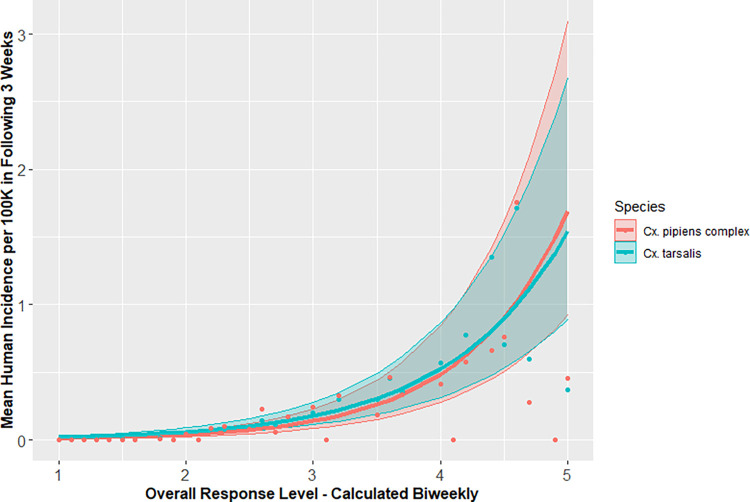
Local vector control and public health agencies in California use the California Mosquito-Borne Virus Surveillance and Response Plan to monitor and evaluate West Nile virus (WNV) activity and guide responses to reduce the burden of WNV disease. All available data from environmental surveillance, such as the abundance and WNV infection rates in Culex tarsalis and the Culex pipiens complex mosquitoes, the numbers of dead birds, seroconversions in sentinel chickens, and ambient air temperatures, are fed into a formula to estimate the risk level and associated risk of human infections. In many other areas of the US, the vector index, based only on vector mosquito abundance and infection rates, is used by vector control programs to estimate the risk of human WNV transmission. We built models to determine the association between risk level and the number of reported symptomatic human disease cases with onset in the following three weeks to identify the essential components of the risk level and to compare California's risk estimates to vector index. Risk level calculations based on Cx. tarsalis and Cx. pipiens complex levels were significantly associated with increased human risk, particularly when accounting for vector control area and population, and were better predictors than using vector index. Including all potential environmental components created an effective tool to estimate the risk of WNV transmission to humans in California.
加利福尼亚州的地方病媒控制和公共卫生机构使用加利福尼亚蚊媒病毒监测和应对计划来监测和评估西尼罗河病毒 (WNV) 活动,并指导应对措施以降低 WNV 疾病负担。所有来自环境监测的可用数据,例如库蚊属和伊蚊属复合蚊中蚊子的丰度和 WNV 感染率、死鸟数量、哨兵鸡的血清转化率以及环境空气温度,都被输入到一个公式中,以估计风险水平和相关的人类感染风险。在美国的许多其他地区,病媒控制计划仅基于病媒蚊的丰度和感染率的病媒指数,用于估计人类 WNV 传播的风险。我们建立了模型来确定风险水平与报告的有症状人类疾病病例数之间的关联,这些病例在接下来的三周内发病,以确定风险水平的基本组成部分,并将加利福尼亚州的风险估计与病媒指数进行比较。基于库蚊属和伊蚊属复合蚊水平的风险水平计算与人类风险增加显著相关,特别是在考虑到病媒控制区域和人口时,并且比使用病媒指数更好地预测。包括所有潜在的环境因素创建了一个有效的工具来估计加利福尼亚州 WNV 向人类传播的风险。