Department of Medicine, School of Medicine, University of Louisville, Louisville, KY, USA.
Endoprotech, Inc., Louisville, KY, USA.
Drug Des Devel Ther. 2022 May 3;16:1301-1309. doi: 10.2147/DDDT.S355796. eCollection 2022.
The phosphodiesterase 4 (PDE4) inhibitor, rolipram, has beneficial effects on tissue inflammation, injury and fibrosis, including in the liver. Since rolipram elicits significant CNS side-effects in humans (ie, nausea and emesis), our group developed a fusogenic lipid vesicle (FLV) drug delivery system that targets the liver to avoid adverse events. We evaluated whether this novel liposomal rolipram formulation reduces emesis.
C57Bl/6J male mice were used to compare the effect of three doses of free and FLV-delivered (FLVs-Rol) rolipram in a behavioral correlate model of rolipram-induced emesis. Tissue rolipram and rolipram metabolite levels were measured using LC-MS/MS. The effect of FLVs-Rol on brain and liver PDE4 activities was evaluated.
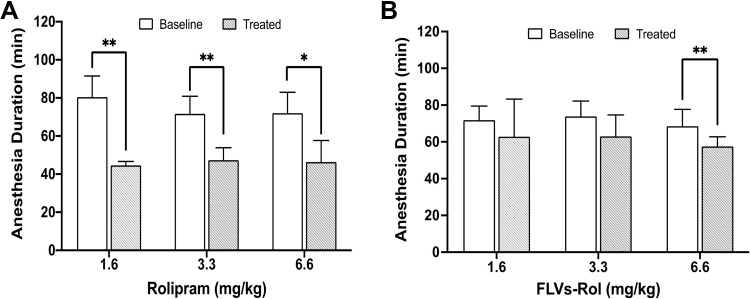
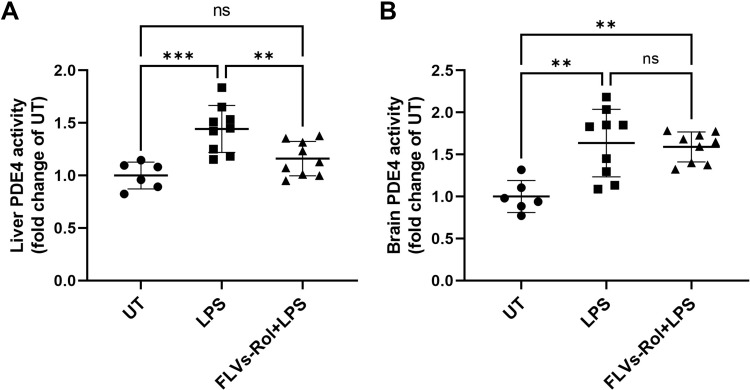
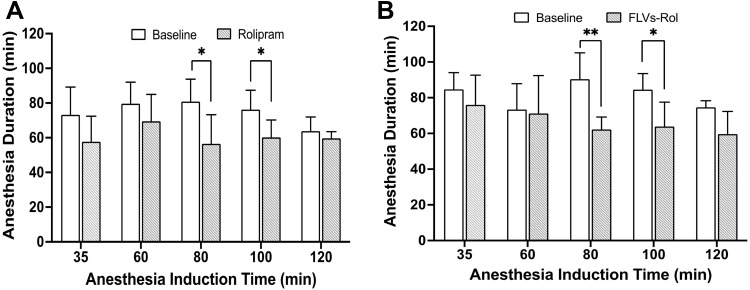
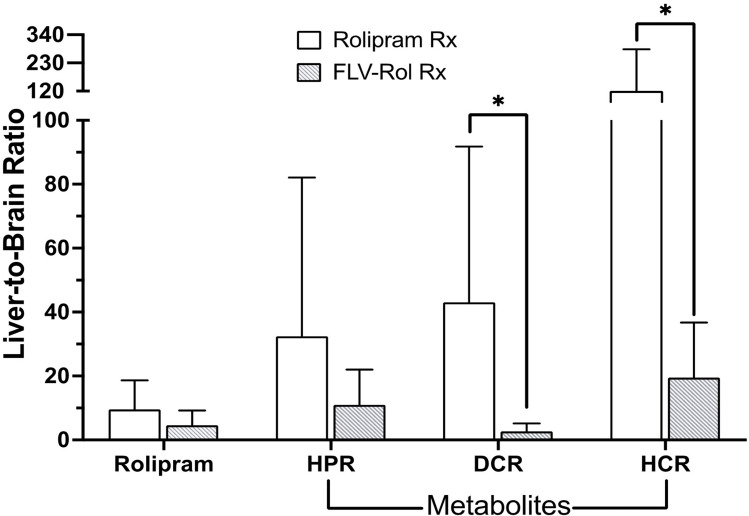
Low and moderate doses of free rolipram significantly reduced anesthesia duration, while the same doses of FLVs-Rol had no effect. However, the onset and duration of adverse effects (shortening of anesthesia period) elicited by a high dose of rolipram was not ameliorated by FLVs-Rol. Post-mortem analysis of brain and liver tissues demonstrated that FLVs affected the rate of rolipram uptake by liver and brain. Lastly, administration of a moderate dose of FLVs-Rol attenuated endotoxin induced PDE4 activity in the liver with negligible effect on the brain.
The findings that the low and moderate doses of FLVs-Rol did not shorten the anesthesia duration time suggest that FLV delivery prevented critical levels of drug from crossing the blood-brain barrier (BBB) to elicit CNS side-effects. However, the inability of high dose FLVs-Rol to prevent CNS side-effects indicates that there was sufficient unencapsulated rolipram to cross the BBB and shorten anesthesia duration. Notably, a moderate dose of FLVs-Rol was able to decrease PDE4 activity in the liver without affecting the brain. Taken together, FLVs-Rol has a strong potential for clinical application for the treatment of liver disease without side effects.
磷酸二酯酶 4(PDE4)抑制剂罗利普兰对组织炎症、损伤和纤维化具有有益作用,包括在肝脏中。由于罗利普兰在人体内引起显著的中枢神经系统副作用(即恶心和呕吐),我们的团队开发了一种融合脂质囊泡(FLV)药物递送系统,该系统靶向肝脏以避免不良事件。我们评估了这种新型脂质体罗利普兰制剂是否能减少呕吐。
使用 C57Bl/6J 雄性小鼠比较三种剂量的游离和 FLV 递送(FLVs-Rol)罗利普兰在罗利普兰诱导呕吐的行为相关模型中的作用。使用 LC-MS/MS 测量组织罗利普兰和罗利普兰代谢物水平。评估 FLVs-Rol 对脑和肝 PDE4 活性的影响。
低剂量和中剂量的游离罗利普兰显著缩短了麻醉持续时间,而相同剂量的 FLVs-Rol 没有影响。然而,高剂量罗利普兰引起的不良反应(麻醉期缩短)的发作和持续时间并未因 FLVs-Rol 而改善。大脑和肝脏组织的死后分析表明,FLVs 影响了肝脏和大脑对罗利普兰摄取的速度。最后,给予中等剂量的 FLVs-Rol 可减轻内毒素诱导的肝 PDE4 活性,而对大脑几乎没有影响。
低剂量和中剂量的 FLVs-Rol 未缩短麻醉持续时间的发现表明,FLV 递药防止了临界水平的药物穿过血脑屏障(BBB)引起中枢神经系统副作用。然而,高剂量 FLVs-Rol 无法预防中枢神经系统副作用表明,有足够的未包裹的罗利普兰穿过 BBB 并缩短麻醉持续时间。值得注意的是,中等剂量的 FLVs-Rol 能够降低肝脏中的 PDE4 活性而不影响大脑。总之,FLVs-Rol 具有很强的临床应用潜力,可用于治疗肝脏疾病而无副作用。