Furubayashi Nobuki, Minato Akinori, Negishi Takahito, Sakamoto Naotaka, Song Yoohyun, Hori Yoshifumi, Tomoda Toshihisa, Harada Mirii, Tamura Shingo, Miura Akihiro, Komori Hiroki, Kuroiwa Kentaro, Seki Narihito, Fujimoto Naohiro, Nakamura Motonobu
Department of Urology, National Hospital Organization Kyushu Cancer Center, Fukuoka, Japan.
Department of Urology, School of Medicine, University of Occupational and Environmental Health, Kitakyushu, Japan.
Cancer Manag Res. 2022 May 3;14:1641-1651. doi: 10.2147/CMAR.S360473. eCollection 2022.
To evaluate the association between immune-related adverse events (irAEs) and the clinical outcomes and also between irAEs and the post-treatment changes in the relative eosinophil count (REC) in advanced urothelial carcinoma (UC) patients treated with pembrolizumab.
This retrospective study analyzed 105 advanced UC patients treated with pembrolizumab after disease progression on platinum-based chemotherapy between January 2018 and June 2021. The association between the occurrence of irAEs and the efficacy of pembrolizumab was investigated. The change in the REC from before the initiation of pembrolizumab therapy, to three weeks after treatment and the incidence of irAEs were determined.
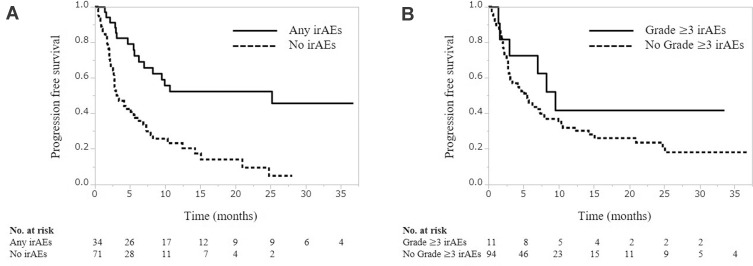
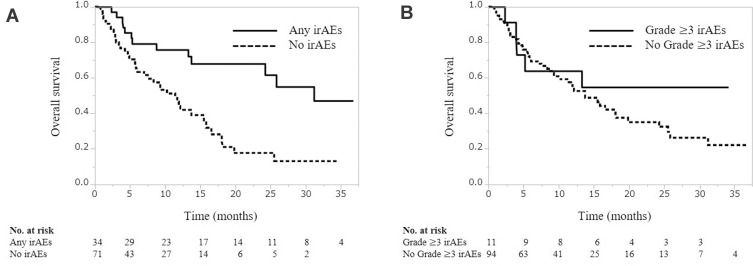
Overall irAEs were associated with a significantly higher objective response rate (ORR) (58.8% vs 25.4%, P<0.001), a longer progression-free survival (PFS) (25.1 months vs 3.1 months, P< 0.001) and overall survival (OS) (31.2 months vs 11.5 months, P< 0.001) compared to patients without irAEs; however, grade ≥3 irAEs were not associated with the ORR (36.4% vs 36.2%, P=0.989), PFS (9.5 vs 5.5 months, P=0.249), or OS (not reached vs 13.7 months, P=0.335). Compared to a decreased REC at 3 weeks after pembrolizumab, an increased relative REC at 3 weeks was not associated with the incidence of any-grade irAEs (32.3% vs 32.5%, P=0.984) or of grade ≥3 irAEs (10.8% vs 10.0%, P=0.900). Multivariate analyses revealed a female sex (P=0.005), Eastern Cooperative Oncology Group Performance Status ≥1 (P=0.024), albumin <3.7 g/dl (P<0.001), decreased REC (3 weeks later) (P<0.001), and the absence of irAEs of any grade (P=0.002) to be independently associated with a worse OS.
Patients with irAEs showed a significantly better survival compared to patients without irAEs in advanced UC treated with pembrolizumab. An increased posttreatment REC may be a marker predicting improved clinical outcomes and it had no significant relationship with the incidence of irAEs.
评估晚期尿路上皮癌(UC)患者接受帕博利珠单抗治疗时免疫相关不良事件(irAE)与临床结局之间的关联,以及irAE与治疗后相对嗜酸性粒细胞计数(REC)变化之间的关联。
这项回顾性研究分析了2018年1月至2021年6月期间105例在铂类化疗疾病进展后接受帕博利珠单抗治疗的晚期UC患者。研究了irAE的发生与帕博利珠单抗疗效之间的关联。确定了从帕博利珠单抗治疗开始前到治疗后三周REC的变化以及irAE的发生率。
与无irAE的患者相比,总体irAE与显著更高的客观缓解率(ORR)(58.8%对25.4%,P<0.001)、更长的无进展生存期(PFS)(25.1个月对3.1个月,P<0.001)和总生存期(OS)(31.2个月对11.5个月,P<0.001)相关;然而,≥3级irAE与ORR(36.4%对36.2%,P=0.989)、PFS(9.5对5.5个月,P=0.249)或OS(未达到对13.7个月,P=0.335)无关。与帕博利珠单抗治疗三周后REC降低相比,治疗三周后REC升高与任何级别的irAE发生率(32.3%对32.5%,P=0.984)或≥3级irAE发生率(10.8%对10.0%,P=0.900)均无关。多因素分析显示女性(P=0.005)、东部肿瘤协作组体能状态≥1(P=0.024)、白蛋白<3.7 g/dl(P<0.001)、REC降低(三周后)(P<0.001)以及无任何级别的irAE(P=0.002)与较差的OS独立相关。
在接受帕博利珠单抗治疗的晚期UC患者中,有irAE的患者与无irAE的患者相比生存明显更好。治疗后REC升高可能是预测临床结局改善的一个标志物,且与irAE的发生率无显著关系。