Shao Yang, Yang Yang, Sun Yong-Xin, Xu Ai-Hua
Department of Rehabilitation Medicine, The First Affiliated Hospital of China Medical University, Shenyang, Liaoning Province, China.
Neural Regen Res. 2022 Nov;17(11):2491-2496. doi: 10.4103/1673-5374.339011.
No definite consensus has currently been reached regarding the safety and efficacy of low- or high-frequency repetitive transcranial magnetic stimulation in the treatment of post-stroke muscle spasticity. The latest research indicates that when combined with local injections of botulinum toxin type A, it is more effective on post-stroke muscle spasticity than local injections of botulinum toxin type A alone. We designed a prospective, single-center, non-randomized, controlled clinical trial to investigate the safety and efficacy of different frequencies of repetitive transcranial magnetic stimulation combined with local injections of botulinum toxin type A in treating post-stroke lower limb muscle spasticity to determine an optimal therapeutic regimen. This trial will enroll 150 patients with post-stroke muscle spasticity admitted to the Department of Rehabilitation Medicine at the First Affiliated Hospital of China Medical University. All enrolled patients will undergo routine rehabilitation training and will be divided into five groups (n = 30 per group) according to the particular area of cerebral infarction and treatment methods. Group A: Patients with massive cerebral infarction will be given local injections of botulinum toxin type A and low-frequency (1 Hz) repetitive transcranial magnetic stimulation on the contralateral side; Group B: Patients with non-massive cerebral infarction will be given local injections of botulinum toxin type A and high-frequency (10-20 Hz) repetitive transcranial magnetic stimulation on the affected side; Group C: Patients with massive/non-massive cerebral infarction will be given local injections of botulinum toxin type A; Group D: Patients with massive cerebral infarction will be given low-frequency (1 Hz) repetitive transcranial magnetic stimulation on the contralateral side; and Group E: Patients with non-massive cerebral infarction will be given high-frequency (10-20 Hz) repetitive transcranial magnetic stimulation on the affected side. The primary outcome measure of this trial is a modified Ashworth scale score from 1 day before treatment to 12 months after treatment. Secondary outcome measures include Fugl-Meyer Assessment of Lower Extremity, Visual Analogue Scale, modified Barthel index, and Berg Balance Scale scores for the same time as specified for primary outcome measures. The safety indicator is the incidence of adverse events at 3-12 months after treatment. We hope to draw a definite conclusion on whether there are differences in the safety and efficacy of low- or high-frequency repetitive transcranial magnetic stimulation combined with botulinum toxin type A injections in the treatment of patients with post-stroke lower limb spasticity under strict grouping and standardized operation, thereby screening out the optimal therapeutic regimen. The study protocol was approved by the Medical Ethics Committee of the First Affiliated Hospital of China Medical University (approval No. [2021] 2021-333-3) on August 19, 2021. The trial was registered with the Chinese Clinical Trial Registry (Registration No. ChiCTR2100052180) on October 21, 2021. The protocol version is 1.1.
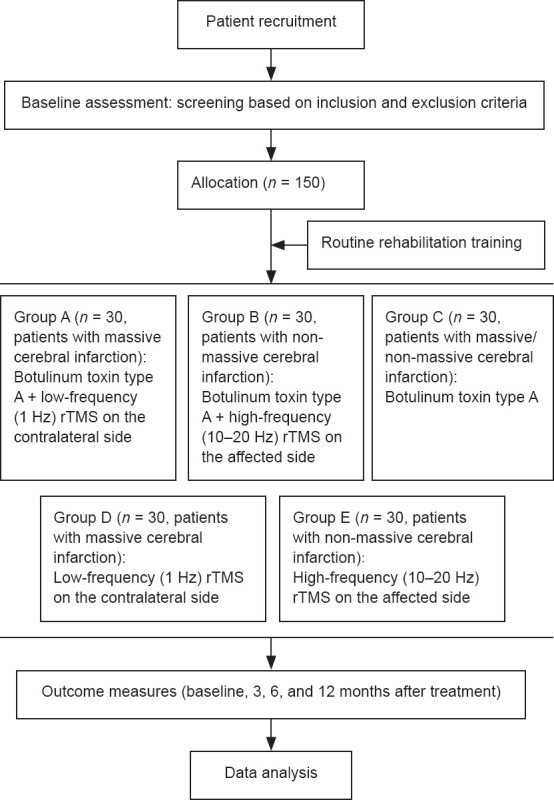
目前,关于低频或高频重复经颅磁刺激治疗脑卒中后肌肉痉挛的安全性和有效性尚未达成明确共识。最新研究表明,与局部注射A型肉毒毒素联合使用时,其治疗脑卒中后肌肉痉挛的效果优于单独局部注射A型肉毒毒素。我们设计了一项前瞻性、单中心、非随机对照临床试验,以研究不同频率的重复经颅磁刺激联合局部注射A型肉毒毒素治疗脑卒中后下肢肌肉痉挛的安全性和有效性,从而确定最佳治疗方案。本试验将纳入中国医科大学附属第一医院康复医学科收治的150例脑卒中后肌肉痉挛患者。所有纳入患者均接受常规康复训练,并根据脑梗死的具体部位和治疗方法分为五组(每组n = 30)。A组:大面积脑梗死患者将在对侧接受局部注射A型肉毒毒素和低频(1 Hz)重复经颅磁刺激;B组:非大面积脑梗死患者将在患侧接受局部注射A型肉毒毒素和高频(10 - 20 Hz)重复经颅磁刺激;C组:大面积/非大面积脑梗死患者将接受局部注射A型肉毒毒素;D组:大面积脑梗死患者将在对侧接受低频(1 Hz)重复经颅磁刺激;E组:非大面积脑梗死患者将在患侧接受高频(10 - 20 Hz)重复经颅磁刺激。本试验的主要观察指标是治疗前1天至治疗后12个月的改良Ashworth量表评分。次要观察指标包括与主要观察指标相同时间的下肢Fugl - Meyer评估、视觉模拟评分、改良Barthel指数和Berg平衡量表评分。安全指标是治疗后3 - 12个月不良事件的发生率。我们希望在严格分组和标准化操作的情况下,就低频或高频重复经颅磁刺激联合A型肉毒毒素注射治疗脑卒中后下肢痉挛患者的安全性和有效性是否存在差异得出明确结论,从而筛选出最佳治疗方案。本研究方案于2021年8月19日获得中国医科大学附属第一医院医学伦理委员会批准(批准文号[2021] 2021 - 333 - 3)。该试验于2021年10月21日在中国临床试验注册中心注册(注册号ChiCTR2100052180)。方案版本为1.1。
