City of Hope Cancer Center and Beckman Research Institute, 1500 East Duarte Rd, Duarte, CA, 91010, USA.
University of Birmingham, Birmingham, UK.
Am J Clin Dermatol. 2022 Jul;23(4):561-570. doi: 10.1007/s40257-022-00687-y. Epub 2022 May 10.
Chlormethine gel was approved for treatment of mycosis fungoides, the most common cutaneous T-cell lymphoma, on the basis of results from study 201 and study 202. A post-hoc analysis of study 201 found interesting trends regarding improved efficacy of chlormethine gel vs ointment and noted a potential association between dermatitis and clinical response.
To expand these results by performing a post-hoc analysis of study 202.
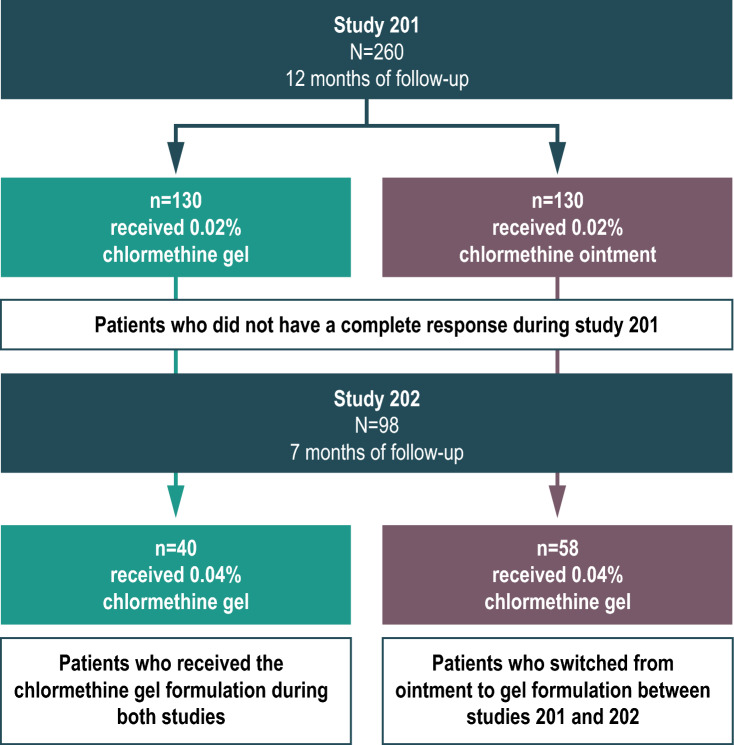
Patients received chlormethine gel or ointment during study 201 (12 months) and higher-concentration chlormethine gel during study 202 (7-month extension). Response was assessed using Composite Assessment of Index Lesion Severity (CAILS). Associations between treatment frequency, response, and skin-related adverse events (AEs) were assessed using multivariate time-to-event analyses. Time-to-response and repeated measures analyses were compared between patients who only used chlormethine gel and those who switched from ointment to gel.
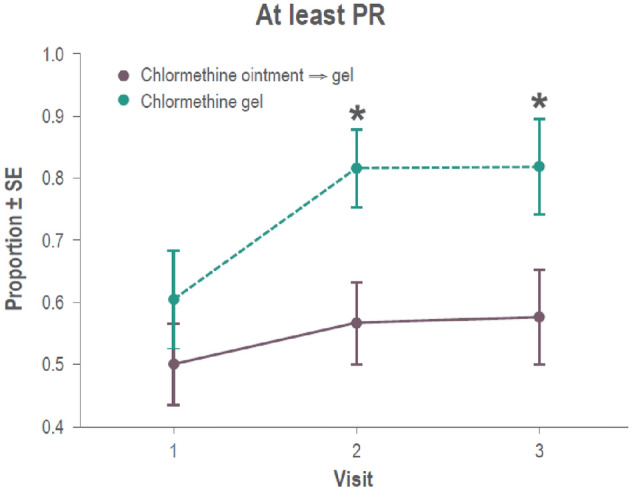
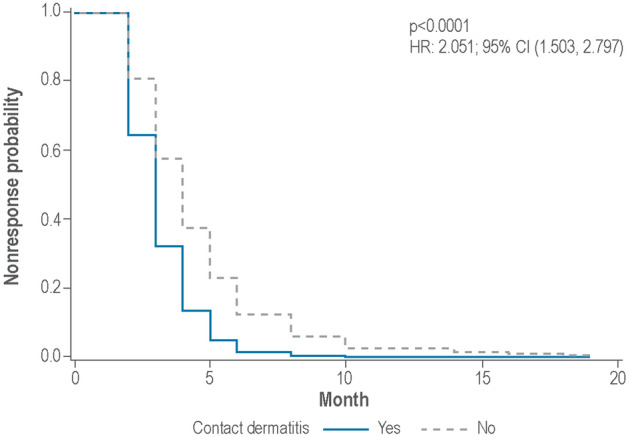
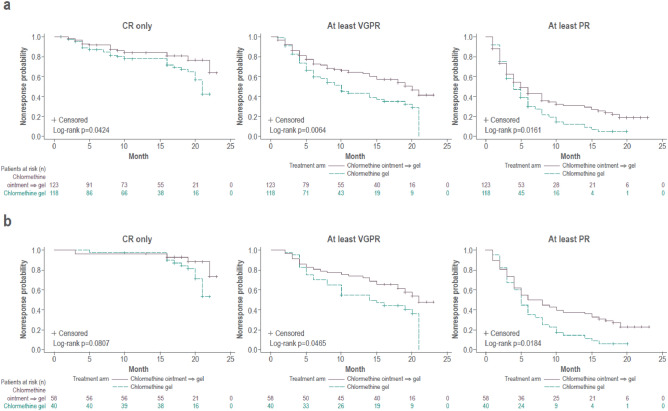
No associations were seen between treatment frequency and improved skin response (CAILS) or AE occurrence within the 201/202 study populations. However, an association was observed specifically between contact dermatitis and improved CAILS response at the next visit (p < 0.0001). Patients who used chlormethine gel during both studies had a significantly (p < 0.05) shorter time to response and higher overall response rates than patients who initiated treatment with ointment.
This post-hoc analysis shows that patients who initiated treatment using chlormethine gel had faster and higher responses compared with patients who initially used chlormethine ointment for 12 months. The development of contact dermatitis may be a potential prognostic factor for response.
Study 201: NCT00168064, September 14, 2002; Study 202: NCT00535470, September 26, 2007.
氯甲烷凝胶基于研究 201 和研究 202 的结果被批准用于治疗蕈样真菌病,即最常见的皮肤 T 细胞淋巴瘤。研究 201 的事后分析发现,氯甲烷凝胶与软膏相比,疗效有显著提高的趋势,并注意到皮炎与临床反应之间存在潜在关联。
通过对研究 202 进行事后分析来扩展这些结果。
患者在研究 201(12 个月)期间接受氯甲烷凝胶或软膏治疗,在研究 202(7 个月的扩展期)期间接受高浓度氯甲烷凝胶治疗。使用综合评估指数病变严重程度(CAILS)评估反应。使用多变量时间事件分析评估治疗频率、反应和皮肤相关不良事件(AE)之间的关联。使用时间反应和重复测量分析比较仅使用氯甲烷凝胶的患者和从软膏转为凝胶的患者之间的差异。
在 201/202 研究人群中,未观察到治疗频率与皮肤反应改善(CAILS)或 AE 发生之间存在关联。然而,在接触性皮炎和下一次就诊时 CAILS 反应改善之间观察到了特定的关联(p<0.0001)。在两项研究中均使用氯甲烷凝胶的患者与最初使用软膏治疗 12 个月的患者相比,反应时间明显更短(p<0.05),总体反应率更高。
这项事后分析表明,与最初使用氯甲烷软膏治疗 12 个月的患者相比,使用氯甲烷凝胶开始治疗的患者反应更快,反应率更高。接触性皮炎的发生可能是反应的一个潜在预后因素。
研究 201:NCT00168064,2002 年 9 月 14 日;研究 202:NCT00535470,2007 年 9 月 26 日。