School of Population Health, Curtin University, Perth, Western Australia, Australia
School of Public Health, Debre Berhan University, Debre Berhan, Amhara, Ethiopia.
BMJ Open. 2022 May 10;12(5):e060308. doi: 10.1136/bmjopen-2021-060308.
This study examined the association between family planning counselling receipt during the 12 months preceding the survey and postpartum modern contraceptive uptake in Ethiopia. We hypothesised that receiving family planning counselling either within the community setting by a field health worker or at a health facility by a healthcare attendant during the 12 months preceding the survey improves postpartum modern contraceptive uptake.
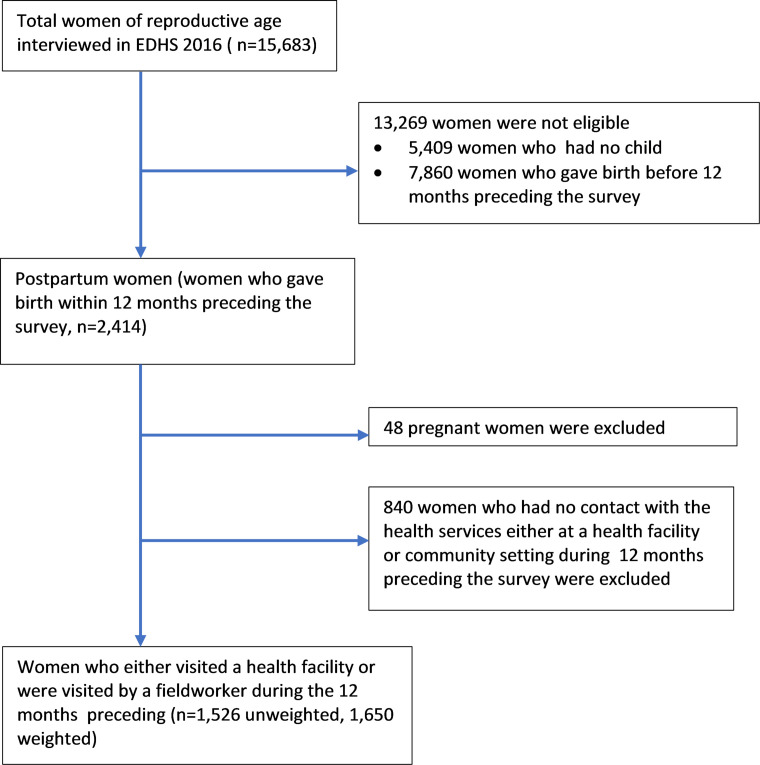
We used a cross-sectional study of the Ethiopian Demographic and Health Survey conducted in 2016.
Ethiopia.
A total of 1650 women who gave birth during the 12 months and had contact with service delivery points during the 12 months preceding the survey.
A weighted modified Poisson regression model was used to estimate an adjusted relative risk (RR) of postpartum modern contraceptives.
Approximately half (48%) of the women have missed the opportunity to receive family planning counselling at the health service contact points during the 12 months preceding the survey. The postpartum modern contraceptive uptake was 27%. Two hundred forty-two (30%) and 204 (24%) of the counselled and not counselled women used postpartum modern contraceptive methods, respectively. Compared with women who did not receive counselling for family planning, women who received counselling had higher contraceptive uptake (RR 1.32, 95% CI 1.04 to 1.67).
Significant numbers of women have missed the opportunity of receiving family planning counselling during contact with health service delivery points. Modern contraceptive uptake among postpartum women was low in Ethiopia. Despite this, our findings revealed that family planning counselling was associated with improved postpartum modern contraceptive uptake.
本研究考察了在调查前 12 个月接受计划生育咨询与埃塞俄比亚产后现代避孕措施使用率之间的关系。我们假设,在调查前 12 个月内,无论是在社区由实地卫生工作者提供的计划生育咨询,还是在医疗机构由医疗保健工作者提供的计划生育咨询,都可以提高产后现代避孕措施的使用率。
我们使用了 2016 年进行的埃塞俄比亚人口与健康调查的横断面研究。
埃塞俄比亚。
共有 1650 名在调查前 12 个月内分娩且在调查前 12 个月内与服务提供点有过接触的妇女。
使用加权改良泊松回归模型估计产后现代避孕药具的调整相对风险(RR)。
大约一半(48%)的妇女在调查前 12 个月的卫生服务接触点错过了接受计划生育咨询的机会。产后现代避孕措施的使用率为 27%。接受咨询的妇女中有 242 人(30%)和未接受咨询的妇女中有 204 人(24%)使用了产后现代避孕方法。与未接受计划生育咨询的妇女相比,接受咨询的妇女的避孕率更高(RR 1.32,95%CI 1.04 至 1.67)。
大量妇女在与卫生服务提供点接触时错过了接受计划生育咨询的机会。产后妇女的现代避孕措施使用率在埃塞俄比亚较低。尽管如此,我们的研究结果表明,计划生育咨询与产后现代避孕措施使用率的提高有关。