School of Medicine and Medical Sciences, Holy Spirit University of Kaslik, P.O. Box 446, Jounieh, Lebanon.
Research Department, Psychiatric Hospital of the Cross, P.O. Box 60096, Jal Eddib, Lebanon.
BMC Womens Health. 2022 May 10;22(1):153. doi: 10.1186/s12905-022-01738-6.
The objective of our study was to evaluate the association between the transition to menopause, body dissatisfaction, and abnormal eating habits (restrained eating, binge eating, and orthorexia nervosa) in a sample of middle-aged Lebanese women.
A cross-sectional study conducted between July 2019 and January 2020 enrolled 1001 women aged 40 years and above from all Lebanese governorates. Data were collected by face-to-face interviews with all participants. The Body dissatisfaction subscale of the Eating Disorder Inventory‑second version was used to assess body dissatisfaction, whereas the Binge Eating Scale, Dutch Restrained Eating Scale, ORTO-15, Dusseldorf Orthorexia Scale (DOS), and Teruel Orthorexia Scale (TOS) were used to assess eating disorders (binge eating, restrained eating and orthorexia nervosa respectively. Multivariable analysis of covariance (MANCOVA) was used to compare multiple measures among the three menopausal phases, after adjustment over potential confounding variables (age, monthly income, body mass index, marital status, education level, and body dissatisfaction).
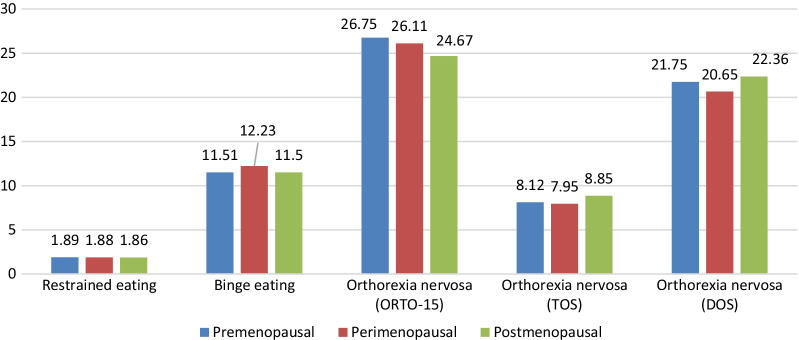
Postmenopause was significantly associated with more orthorexia nervosa tendencies (lower ORTO-15 scores) than premenopause (β = - 1.87; p = 0.022). Perimenopause was associated with more binge eating (β = 1.56; p = 0.031), and less orthorexia nervosa (as measured by the DOS) than premenopause, with this association tending to significance (β = - 1.10; p = 0.051). Furthermore, higher body dissatisfaction was significantly associated with higher restrained eating (β = 0.02; p < 0.001), binge eating (β = 0.48; p < 0.001), and orthorexia nervosa as measured by ORTO-15 (β = - 0.17; p < 0.001) and TOS (β = 0.08; p = 0.002), but not DOS.
Our study showed that menopausal stages are associated with some disordered eating behaviors (binge eating and orthorexia nervosa) among middle-aged women. Those results may serve as a first step towards spreading awareness among women within this age group regarding eating attitudes. Moreover, healthcare professionals should screen for the presence of disordered eating during those women's routine visits to the clinics.
本研究旨在评估绝经过渡、身体不满和异常饮食习惯(限制进食、暴食和饮食失调)之间的关联,研究对象为黎巴嫩中年女性。
2019 年 7 月至 2020 年 1 月期间,我们进行了一项横断面研究,招募了来自黎巴嫩所有省份的 1001 名 40 岁以上的女性。所有参与者均通过面对面访谈收集数据。使用饮食失调清单第二版的身体不满分量表评估身体不满,使用暴食量表、荷兰限制进食量表、ORTO-15、杜塞尔多夫饮食失调量表(DOS)和特鲁埃尔饮食失调量表(TOS)评估暴食、限制进食和饮食失调(分别为暴食、限制进食和饮食失调)。调整潜在混杂变量(年龄、月收入、体重指数、婚姻状况、教育水平和身体不满)后,采用协方差多变量分析(MANCOVA)比较绝经三个阶段的多项指标。
绝经后与绝经前相比,饮食失调倾向(ORTO-15 评分较低)明显更高(β=-1.87;p=0.022)。围绝经期与绝经前相比,暴食(β=1.56;p=0.031)更多,而饮食失调倾向(DOS)更低,这种关联具有显著趋势(β=-1.10;p=0.051)。此外,较高的身体不满与更高的限制进食(β=0.02;p<0.001)、暴食(β=0.48;p<0.001)和 ORTO-15(β=-0.17;p<0.001)和 TOS(β=0.08;p=0.002)测量的饮食失调显著相关,但与 DOS 无关。
我们的研究表明,绝经阶段与中年女性的一些饮食失调行为(暴食和饮食失调)有关。这些结果可能是在该年龄组女性中提高对饮食态度的认识的第一步。此外,医疗保健专业人员应在这些女性常规就诊时筛查饮食失调的存在。