Lee Gil Ya Cancer and Diabetes Institute, Gachon University, 155, Gaetbeol-ro, Yeonsu-gu, Incheon, 21999, Republic of Korea.
College of Pharmacy and Gachon Institute of Pharmaceutical Sciences, Gachon University, 191, Hambangmoe-ro, Yeonsu-gu, Incheon, 21936, Republic of Korea.
J Biomed Sci. 2022 May 10;29(1):31. doi: 10.1186/s12929-022-00814-1.
Mesangial cell fibrosis, a typical symptom of diabetic nephropathy (DN), is a major contributor to glomerulosclerosis. We previously reported that the pharmacological blockade of lysophosphatidic acid (LPA) signaling improves DN. Although LPA signaling is implicated in diabetic renal fibrosis, the underlying molecular mechanisms remain unclear. Here, the role of carbohydrate-responsive element-binding protein (ChREBP) in LPA-induced renal fibrosis and the underlying mechanisms were investigated.
Eight-week-old wild-type and db/db mice were intraperitoneally injected with the vehicle or an LPAR1/3 antagonist, ki16425 (10 mg/kg), for 8 weeks on a daily basis, following which the mice were sacrificed and renal protein expression was analyzed. SV40 MES13 cells were treated with LPA in the presence or absence of ki16425, and the expression of ChREBP and fibrotic factors, including fibronectin, TGF-β, and IL-1β, was examined. The role of ChREBP in the LPA-induced fibrotic response was investigated by ChREBP overexpression or knockdown. The involvement of Smad ubiquitination regulatory factor-2 (Smurf2), an E3 ligase, in LPA-induced expression of ChREBP and fibrotic factors was investigated by Smurf2 overexpression or knockdown. To identify signaling molecules regulating Smurf2 expression by LPA, pharmacological inhibitors such as A6370 (Akt1/2 kinase inhibitor) and Ly 294002 (PI3K inhibitor) were used.
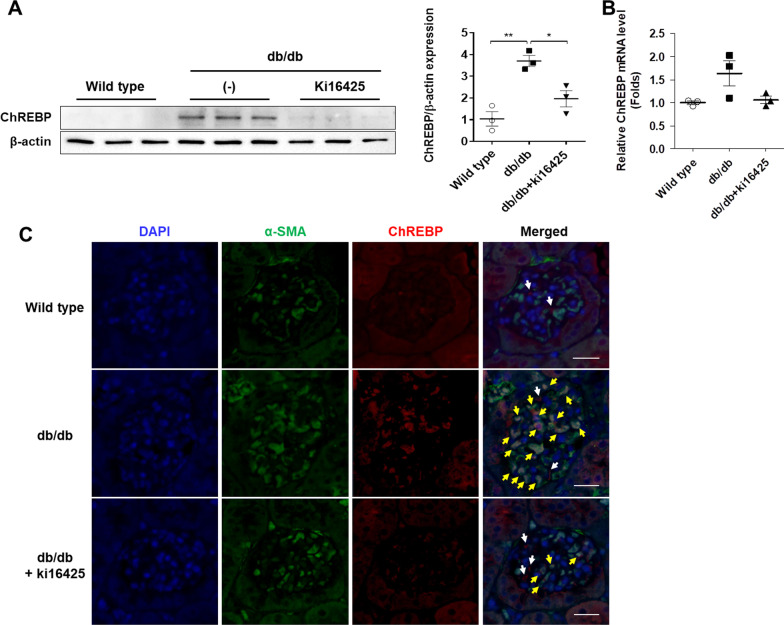
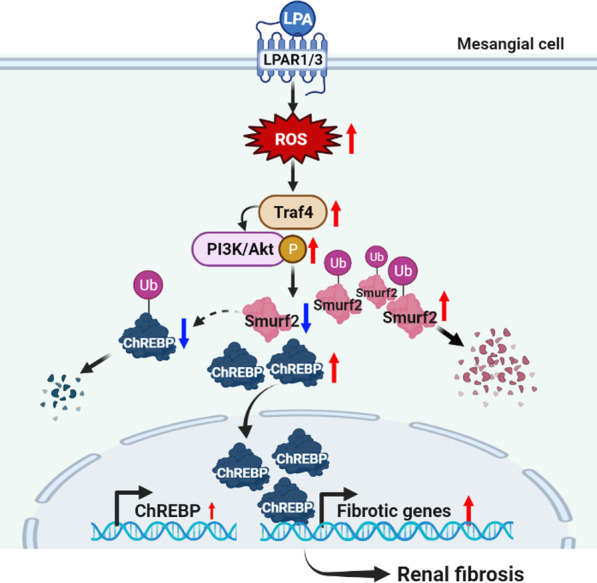
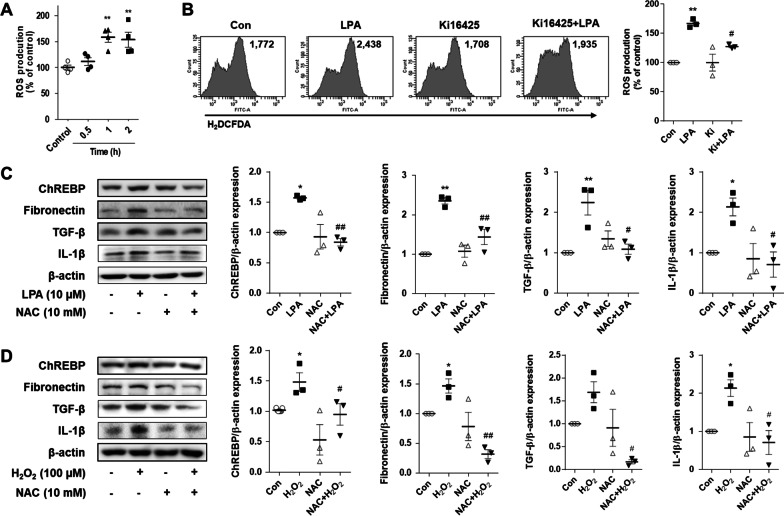
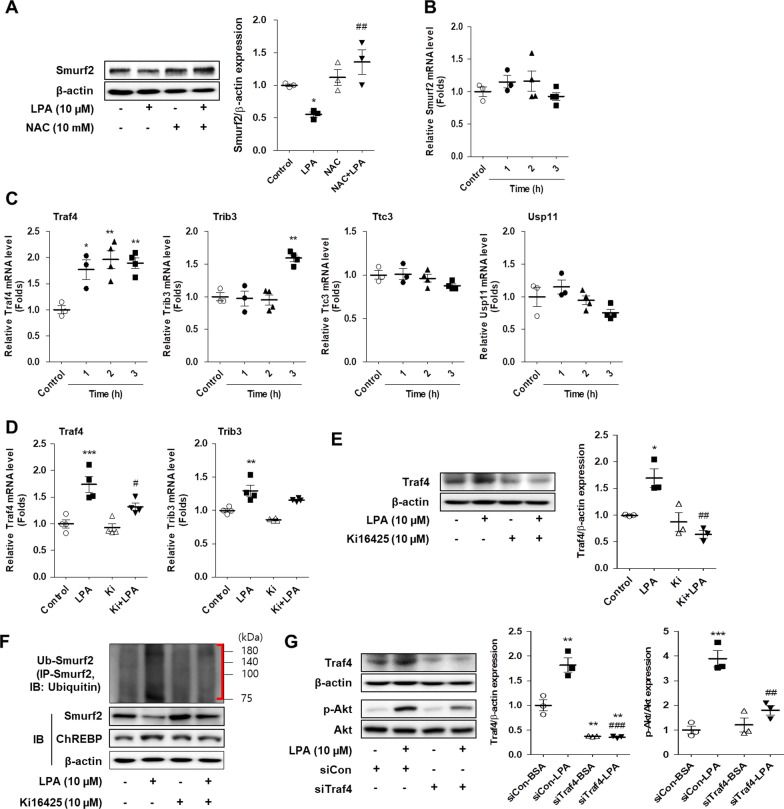
The renal expression of ChREBP increased in diabetic db/db mice, and was reduced following treatment with the ki16425. Treatment with LPA induced the expression of ChREBP and fibrotic factors, including fibronectin, TGF-β, and IL-1β, in SV40 MES13 cells, which were positively correlated. The LPA-induced expression of fibrotic factors increased or decreased following ChREBP overexpression and knockdown, respectively. The production of reactive oxygen species (ROS) mediated the LPA-induced expression of ChREBP and fibrotic factors, and LPA decreased Smurf2 expression via Traf4-mediated ubiquitination. The LPA-induced expression of ubiquitinated-ChREBP increased or decreased following Smurf2 overexpression and knockdown, respectively. Additionally, Smurf2 knockdown significantly increased the expression of ChREBP and fibrotic factors. The pharmacological inhibition of Akt signaling suppressed the LPA-induced alterations in the expression of ChREBP and Smurf2.
Collectively, the results demonstrated that the ROS/Akt-dependent downregulation of Smurf2 and the subsequent increase in ChREBP expression might be one of the mechanisms by which LPA induces mesangial cell fibrosis in DN.
系膜细胞纤维化是糖尿病肾病(DN)的典型症状,也是肾小球硬化的主要原因。我们之前的研究报道,抑制溶血磷脂酸(LPA)信号通路可改善 DN。尽管 LPA 信号通路与糖尿病肾纤维化有关,但其中的分子机制尚不清楚。在这里,我们研究了碳水化合物反应元件结合蛋白(ChREBP)在 LPA 诱导的肾纤维化中的作用及其潜在机制。
8 周龄野生型和 db/db 小鼠每天腹膜内注射载体或 LPAR1/3 拮抗剂 ki16425(10mg/kg),持续 8 周,然后处死小鼠并分析肾脏蛋白表达。SV40 MES13 细胞用 LPA 处理,同时用或不用 ki16425,检测 ChREBP 和纤维化因子(包括纤维连接蛋白、TGF-β 和 IL-1β)的表达。通过 ChREBP 过表达或敲低研究 ChREBP 在 LPA 诱导的纤维化反应中的作用。通过过表达或敲低 Smad 泛素化调节因子-2(Smurf2),一种 E3 连接酶,研究其在 LPA 诱导的 ChREBP 和纤维化因子表达中的作用。为了鉴定由 LPA 调节 Smurf2 表达的信号分子,使用了药理学抑制剂,如 A6370(Akt1/2 激酶抑制剂)和 Ly 294002(PI3K 抑制剂)。
糖尿病 db/db 小鼠肾脏中 ChREBP 的表达增加,用 ki16425 处理后减少。LPA 诱导 SV40 MES13 细胞中 ChREBP 和纤维化因子(包括纤维连接蛋白、TGF-β 和 IL-1β)的表达,这些因子呈正相关。ChREBP 过表达或敲低分别增加或减少 LPA 诱导的纤维化因子表达。活性氧(ROS)介导了 LPA 诱导的 ChREBP 和纤维化因子的表达,而 LPA 通过 Traf4 介导的泛素化降低了 Smurf2 的表达。LPA 诱导的泛素化 ChREBP 的表达增加或减少分别与 Smurf2 过表达和敲低有关。此外,Smurf2 敲低显著增加了 ChREBP 和纤维化因子的表达。Akt 信号的药理学抑制抑制了 LPA 诱导的 ChREBP 和 Smurf2 表达的改变。
总之,这些结果表明,ROS/Akt 依赖性下调 Smurf2 和随后 ChREBP 表达的增加可能是 LPA 诱导糖尿病肾病系膜细胞纤维化的机制之一。