Voskarides Konstantinos
Department of Basic and Clinical Sciences, University of Nicosia Medical School, Nicosia, Cyprus.
Evol Med Public Health. 2022 Apr 29;10(1):214-220. doi: 10.1093/emph/eoac018. eCollection 2022.
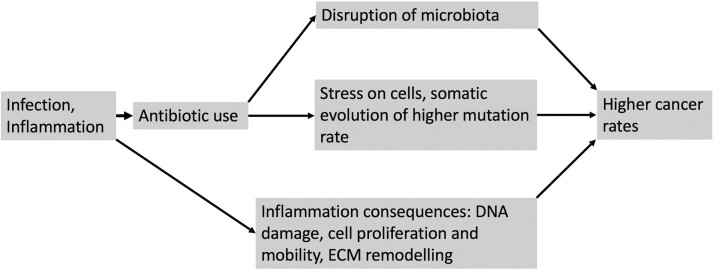
: More than 10 studies have confirmed the association of antibiotic overuse with colorectal cancer. The exact cause is unknown, but most authors hypothesize that disturbance of colon microbiota is the main culprit. In this commentary, an evolutionary explanation is proposed. It is well known that antibiotics can induce antibiotic resistance in bacteria through selection of mutators-DNA mismatch repair deficient (dMMR) strains. Mutators have an increased survival potential due to their high mutagenesis rate. Antibiotics can also cause stress in human cells. Selection of dMMR colon cells may be advantageous under this stress, mimicking selection of bacterial mutators. Concomitantly, mismatch repair deficiency is a common cause of cancer, this may explain the increased cancer risk after multiple cycles of oral antibiotics. This proposed rationale is described in detail, along with supporting evidence from the peer-reviewed literature and suggestions for testing hypothesis validity. Treatment schemes could be re-evaluated, considering toxicity and somatic selection mechanisms.
The association of antibiotics with colon cancer is well established but of unknown cause. Under an evolutionary framework, antibiotics may select for stress-resistant cancerous cells that lack mechanisms for DNA mismatch repair (MMR). This mimics the selection of antibiotic resistant 'mutators'-MMR-deficient micro-organisms-highly adaptive due to their increased mutagenesis rate.
超过10项研究证实了抗生素过度使用与结直肠癌之间的关联。确切原因尚不清楚,但大多数作者推测结肠微生物群紊乱是主要原因。在这篇评论中,提出了一种进化论解释。众所周知,抗生素可通过选择突变体——DNA错配修复缺陷(dMMR)菌株诱导细菌产生抗生素耐药性。由于其高突变率,突变体具有更高的生存潜力。抗生素也会给人类细胞造成压力。在这种压力下,选择dMMR结肠细胞可能具有优势,这类似于对细菌突变体的选择。与此同时,错配修复缺陷是癌症的常见病因,这可能解释了多次口服抗生素后癌症风险增加的原因。本文详细描述了这一提出的基本原理,以及来自同行评审文献的支持证据和检验假设有效性的建议。考虑到毒性和体细胞选择机制,治疗方案可能需要重新评估。
抗生素与结肠癌之间的关联已得到充分证实,但原因不明。在进化框架下,抗生素可能会选择缺乏DNA错配修复(MMR)机制的抗应激癌细胞。这类似于对抗生素耐药的“突变体”——MMR缺陷微生物的选择,由于其突变率增加,这些微生物具有高度适应性。