Zou Yimin, Tu Bin, Yu Lanlan, Zheng Yongfang, Lin Yuchen, Luo Wendi, Yang Yanlian, Fang Qiaojun, Wang Chen
CAS Key Laboratory of Biological Effects of Nanomaterials and Nanosafety, CAS Key Laboratory of Standardization and Measurement for Nanotechnoloty of Nanomaterials and Nanosafety, CAS Center for Excellence in Nanoscience, CAS Center for Excellence in Brain Science, National Center for Nanoscience and Technology Beijing 100190 P. R. China
Sino-Danish Center for Education and Research, University of Chinese Academy of Sciences Beijing 100190 P. R. China.
RSC Adv. 2019 Dec 13;9(70):41345-41350. doi: 10.1039/c9ra09320f. eCollection 2019 Dec 9.
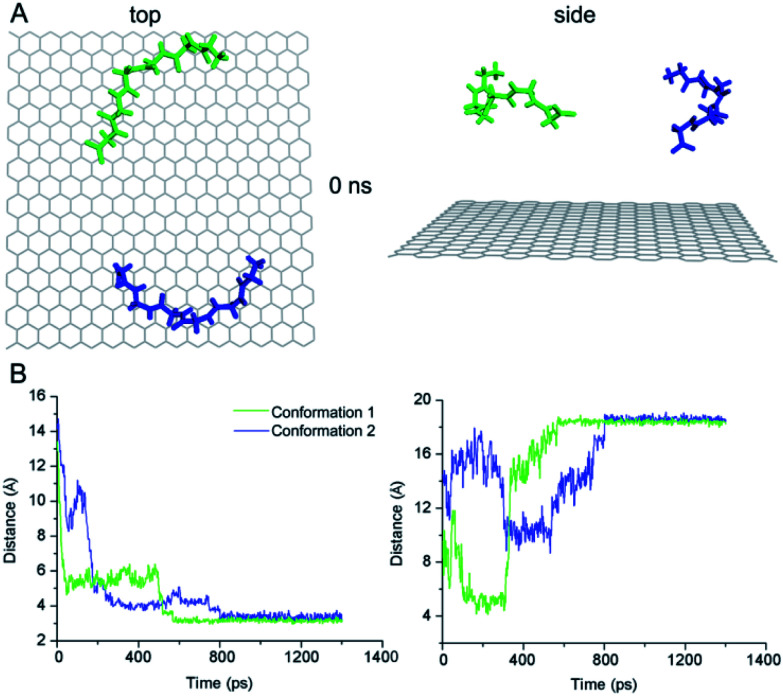
The characteristics of peptide conformations in both solution and surface-bound states, using poly-glycine as a model structure, are analyzed by using molecular dynamics (MD) simulations. The clustering analysis revealed significant linearization effect on the peptide conformations as a result of adsorption to surface, accompanied by varied adsorption kinetics and energetics. Depending on the inter-peptide interaction characteristics, distinctively different surface-mediated oligomerization modalities, such as antiparallel conformations, can be identified in MD and confirmed by scanning tunneling microscopy (STM) analysis of the assembly structures. These observations are beneficial for obtaining molecular insights of assembling propensity relating to peptide-surface and peptide-peptide interactions.
以聚甘氨酸为模型结构,通过分子动力学(MD)模拟分析了肽在溶液和表面结合状态下的构象特征。聚类分析表明,肽吸附到表面后,其构象会产生显著的线性化效应,同时伴随着不同的吸附动力学和能量学。根据肽间相互作用特征,在分子动力学模拟中可识别出明显不同的表面介导的低聚模式,如反平行构象,并通过对组装结构的扫描隧道显微镜(STM)分析得到证实。这些观察结果有助于深入了解与肽-表面和肽-肽相互作用相关的组装倾向的分子机制。