Singh Anju, Kalamuddin Md, Mohmmed Asif, Malhotra Pawan, Hoda Nasimul
Drug Design and Synthesis Lab., Department of Chemistry, Jamia Millia Islamia Jamia Nagar New Delhi-110025 India
International Centre for Genetic Engineering and Biotechnology (ICGEB) Aruna Asaf Ali Marg New Delhi-110067 India
RSC Adv. 2019 Nov 29;9(67):39410-39421. doi: 10.1039/c9ra06571g. eCollection 2019 Nov 27.
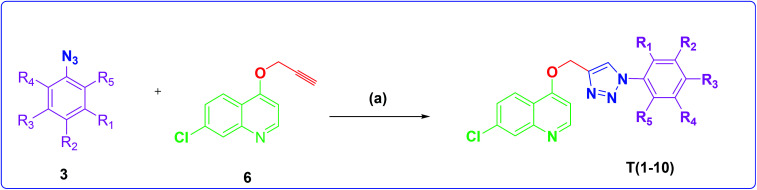
Falcipain-2 (FP2) is a papain family cysteine protease and a key member of the hemoglobin degradation pathway, a process that is required at erythrocytic stages of to obtain amino acids. In this study, we report a set of 10 quinoline-triazole-based compounds (T1-T10) which exhibit a good binding affinity for FP2, inhibit its catalytic activity at micromolar concentrations and thereby arrest the parasite growth. Compounds T4 and T7 inhibited FP2 with IC values of 16.16 μM and 25.64 μM respectively. Both the compounds T4 and T7 arrested the development of at the trophozoite stage with an EC value 21.89 μM and 49.88 μM. These compounds also showed morphological and food-vacuole abnormalities like E-64, a known inhibitor of FP2. Our results thus identify the quinoline-triazole-based compounds as a probable starting point for the design of FP2 inhibitors and they should be further investigated as potential antimalarial agents.
恶性疟原虫蛋白酶-2(FP2)是一种木瓜蛋白酶家族的半胱氨酸蛋白酶,也是血红蛋白降解途径的关键成员,这一过程在疟原虫红细胞阶段是获取氨基酸所必需的。在本研究中,我们报告了一组基于喹啉-三唑的化合物(T1-T10),它们对FP2表现出良好的结合亲和力,在微摩尔浓度下抑制其催化活性,从而阻止疟原虫生长。化合物T4和T7分别以16.16μM和25.64μM的IC值抑制FP2。化合物T4和T7均以21.89μM和49.88μM的EC值在滋养体阶段阻止疟原虫发育。这些化合物还表现出与已知的FP2抑制剂E-64类似的形态和食物泡异常。因此,我们的结果确定基于喹啉-三唑的化合物可能是设计FP2抑制剂的起点,它们应作为潜在的抗疟药物进一步研究。