School of Psychology, 4589Liverpool John Moores University, UK.
Department of Psychology, University of York, UK.
Perception. 2022 Aug;51(8):521-538. doi: 10.1177/03010066221098728. Epub 2022 May 11.
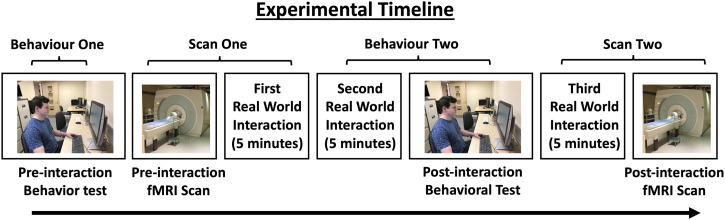
Making new acquaintances requires learning to recognise previously unfamiliar faces. In the current study, we investigated this process by staging real-world social interactions between actors and the participants. Participants completed a face-matching behavioural task in which they matched photographs of the actors (whom they had yet to meet), or faces similar to the actors (henceforth called foils). Participants were then scanned using functional magnetic resonance imaging (fMRI) while viewing photographs of actors and foils. Immediately after exiting the scanner, participants met the actors for the first time and interacted with them for 10 min. On subsequent days, participants completed a second behavioural experiment and then a second fMRI scan. Prior to each session, actors again interacted with the participants for 10 min. Behavioural results showed that social interactions improved performance accuracy when matching actor photographs, but not foil photographs. The fMRI analysis revealed a difference in the neural response to actor photographs and foil photographs across all regions of interest (ROIs) only after social interactions had occurred. Our results demonstrate that short social interactions were sufficient to learn and discriminate previously unfamiliar individuals. Moreover, these learning effects were present in brain areas involved in face processing and memory.
结识新朋友需要学会识别以前不熟悉的面孔。在当前的研究中,我们通过演员与参与者之间的真实社交互动来研究这个过程。参与者完成了一项面孔匹配行为任务,在该任务中,他们需要匹配演员的照片(他们尚未见过)或与演员相似的面孔(以下称为替身)。然后,参与者在观看演员和替身的照片时接受功能磁共振成像(fMRI)扫描。扫描结束后,参与者立即首次见到演员并与他们互动 10 分钟。在接下来的几天里,参与者完成了第二个行为实验和第二个 fMRI 扫描。在每次会议之前,演员再次与参与者互动 10 分钟。行为结果表明,在匹配演员照片时,社交互动可以提高准确性,但在匹配替身照片时则不然。fMRI 分析显示,只有在社交互动发生后,所有感兴趣区域(ROI)的大脑对演员照片和替身照片的反应才会有所不同。我们的研究结果表明,短暂的社交互动足以学习和区分以前不熟悉的个体。此外,这些学习效果出现在涉及面孔处理和记忆的大脑区域中。