RAND Drug Policy Research Center, Santa Monica, CA, USA.
RAND Drug Policy Research Center, Arlington, VA, USA.
Addiction. 2022 Oct;117(10):2745-2749. doi: 10.1111/add.15942. Epub 2022 Jun 8.
Synthetic opioids, mostly illegally manufactured fentanyl (IMF), were mentioned in 60% of United States (US) drug overdose deaths in 2020, with dramatic variation across states that mirrors variation in IMF supply. However, little is known about IMF markets in the United States and how they are changing. Researchers have previously used data from undercover cocaine, heroin, and methamphetamine purchases and seizures to examine how their use and related harms respond to changes in price and availability. This analysis used US Drug Enforcement Administration (DEA) data to address two questions: (i) "To what extent does IMF supply vary over time and geography?" and (ii) "What has happened to the purity-adjusted price of IMF?"
We developed descriptive statistics and visualizations using data from 66 713 observations mentioning IMF and/or heroin from the DEA's System to Retrieve Information from Drug Evidence (STRIDE; now STARLIMS) from 2013 to 2021. Price regressions were estimated with city-level fixed effects examining IMF-only powder observations with purity and price information at the low-to-medium wholesale level (>1 g to ≤100 g; n = 964).
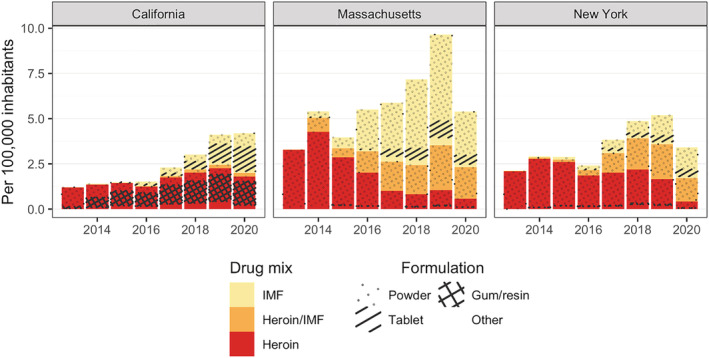
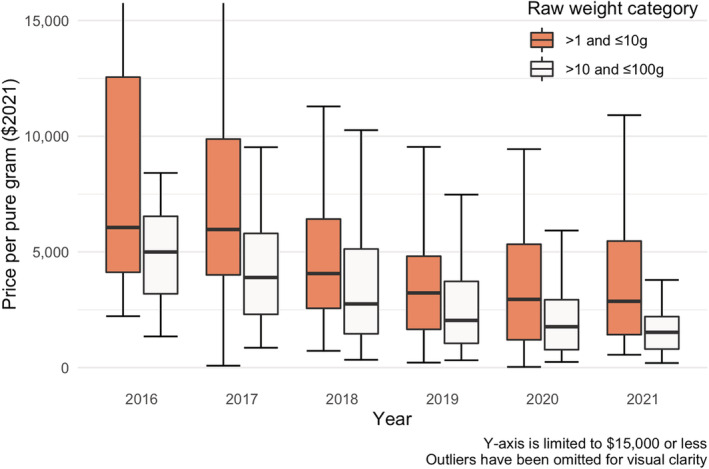
From 2013 to 2021, the share of heroin and/or IMF observations mentioning IMF grew from near zero to more than two-thirds. The share of heroin observations also containing IMF grew from <1% to ~40%. There is important geographic variation: in California, most IMF seizures involved counterfeit tablets, whereas New York and Massachusetts largely involved powder formulation. The median price per pure gram of IMF powder sold at the >10 to ≤100 g level fell by more than 50% from 2016 to 2021; regression analyses suggested an average annual decline of 17% (P < 0.001). However, this price decline appears to have been driven by observations from the Northeast.
Since 2013, the illegally manufactured fentanyl problem in the United States has become more deadly and more diverse.
2020 年,在美国(美国)药物过量死亡病例中,有 60%提到了合成阿片类药物,主要是非法制造的芬太尼(IMF),各州之间存在显著差异,这与 IMF 供应的差异相吻合。然而,人们对美国的 IMF 市场以及其变化情况知之甚少。研究人员此前曾使用来自卧底可卡因、海洛因和甲基苯丙胺购买和缉获的数据,研究其使用情况和相关危害如何对价格和供应的变化做出反应。本分析使用美国缉毒局(DEA)的数据来回答两个问题:(i)“IMF 供应随时间和地域变化的程度如何?”以及(ii)“IMF 的调整后纯度价格发生了什么变化?”
我们使用了 2013 年至 2021 年期间来自美国缉毒局的系统检索毒品证据(STRIDE;现在的 STARLIMS)的 66713 个提到 IMF 和/或海洛因的观察结果的数据,使用描述性统计和可视化方法进行了分析。我们使用城市层面的固定效应估计了价格回归,检验了具有中低批发水平(>1 克至≤100 克;n=964)的 IMF 纯粉观察结果的纯度和价格信息的 IMF 仅粉末观察结果。
从 2013 年到 2021 年,提到 IMF 的海洛因和/或 IMF 观察结果的比例从几乎为零增加到三分之二以上。包含 IMF 的海洛因观察结果的比例也从<1%增加到~40%。存在重要的地域差异:在加利福尼亚州,大多数 IMF 缉获物涉及假冒片剂,而纽约州和马萨诸塞州则主要涉及粉末制剂。在>10 至≤100 克范围内销售的每克纯 IMF 粉末的中位数价格从 2016 年到 2021 年下降了 50%以上;回归分析表明,平均每年下降 17%(P<0.001)。然而,这种价格下降似乎是由来自东北部的观察结果驱动的。
自 2013 年以来,美国非法制造的芬太尼问题变得更加致命和多样化。