Department of Anesthesiology, Chronic Pain and Fatigue Research Center, University of Michigan, Ann Arbor, MI, United States.
Department of Obstetrics and Gynecology, NorthShore University HealthSystem, Evanston, IL, United States.
Pain. 2023 Jan 1;164(1):142-148. doi: 10.1097/j.pain.0000000000002676. Epub 2022 May 10.
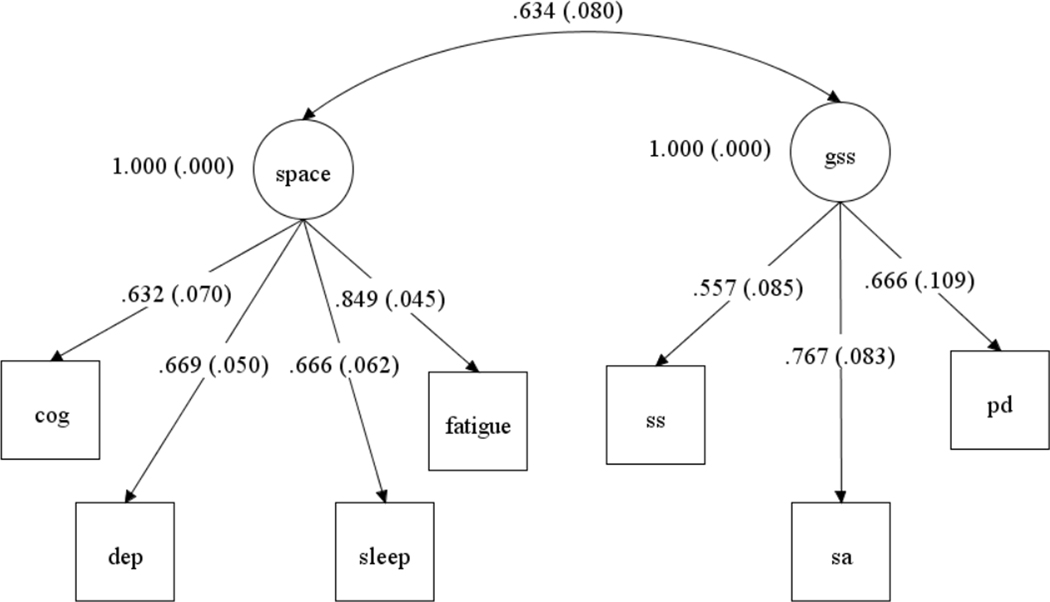
Dysmenorrhea is characterized by high rates of transition to chronic pain. In a previous study using structural equation modeling, we demonstrated that several symptom domains associated with the emerging concept of nociplastic pain can be described using 2 symptom groups: generalized sensory sensitivity (GSS; composed of widespread pain, interceptive sensitivity, and environmental sensitivity) and SPACE (composed of unrefreshing sleep, pain, affective disturbances, cognitive issues, and reduced energy). Here, we perform a secondary cross-sectional analysis examining the same symptoms groups in a cohort of patients with dysmenorrhea without a diagnosis of chronic pain. Our purpose is to determine if the same symptom patterns are apparent and if they are associated with the presence and severity of comorbid pain. Participants were 201 women with dysmenorrhea. We replicated the hypothesized 2-factor structure in this cohort (comparative fit index = 0.971 and root mean square error of approximation =0.055; 90% CI: 0.000-0.097). Generalized sensory sensitivity was associated with the severity of bladder, bowel, and overall pain in multivariable models including SPACE, patient age, and BMI (all β > 0.32, all P < 0.05). Sleep, pain, affective disturbances, cognitive issues, and reduced energy were associated with menstrual pain during nonsteroidal anti-inflammatory drug use, whereas GSS was associated with the same in the absence of nonsteroidal anti-inflammatory drug use (both P < 0.05). This 2-factor model of symptoms seems to be replicable and valid in a cohort of women at risk for developing chronic pain conditions. These symptom groups are promising potential markers of future pain chronification and may point to patients in need of earlier or more aggressive intervention.
痛经的特征是向慢性疼痛转变的发生率较高。在之前使用结构方程模型的研究中,我们证明了与新兴的伤害感受性疼痛概念相关的几个症状领域可以用 2 个症状组来描述:全身感觉敏化(由广泛疼痛、拦截性敏感和环境敏感组成)和 SPACE(由睡眠质量差、疼痛、情绪障碍、认知问题和能量减少组成)。在这里,我们进行了一项横断面分析,检查了无慢性疼痛诊断的痛经患者队列中的相同症状组。我们的目的是确定是否存在相同的症状模式,以及它们是否与共病疼痛的存在和严重程度有关。参与者为 201 名痛经女性。在该队列中复制了假设的 2 因素结构(比较拟合指数=0.971,均方根误差近似值=0.055;90%置信区间:0.000-0.097)。全身感觉敏化与膀胱、肠道和整体疼痛的严重程度相关,在包括 SPACE、患者年龄和 BMI 的多变量模型中(所有β>0.32,所有 P<0.05)。睡眠、疼痛、情绪障碍、认知问题和能量减少与非甾体抗炎药使用期间的月经痛相关,而 GSS 与非甾体抗炎药使用期间的月经痛相关(均 P<0.05)。在有发生慢性疼痛疾病风险的女性队列中,这种症状的 2 因素模型似乎是可复制和有效的。这些症状组是未来疼痛慢性化的有希望的潜在标志物,可能指向需要更早或更积极干预的患者。