Department of Chemistry, Imperial College London, Molecular Sciences Research Hub, 82 Wood Lane, White City Campus, London W12 0BZ, UK.
School of Biomedical Engineering & Imaging Sciences, King's College London, 4th Floor Lambeth Wing, St Thomas' Hospital, London SE1 7EH, UK.
Inorg Chem. 2022 May 23;61(20):8000-8014. doi: 10.1021/acs.inorgchem.2c00693. Epub 2022 May 11.
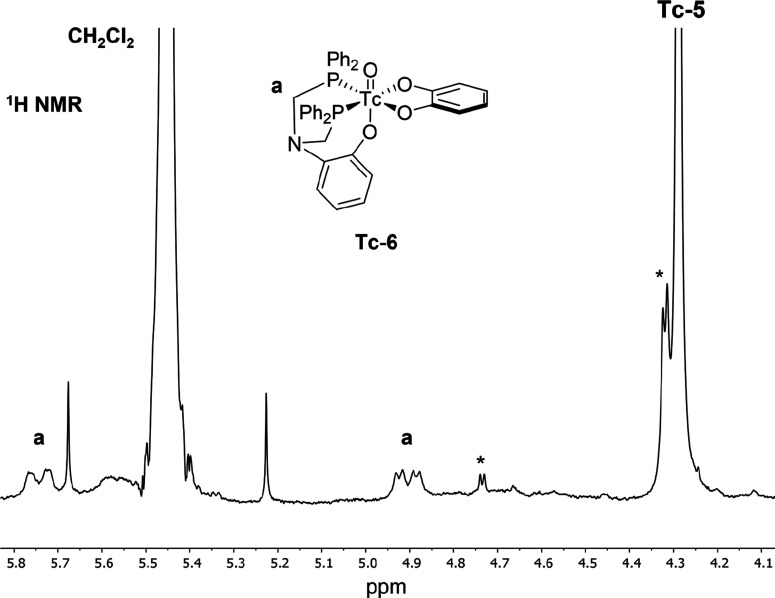
N-Triphos derivatives (NP, R = alkyl, aryl) and asymmetric variants (NPX, R' = alkyl, aryl, X = OH, NR, NRR') are an underexplored class of tuneable, tripodal ligands in relation to the coordination chemistry of Re and Tc for biomedical applications. Mixed-ligand approaches are a flexible synthetic route to obtain Tc complexes of differing core structures and physicochemical properties. Reaction of the NP ligand with the Re(V) oxo precursor [ReOCl(PPh)] generated the bidentate complex [ReOCl(κ-NPOH)], which possesses an unusual AA'BB'XX' spin system with a characteristic second-order NMR lineshape that is sensitive to the bi- or tridentate nature of the coordinating diphosphine unit. The use of the asymmetric NPOH ligand resulted in the formation of both bidentate and tridentate products depending on the presence of base. The tridentate Re(V) complex [ReOCl(κ-NPO)] has provided the basis of a new reactive "metal-fragment" for further functionalization in [3 + 2] mixed-ligand complexes. The synthesis of [3 + 2] complexes with catechol-based π-donors could also be achieved under one-pot, single-step conditions from Re(V) oxo precursors. Analogous complexes can also be synthesized from suitable Tc(V) precursors, and these complexes have been shown to exhibit highly similar structural properties through spectroscopic and chromatographic analysis. However, a tendency for the {MO} core to undergo hydrolysis to the {MO} core has been observed both in the case of M = Re and markedly for M = Tc complexes. It is likely that controlling this pathway will be critical to the generation of further stable Tc(V) derivatives.
N-三膦衍生物(NP,R = 烷基,芳基)和不对称变体(NPX,R' = 烷基,芳基,X = OH,NR,NRR')是一类未充分探索的可调三脚架配体,与 Re 和 Tc 的配位化学有关,可用于生物医学应用。混合配体方法是获得具有不同核心结构和物理化学性质的 Tc 配合物的灵活合成途径。NP 配体与 Re(V) 氧前体[ReOCl(PPh)]反应生成双齿配合物[ReOCl(κ-NPOH)],其具有不寻常的 AA'BB'XX'自旋系统,具有特征的二级 NMR 线宽,对配位双膦单元的双齿或三齿性质敏感。不对称 NPOH 配体的使用取决于碱的存在与否,导致形成双齿和三齿产物。三齿 Re(V) 配合物[ReOCl(κ-NPO)]为进一步官能化提供了新的反应性“金属片段”,用于[3 + 2]混合配体配合物。在 Re(V) 氧前体存在下,也可以通过一锅一步条件合成具有儿茶酚基π-供体的[3 + 2]配合物。类似的配合物也可以由合适的 Tc(V) 前体制备,并且通过光谱和色谱分析表明,这些配合物具有高度相似的结构性质。然而,已经观察到{MO}核在 Re 和 Tc 配合物的情况下都倾向于水解为{MO}核。控制这种途径对于生成进一步稳定的 Tc(V)衍生物可能至关重要。