Department of Pharmaceutics, School of Pharmacy, University of Washington, Seattle, Washington (A.S.Y., F.S., N.I.); Department of Drug Metabolism and Pharmacokinetics, Genentech, Inc., South San Francisco, California (M.K., S.W., J.R.K.); and Department of Medicine, University of Washington, Seattle, Washington (J.K.A.).
Department of Pharmaceutics, School of Pharmacy, University of Washington, Seattle, Washington (A.S.Y., F.S., N.I.); Department of Drug Metabolism and Pharmacokinetics, Genentech, Inc., South San Francisco, California (M.K., S.W., J.R.K.); and Department of Medicine, University of Washington, Seattle, Washington (J.K.A.)
Drug Metab Dispos. 2022 Jul;50(7):1042-1052. doi: 10.1124/dmd.122.000882. Epub 2022 May 11.
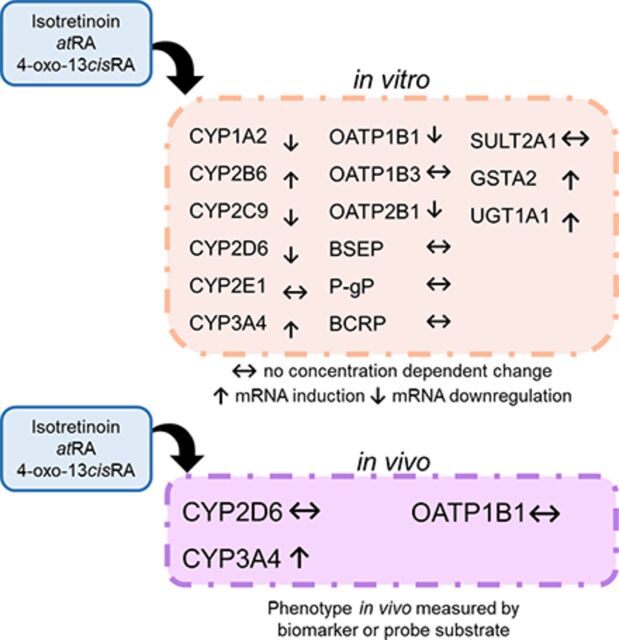
Isotretinoin [13--retinoic acid (13RA)] is widely used for the treatment of neuroblastoma and acne. It acts via regulating gene transcription through binding to retinoic acid receptors. Yet, the potential for isotretinoin to cause transcriptionally mediated drug-drug interactions (DDIs) has not been fully explored. We hypothesized that isotretinoin and its active metabolites all--retinoic acid (RA) and 4-oxo-13RA would alter the transcription of enzymes and transporters in the human liver via binding to nuclear receptors. The goal of this study was to define the DDI potential of isotretinoin and its metabolites resulting from transcriptional regulation of cytochrome P450 and transporter mRNAs. In human hepatocytes (n = 3), 13RA, RA, and 4-oxo-13RA decreased OATP1B1, CYP1A2, CYP2C9, and CYP2D6 mRNA and increased CYP2B6 and CYP3A4 mRNA in a concentration-dependent manner. The values for OATP1B1 mRNA downregulation ranged from 2 to 110 nM, with maximum effect ( ) ranging from 0.17- to 0.54-fold. Based on the and values and the known circulating concentrations of 13RA and its metabolites after isotretinoin dosing, a 55% decrease in OATP1B1 activity was predicted in vivo. In vivo DDI potential was evaluated clinically in participants dosed with isotretinoin for up to 32 weeks using coproporphyrin-I (CP-I) as an OATP1B1 biomarker. CP-I steady-state serum concentrations were unaltered following 2, 8, or 16 weeks of isotretinoin treatment. These data show that isotretinoin and its metabolites alter transcription of multiple enzymes and transporters in vitro, but translation of these changes to in vivo drug-drug interactions requires clinical evaluation for each enzyme. SIGNIFICANCE STATEMENT: Isotretinoin and its metabolites alter the mRNA expression of multiple cytochrome P450s (CYPs) and transporters in human hepatocytes, suggesting that isotretinoin may cause clinically significant drug-drug interactions (DDIs). Despite the observed changes in organic anion transporting polypeptide 1B1 (OATP1B1) mRNA in human hepatocytes, no clinical DDI was observed when measuring a biomarker, coproporphyrin-I. Further work is needed to determine whether these findings can be extrapolated to a lack of a DDI with CYP1A2, CYP2B6, and CYP2C9 substrates.
异维 A 酸[13--视黄酸(13RA)]被广泛用于治疗神经母细胞瘤和痤疮。它通过与视黄酸受体结合来调节基因转录,从而发挥作用。然而,异维 A 酸引起转录介导的药物相互作用(DDI)的潜力尚未得到充分探索。我们假设异维 A 酸及其活性代谢物全反式视黄酸(RA)和 4-氧代-13RA 通过与核受体结合,改变人肝内酶和转运体的转录。本研究的目的是通过细胞色素 P450 和转运体 mRNA 的转录调控来定义异维 A 酸及其代谢物的 DDI 潜力。在人原代肝细胞(n = 3)中,13RA、RA 和 4-氧代-13RA 以浓度依赖性方式降低 OATP1B1、CYP1A2、CYP2C9 和 CYP2D6 mRNA,并增加 CYP2B6 和 CYP3A4 mRNA。OATP1B1 mRNA 下调的 值范围为 2 至 110 nM,最大效应( )范围为 0.17 至 0.54 倍。基于 值和 值以及异维 A 酸给药后 13RA 及其代谢物的已知循环浓度,预测体内 OATP1B1 活性将降低 55%。在接受异维 A 酸治疗长达 32 周的参与者中,使用原卟啉 I(CP-I)作为 OATP1B1 生物标志物,临床评估了体内 DDI 潜力。CP-I 稳态血清浓度在异维 A 酸治疗 2、8 或 16 周后未改变。这些数据表明,异维 A 酸及其代谢物在体外改变多种酶和转运体的转录,但这些变化转化为体内药物相互作用需要对每种酶进行临床评估。意义声明:异维 A 酸及其代谢物改变人原代肝细胞中多种细胞色素 P450(CYP)和转运体的 mRNA 表达,表明异维 A 酸可能引起临床上显著的药物相互作用(DDI)。尽管在人原代肝细胞中观察到有机阴离子转运多肽 1B1(OATP1B1)mRNA 的变化,但在测量生物标志物原卟啉 I 时未观察到临床 DDI。需要进一步研究以确定这些发现是否可以推断为缺乏 CYP1A2、CYP2B6 和 CYP2C9 底物的 DDI。