Departmrnt of Orthopaedic Trauma, The Affiliated Chenzhou Hospital, Hengyang Medical School, University of South China, Hengyang, 423000, Hunan, China.
Department of Orthopaedics, Xiangya Hospital, Central South University, Changsha, 410008, Hunan, China.
BMC Musculoskelet Disord. 2022 May 11;23(1):441. doi: 10.1186/s12891-022-05377-8.
Hip fractures are anatomically classified in relation to femoral neck, intertrochanteric or subtrochanteric fractures. Simple hip fractures discussed in this study are femoral neck fractures or intertrochanteric fractures, which are the most common types of hip fractures. Controversy remains regarding the value of biochemical indices of thrombosis in elderly patients with fractures. A retrospective study was conducted to investigate the index admission data in blood draws of elderly patients with hip fractures and their high-risk factors for deep venous thrombosis (DVT). A nomogram prediction model for DVT was established to facilitate a rapid, accurate, and effective prediction based on the results.
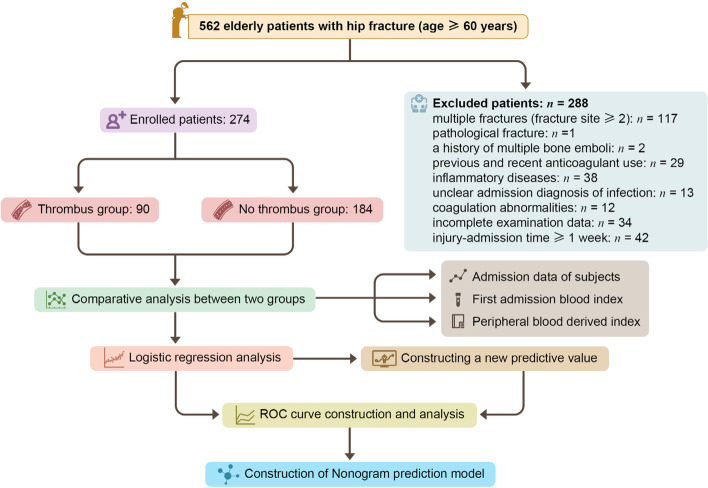
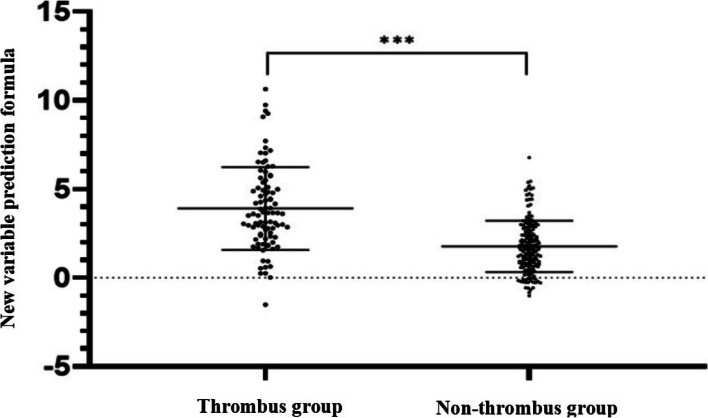
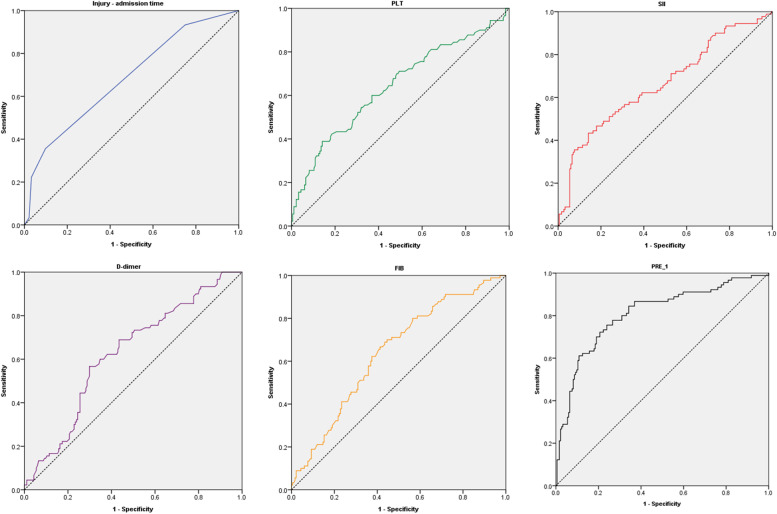
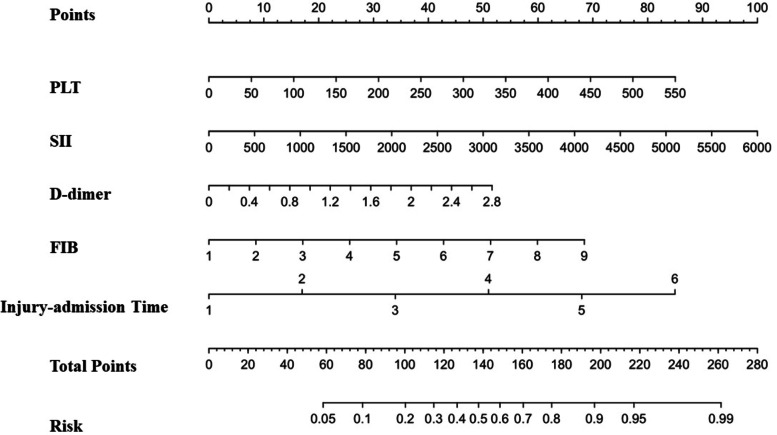
The data were based on 562 elderly patients undergoing hip fracture surgery, from whom 274 patients were selected for enrollment. The 274 patients were divided into two groups using preoperative vascular color Doppler ultrasonography. Chi-square tests, t-tests, and U tests were conducted, and logistic regression analysis was conducted showing different factors between the two groups. Independent risk factors with statistical significance (P < 0.05) were obtained, and the logistic regression equation and the new variable prediction probability_1 (PRE_1) were constructed. The receiver operating characteristic (ROC) curve of risk factors and PRE_1 was drawn to obtain the area under the curve (AUC) and truncation value of each risk factor. Finally, a nomogram prediction model was constructed using the R programming language to calculate the concordance index (C-index).
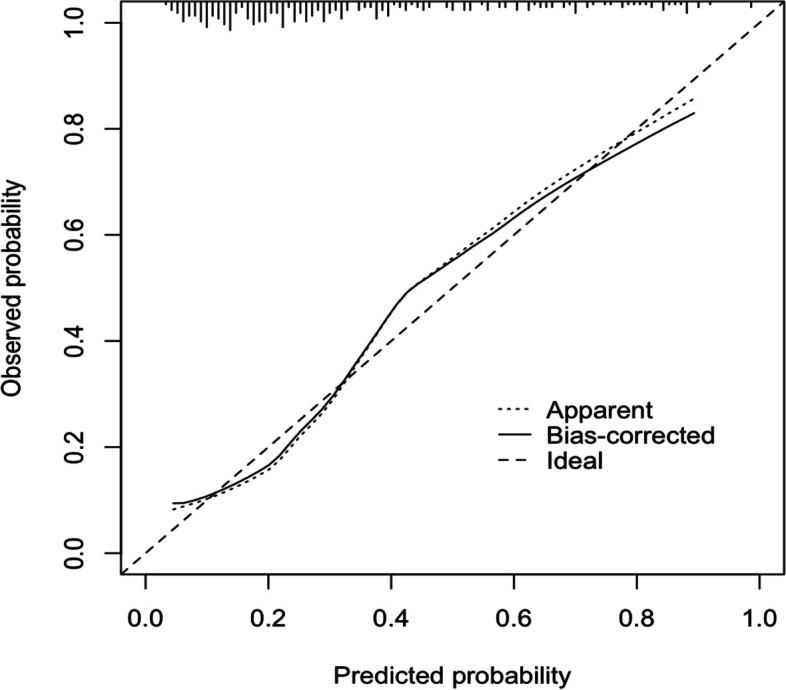
Time from injury to hospitalization, platelet (PLT) count, D-dimer level, fibrinogen (FIB) level, and systemic immune-inflammatory index (SII) score were independent risk factors for preoperative DVT in elderly patients with hip fractures. The logistic regression equation and PRE_1 were constructed by combining the above factors. ROC analysis showed that the area under the curve for PRE_1 (AUC = 0.808) was greater than that of the other factors. The sensitivity of PRE_1 (sensitivity = 0.756) was also higher than that of the other factors, and the specificity of PRE_1 (specificity = 0.756) was higher than that of two other factors. Moreover, a predictive nomogram was established, and the results showed a high consistency between the actual probability and the predicted probability (C-index = 0.808), indicating a high predictive value in fractures accompanied by DVT.
This study confirmed that SII score could be used as a risk factor in the prediction of DVT occurrence. A nomogram prediction model was constructed by combining 5 independent risk factors: time from injury to admission, PLT count, D-dimer level, FIB level, and SII score, which had high predictive values for fractures accompanied by DVT. This model use is limited to simple hip fracture.
髋部骨折在解剖学上与股骨颈、转子间或转子下骨折有关。本研究中讨论的单纯髋部骨折是股骨颈骨折或转子间骨折,这是最常见的髋部骨折类型。关于血栓形成的生化指标在老年骨折患者中的价值仍存在争议。本研究进行了一项回顾性研究,旨在调查老年髋部骨折患者入院时的血液检测指标及其深静脉血栓形成(DVT)的高危因素。建立了列线图预测模型,以便根据结果进行快速、准确和有效的预测。
数据基于 562 例接受髋部骨折手术的老年患者,其中 274 例患者入选。使用术前血管彩色多普勒超声对 274 例患者进行分组。进行卡方检验、t 检验和 U 检验,对两组间不同因素进行 logistic 回归分析。得出有统计学意义的独立危险因素(P<0.05),构建 logistic 回归方程和新变量预测概率_1(PRE_1)。绘制危险因素和 PRE_1 的受试者工作特征(ROC)曲线,获得各危险因素的曲线下面积(AUC)和截断值。最后,使用 R 编程语言构建列线图预测模型,计算一致性指数(C-index)。
从受伤到住院的时间、血小板(PLT)计数、D-二聚体水平、纤维蛋白原(FIB)水平和全身免疫炎症指数(SII)评分是老年髋部骨折患者术前 DVT 的独立危险因素。通过结合上述因素构建了 logistic 回归方程和 PRE_1。ROC 分析表明,PRE_1 的 AUC(AUC=0.808)大于其他因素。PRE_1 的灵敏度(灵敏度=0.756)也高于其他因素,而 PRE_1 的特异性(特异性=0.756)高于其他两个因素。此外,建立了预测列线图,结果表明实际概率与预测概率之间具有高度一致性(C-index=0.808),表明该模型对伴有 DVT 的骨折具有较高的预测价值。
本研究证实 SII 评分可作为 DVT 发生的预测危险因素。通过结合 5 个独立危险因素:受伤到入院的时间、PLT 计数、D-二聚体水平、FIB 水平和 SII 评分,构建了一个对伴有 DVT 的骨折具有较高预测价值的列线图预测模型。该模型的使用仅限于单纯髋部骨折。