Department of Epidemiology, GROW School for Oncology and Reproduction, Maastricht University Medical Center+, P.O. BOX 616, 6200 MD, Maastricht, The Netherlands.
Department of Pathology, GROW School for Oncology and Reproduction, Maastricht University Medical Center+, P.O. BOX 5800, 6202 AZ, Maastricht, The Netherlands.
J Cancer Res Clin Oncol. 2022 Oct;148(10):2723-2742. doi: 10.1007/s00432-022-04019-9. Epub 2022 May 11.
KRAS mutations (KRAS), PIK3CA, BRAF, and mismatch repair deficiency (dMMR) have been associated with the Warburg-effect. We previously observed differential associations between energy balance-related factors (BMI, clothing-size, physical activity) and colorectal cancer (CRC) subtypes based on the Warburg-effect. We now investigated whether associations between energy balance-related factors and risk of CRC differ between subgroups based on mutation and MMR status.
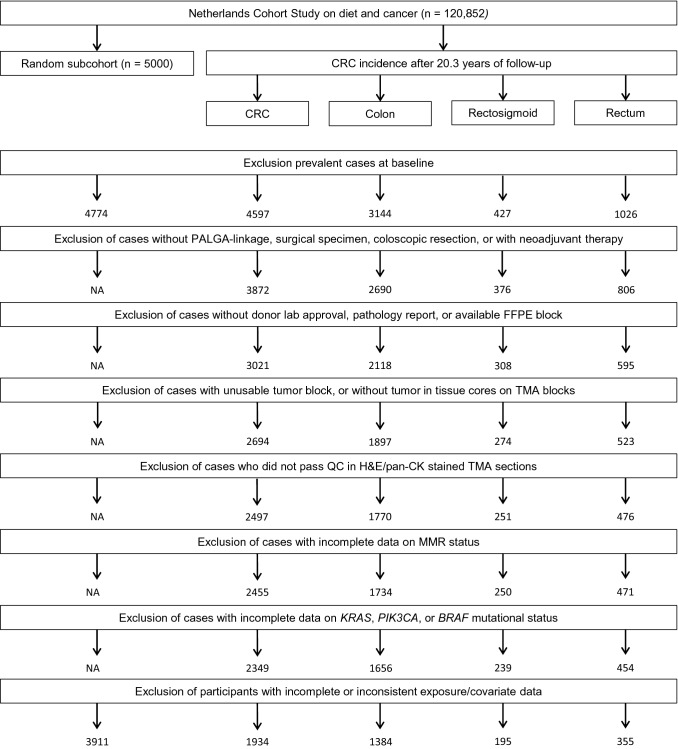
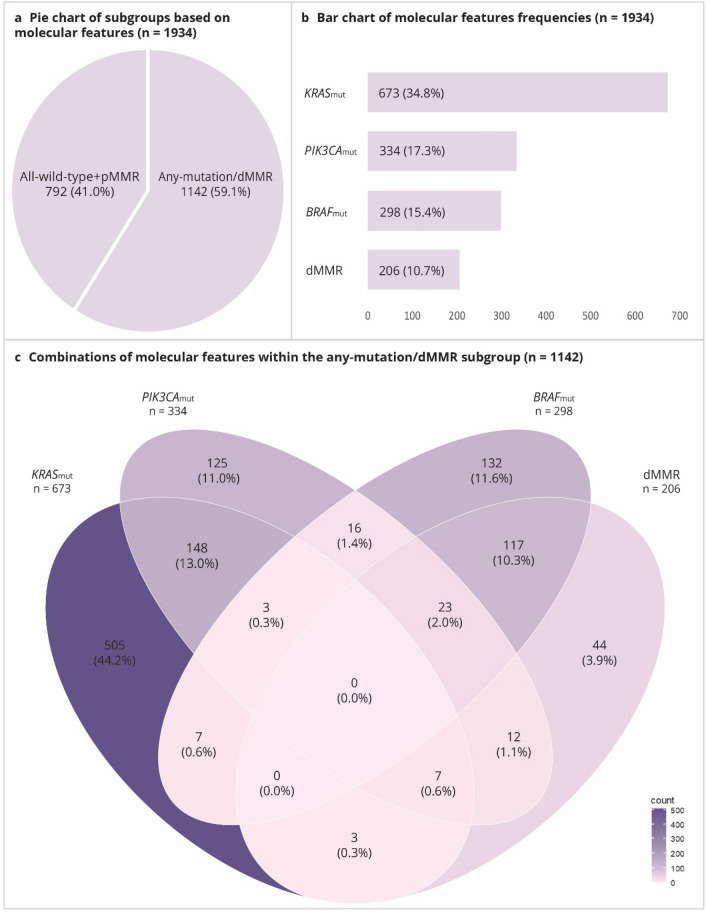
Information on molecular features was available for 2349 incident CRC cases within the Netherlands Cohort Study (NLCS), with complete covariate data available for 1934 cases and 3911 subcohort members. Multivariable-adjusted Cox-regression was used to estimate associations of energy balance-related factors with risk of CRC based on individual molecular features (KRAS; PIK3CA; BRAF; dMMR) and combinations thereof (all-wild-type + MMR-proficient (pMMR); any-mutation/dMMR).
In men, BMI and clothing-size were positively associated with risk of colon, but not rectal cancer, regardless of molecular features subgroups; the strongest associations were observed for PIK3CA colon cancer. In women, however, BMI and clothing-size were only associated with risk of KRAS colon cancer (p-heterogeneity = 0.008). Inverse associations of non-occupational physical activity with risk of colon cancer were strongest for any-mutation/dMMR tumors in men and women, and specifically for PIK3CA tumors in women. Occupational physical activity was inversely associated with both combination subgroups of colon cancer in men.
In men, associations did not vary according to molecular features. In women, a role of KRAS mutations in the etiological pathway between adiposity and colon cancer is suggested, and of PIK3CA mutations between physical activity and colon cancer.
KRAS 突变(KRAS)、PIK3CA、BRAF 和错配修复缺陷(dMMR)与瓦伯格效应有关。我们之前观察到,基于瓦伯格效应,能量平衡相关因素(BMI、衣服尺码、体力活动)与结直肠癌(CRC)亚型之间存在不同的关联。现在,我们研究了基于突变和 MMR 状态,能量平衡相关因素与 CRC 风险之间的关联是否在亚组之间存在差异。
荷兰队列研究(NLCS)中 2349 例结直肠癌病例的分子特征信息可用,其中 1934 例病例和 3911 名亚组成员有完整的协变量数据。多变量调整的 Cox 回归用于估计基于个体分子特征(KRAS;PIK3CA;BRAF;dMMR)和它们的组合(所有野生型+MMR 功能正常(pMMR);任何突变/dMMR)的能量平衡相关因素与 CRC 风险之间的关联。
在男性中,BMI 和衣服尺码与结直肠癌(但不是直肠癌)的风险呈正相关,无论分子特征亚组如何;最强的关联是 PIK3CA 结直肠癌。然而,在女性中,BMI 和衣服尺码仅与 KRAS 结直肠癌的风险相关(p 异质性=0.008)。非职业体力活动与结直肠癌风险的负相关,在男性和女性中最强的是任何突变/dMMR 肿瘤,特别是在女性中是 PIK3CA 肿瘤。职业体力活动与男性结直肠癌的两个组合亚组均呈负相关。
在男性中,关联不随分子特征而变化。在女性中,提示 KRAS 突变在肥胖与结肠癌之间的发病途径中起作用,PIK3CA 突变在体力活动与结肠癌之间起作用。