Zhang Chengchun, Gao Meihong, Liu Guangyuan, Zheng Yihua, Xue Chen, Shen Chun
Key Laboratory of Bionic Engineering (Ministry of Education), Jilin University, Changchun, China.
State Key Laboratory of Automotive Simulation and Control, Jilin University, Changchun, China.
Front Bioeng Biotechnol. 2022 Apr 25;10:742437. doi: 10.3389/fbioe.2022.742437. eCollection 2022.
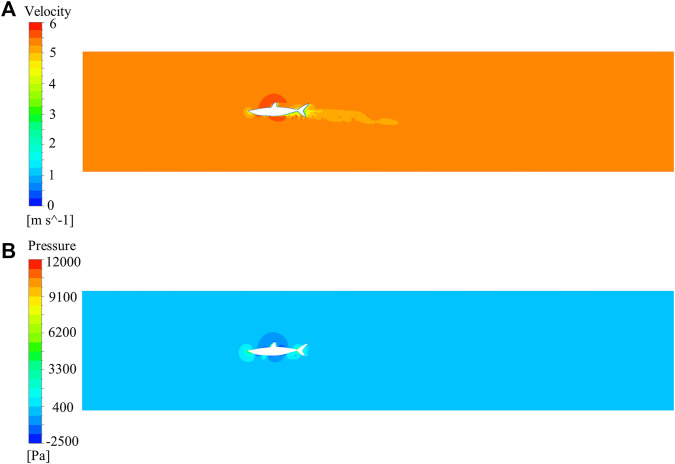
The aim of this study was to reveal potential relationship between the main flow field around a shortfin mako shark and the surface morphology of shark skin. Firstly, a numerical simulation using the large eddy simulation (LES) method was conducted to obtain the main flow field around a smooth shark model. Then, the surface morphology characteristics of a shark () at different positions were characterized by scanning electron microscope (SEM), which showed that the morphology, riblet size, and density of scales at different positions on the shark were significantly different. At positions where the surfaces face into the water flow direction (i.e., nose and leading edge of fins), the scales were flat and round, with a lower density, and the pressure or wall shear stress (WSS) was greater. Scales with three longitudinal riblets ending in three tips were found on the middle and trailing edges of the first dorsal fin and caudal fin, where water flow states progress from transitional to turbulent. The ranges of the ratio of riblet depth to spacing (RD/RS) in the anterior zone, middle zone and posterior zone of the shark were 0.05-0.17, 0.08-0.23, and 0.32-0.33, respectively. The riblet angle generally followed the flow direction, but it varied across different areas of the body. The turbulence intensity increased gradually across the first dorsal fin, pectoral fin, caudal fin, and the shark body overall. In summary, it was found that the microstructure riblets on the shark skin surface, generally thought to be drag reduction structures, were only located in transitional and turbulent regions at the middle and trailing edge of the shark body and fin surfaces, and there were almost no microstructural grooves in the laminar flow regions along the leading edge. These findings can provide design guidance for engineering applications of bionic riblet surfaces. Riblets placed in transitional and fully turbulent regions can be used to effectively reduce drag. The riblet direction should be consistent with the direction of flow.
本研究的目的是揭示短鳍灰鲭鲨周围的主流场与鲨鱼皮肤表面形态之间的潜在关系。首先,采用大涡模拟(LES)方法进行数值模拟,以获得光滑鲨鱼模型周围的主流场。然后,用扫描电子显微镜(SEM)对鲨鱼不同位置的表面形态特征进行表征,结果表明鲨鱼不同位置的形态、脊状微结构尺寸和鳞片密度存在显著差异。在表面朝向水流方向的位置(即鼻子和鳍的前缘),鳞片扁平且呈圆形,密度较低,压力或壁面剪应力(WSS)较大。在第一背鳍和尾鳍的中部和后缘发现了带有三个纵向脊状微结构且末端为三个尖端的鳞片,此处水流状态从过渡流发展为湍流。鲨鱼前部区域、中部区域和后部区域的脊状微结构深度与间距之比(RD/RS)范围分别为0.05 - 0.17、0.08 - 0.23和0.32 - 0.33。脊状微结构的角度通常沿流动方向,但在身体的不同区域有所变化。整个第一背鳍、胸鳍、尾鳍以及鲨鱼身体的湍流强度逐渐增加。总之,研究发现鲨鱼皮肤表面的微观结构脊状微结构通常被认为是减阻结构,仅位于鲨鱼身体和鳍表面中部和后缘的过渡流和湍流区域,沿前缘的层流区域几乎没有微观结构凹槽。这些发现可为仿生脊状微结构表面的工程应用提供设计指导。置于过渡流和完全湍流区域的脊状微结构可有效减阻。脊状微结构的方向应与流动方向一致。