Luo Manli, Wu Songmei, Ma Yan, Liang Hong, Luo Yage, Gu Wentao, Fan Lijuan, Hao Yang, Li Haiting, Xing Linbo
Luoyang Orthopedic Hospital of Henan Province (Orthopedic Hospital of Henan Province), Luoyang, China.
Henan Provincial Rehabilitation Hospital, Luoyang, China.
Front Genet. 2022 Apr 25;13:872253. doi: 10.3389/fgene.2022.872253. eCollection 2022.
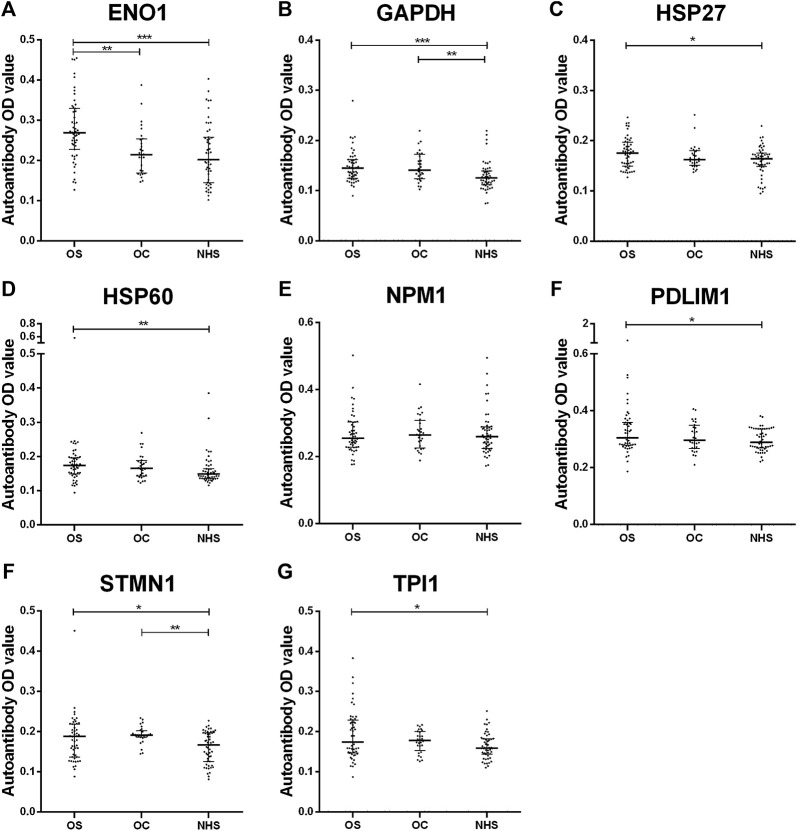
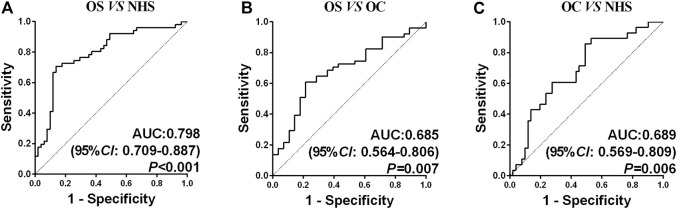
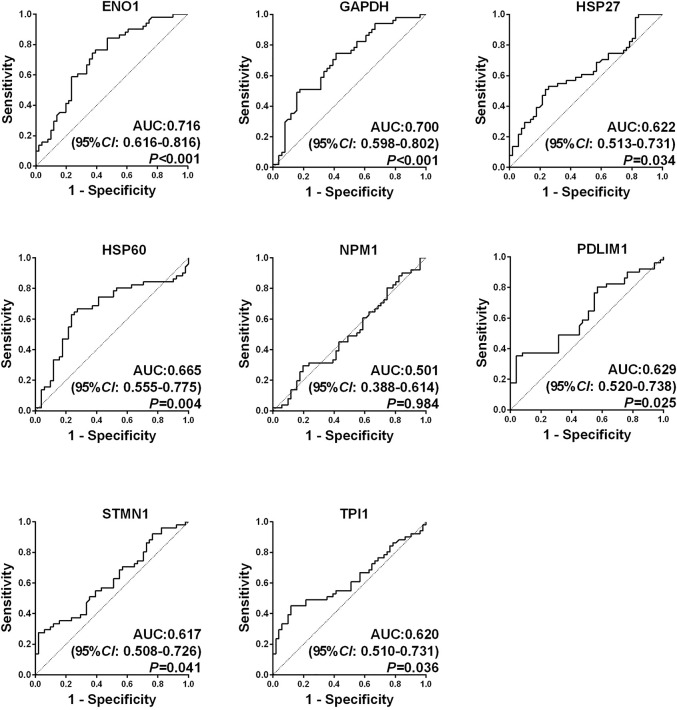
The aim of this study was to identify a panel of candidate autoantibodies against tumor-associated antigens in the detection of osteosarcoma (OS) so as to provide a theoretical basis for constructing a non-invasive serological diagnosis method in early immunodiagnosis of OS. The serological proteome analysis (SERPA) approach was used to select candidate anti-TAA autoantibodies. Then, indirect enzyme-linked immunosorbent assay (ELISA) was used to verify the expression levels of eight candidate autoantibodies in the serum of 51 OS cases, 28 osteochondroma (OC), and 51 normal human sera (NHS). The rank-sum test was used to compare the content of eight autoantibodies in the sera of three groups. The diagnostic value of each indicator for OS was analyzed by an ROC curve. Differential autoantibodies between OS and NHS were screened. Then, a binary logistic regression model was used to establish a prediction logistical regression model. Through ELISA, the expression levels of seven autoantibodies (ENO1, GAPDH, HSP27, HSP60, PDLIM1, STMN1, and TPI1) in OS patients were identified higher than those in healthy patients ( < 0.05). By establishing a binary logistic regression predictive model, the optimal panel including three anti-TAAs (ENO1, GAPDH, and TPI1) autoantibodies was screened out. The sensitivity, specificity, Youden index, accuracy, and AUC of diagnosis of OS were 70.59%, 86.27%, 0.5686, 78.43%, and 0.798, respectively. The results proved that through establishing a predictive model, an optimal panel of autoantibodies could help detect OS from OC or NHS at an early stage, which could be used as a promising and powerful tool in clinical practice.
本研究旨在鉴定一组针对骨肉瘤(OS)相关肿瘤抗原的自身抗体,为构建OS早期免疫诊断的非侵入性血清学诊断方法提供理论依据。采用血清蛋白质组分析(SERPA)方法筛选候选抗肿瘤相关抗原(TAA)自身抗体。然后,采用间接酶联免疫吸附测定(ELISA)法检测51例骨肉瘤患者、28例骨软骨瘤(OC)患者及51例正常人血清(NHS)中8种候选自身抗体的表达水平。采用秩和检验比较三组血清中8种自身抗体的含量。通过ROC曲线分析各指标对骨肉瘤的诊断价值,筛选骨肉瘤与正常人血清间的差异自身抗体,进而采用二元逻辑回归模型建立预测逻辑回归模型。通过ELISA法鉴定出骨肉瘤患者血清中7种自身抗体(烯醇化酶1(ENO1)、甘油醛-3-磷酸脱氢酶(GAPDH)、热休克蛋白27(HSP27)、热休克蛋白60(HSP60)、PDLIM1蛋白、Stathmin 1(STMN1)和磷酸丙糖异构酶1(TPI1))的表达水平高于健康患者(P<0.05)。通过建立二元逻辑回归预测模型,筛选出包含3种抗TAA自身抗体(ENO1、GAPDH和TPI1)的最佳组合。骨肉瘤诊断的灵敏度、特异度、约登指数、准确度及曲线下面积(AUC)分别为70.59%、86.27%、0.5686、78.43%和0.798。结果证明,通过建立预测模型,一组最佳自身抗体组合有助于早期从骨软骨瘤或正常人血清中检测出骨肉瘤,有望成为临床实践中有价值的有力工具。