Guerra-Que Zenaida, Pérez-Vidal Hermicenda, Torres-Torres G, Arévalo-Pérez Juan Carlos, Silahua Pavón Adib Abiu, Cervantes-Uribe Adrian, Espinosa de Los Monteros A, Lunagómez-Rocha Ma Antonia
Laboratory of Catalytic Nanomaterials Applied to the Development of Energy Sources and Environmental Remediation, Applied Science and Technology Research Center of Tabasco (CICTAT), Juarez Autonomous University of Tabasco, DACB Road Km. 1 Cunduacan-Jalpa de Mendez Cunduacan Tabasco C.P. 86690 Mexico
RSC Adv. 2019 Mar 13;9(15):8463-8479. doi: 10.1039/c9ra00509a. eCollection 2019 Mar 12.
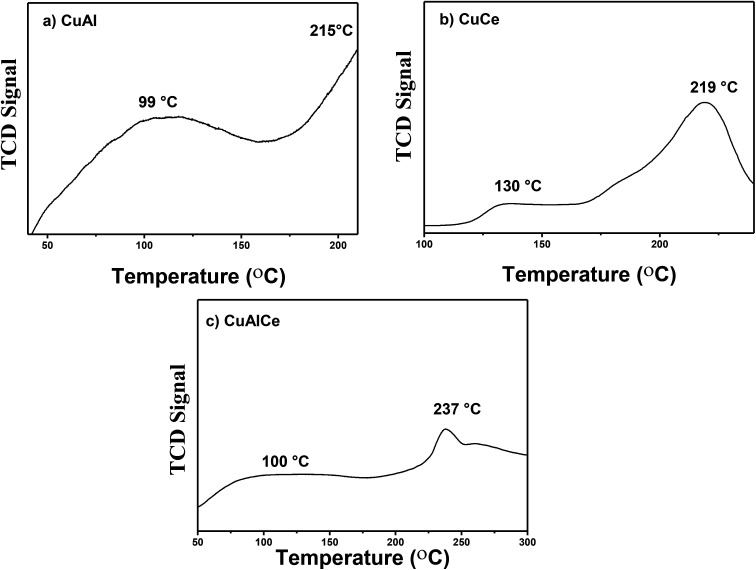
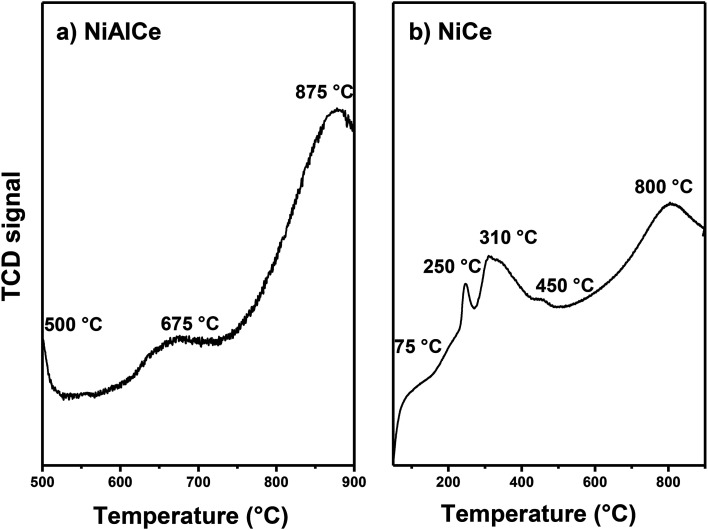
Cu, Ni, CuO and NiO catalysts, prepared by wet impregnation with urea and supported on γ-AlO, CeO, and AlO-CeO, were evaluated for Catalytic Wet Air Oxidation (CWAO) of phenol in a batch reactor under a milder condition (120 °C and 10 bar O). The synthesized samples, at their calcined and/or their reduced form, were characterized by XRD, H-TPR, N adsorption-desorption, SEM-EDS and DR-UV-Vis to explain the differences observed in their catalytic activity towards the studied reaction. The influence of the support on the efficiency of CWAO of phenol at 120 °C and 10 bar of pure oxygen has been examined and compared over nickel and copper species. The SEM-EDS results reveal that the spherical crystalline Cu and Ni were successfully deposited on the surface of γ-AlO, CeO, AlO-CeO within 16-90 nm and that they were highly homogeneously dispersed. It was found that catalysts prepared from impregnation solutions of Cu(NO)·3HO and Ni(NO)·6HO with urea addition had different textural characteristics and degrees of dispersion of Cu and Ni species. The urea addition in the traditional wet impregnation method was essential to improve the reducibility and degree of dispersion in Ni, and to a lesser extent, in Cu. According to the characterization analysis of H-TPR and UV-VIS RD a structure-activity relationship can be determined. The chemical oxygen demand (COD) and GC analyses confirmed the effect of calcined and reduced species for Cu and Ni applied to the catalytic oxidation of phenol, showing their significant impact in the final performance of the catalyst.
通过尿素湿浸渍法制备并负载于γ-Al₂O₃、CeO₂以及Al₂O₃-CeO₂上的铜、镍、氧化铜和氧化镍催化剂,在间歇式反应器中于较温和条件(120℃和10 bar O₂)下对苯酚的催化湿式空气氧化(CWAO)进行了评估。对合成后的样品在其煅烧态和/或还原态下进行了X射线衍射(XRD)、氢气程序升温还原(H-TPR)、氮气吸附-脱附、扫描电子显微镜-能谱分析(SEM-EDS)以及漫反射紫外可见光谱(DR-UV-Vis)表征,以解释观察到的它们对所研究反应的催化活性差异。研究并比较了载体对120℃和10 bar纯氧条件下苯酚CWAO效率的影响,涉及镍和铜物种。SEM-EDS结果表明,球形结晶的铜和镍成功沉积在γ-Al₂O₃、CeO₂、Al₂O₃-CeO₂表面,粒径在16 - 90 nm之间,且高度均匀分散。发现由添加尿素的Cu(NO₃)₂·3H₂O和Ni(NO₃)₂·6H₂O浸渍溶液制备的催化剂具有不同的织构特征以及铜和镍物种的分散程度。在传统湿浸渍法中添加尿素对于提高镍的还原度和分散程度至关重要,对铜的影响程度较小。根据H-TPR和UV-VIS RD的表征分析,可以确定结构-活性关系。化学需氧量(COD)和气相色谱(GC)分析证实了煅烧态和还原态的铜和镍物种对苯酚催化氧化的作用,显示出它们对催化剂最终性能的显著影响。