Cassell Kelsie, Zipfel Casey M, Bansal Shweta, Weinberger Daniel M
Department of Epidemiology of Microbial Diseases, Yale School of Public Health, New Haven CT, USA.
Department of Biology, Georgetown University, Washington DC, USA.
medRxiv. 2022 Apr 28:2022.04.26.22274301. doi: 10.1101/2022.04.26.22274301.
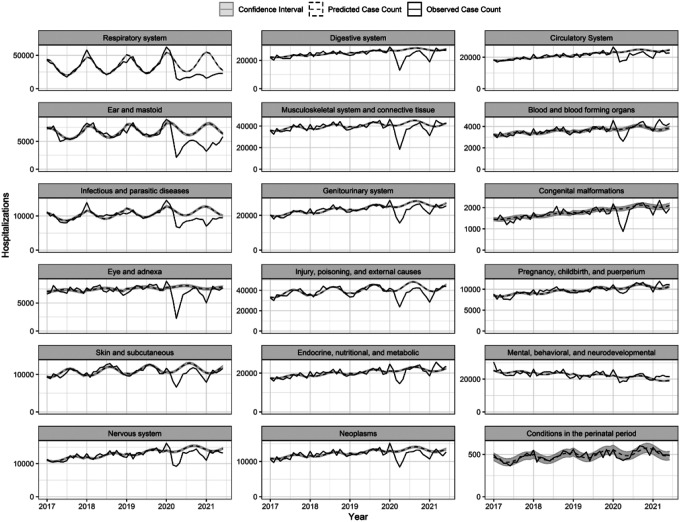
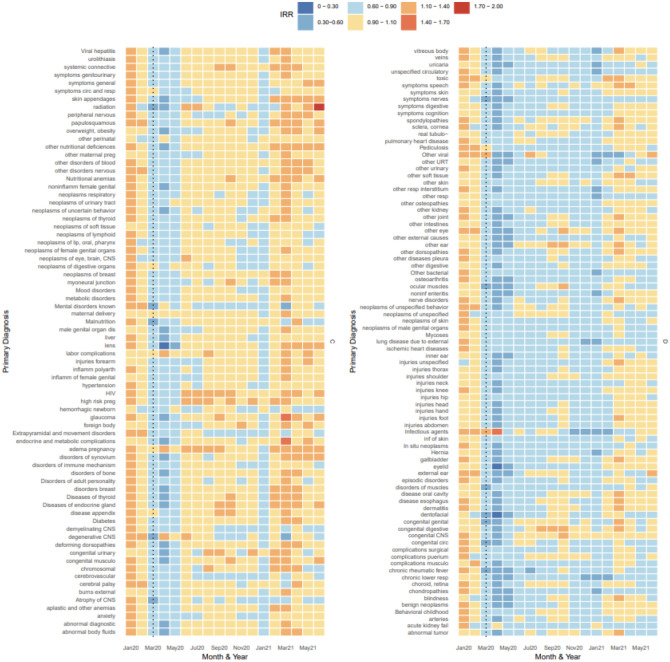
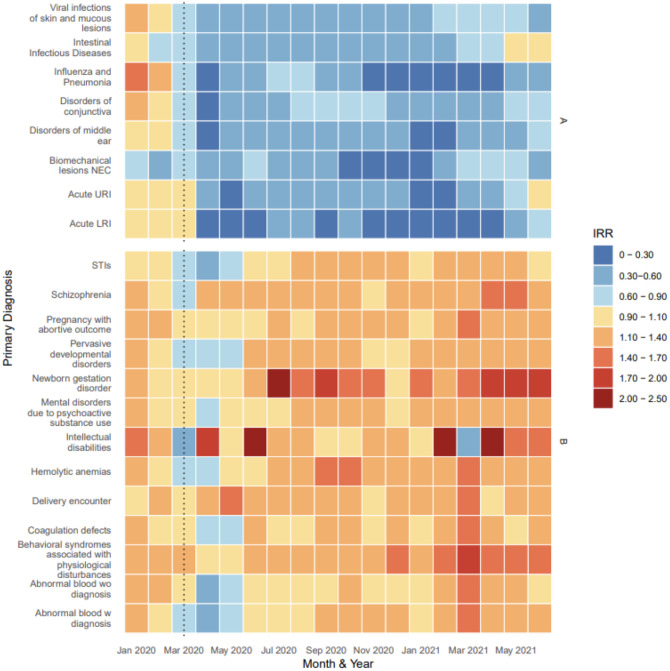
COVID-19 pandemic-related shifts in healthcare utilization, in combination with trends in non-COVID-19 disease transmission and NPI use, had clear impacts on infectious and chronic disease hospitalization rates. Using a national healthcare billing database (C19RDB), we estimated the monthly incidence rate ratio of hospitalizations between March 2020 and June 2021 according to 19 ICD-10 diagnostic chapters and 189 subchapters. The majority of hospitalization causes showed an immediate decline in incidence during March 2020. Hospitalizations for diagnoses such as reproductive neoplasms, hypertension, and diabetes returned to pre-pandemic norms in incidence during late 2020 and early 2021, while others, like those for infectious respiratory disease, never returned to pre-pandemic norms. These results are crucial for contextualizing future research, particularly time series analyses, utilizing surveillance and hospitalization data for non-COVID-19 disease. Our assessment of subchapter level primary hospitalization codes offers new insight into trends among less frequent causes of hospitalization during the COVID-19 pandemic.
与新冠疫情相关的医疗保健利用变化,再加上非新冠疾病传播趋势和非药物干预措施的使用情况,对传染病和慢性病住院率产生了明显影响。我们利用一个全国医疗计费数据库(C19RDB),根据19个国际疾病分类第十版(ICD-10)诊断章节和189个细分章节,估算了2020年3月至2021年6月期间住院治疗的月发病率比。大多数住院病因在2020年3月期间发病率立即下降。生殖系统肿瘤、高血压和糖尿病等诊断的住院率在2020年末和2021年初恢复到疫情前的发病水平,而其他疾病,如传染性呼吸道疾病的住院率则从未恢复到疫情前的水平。这些结果对于将未来研究(尤其是利用非新冠疾病监测和住院数据进行的时间序列分析)置于背景中至关重要。我们对细分章节一级主要住院编码的评估为了解新冠疫情期间不常见住院病因的趋势提供了新的视角。