Bai De, Chen Qin, Chai Yang, Ren Tianhua, Huang Caijuan, Ingram Ian D V, North Michael, Zheng Qiang, Xie Haibo
Department of Polymeric Materials & Engineering, College of Materials & Metallurgy, Guizhou University West Campus, Huaxi District Guiyang P. R. China 550025
Green Chemistry Centre of Excellence, Department of Chemistry, University of York York UK YO10 5DD.
RSC Adv. 2018 Oct 5;8(60):34297-34303. doi: 10.1039/c8ra07185c. eCollection 2018 Oct 4.
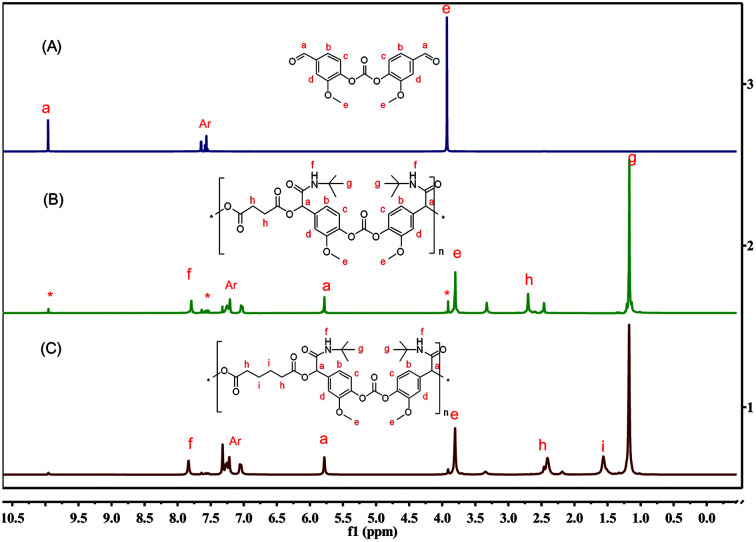
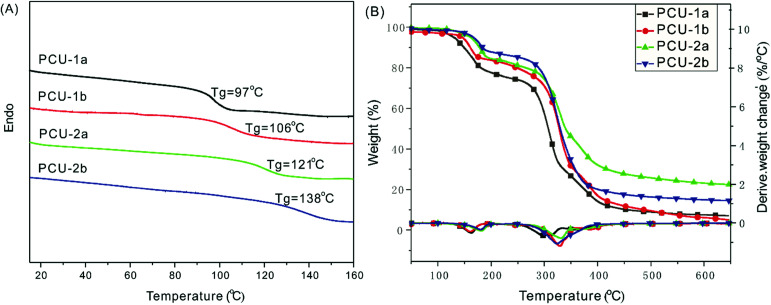
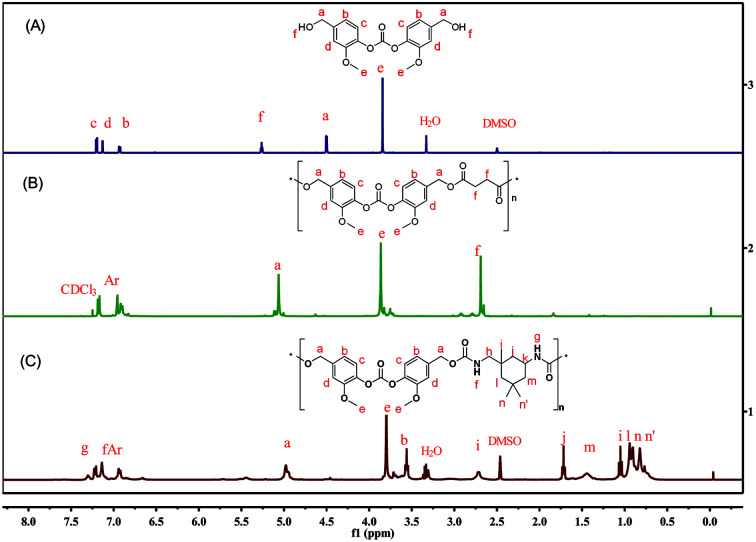
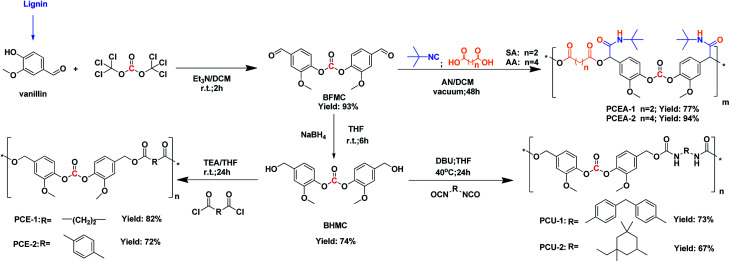
Vanillin has been regarded as one of the important biomass-based platform chemicals for aromatic polymers synthesis. Herein, novel symmetric bis(4-formyl-2-methoxyphenyl)carbonate (BFMC) and bis(4-(hydroxymethyl)-2-methoxyphenyl)carbonate (BHMC) polymeric monomers have been synthesized in high yields using vanillin as a raw chemical, which have been submitted for polymer synthesis well-established polymeric strategies. A new class of poly(carbonate ester)s oligomers with amide moieties in their side chain can be prepared by using the BFMC as one of monomers the Passerini three compound reaction (3CR). A new class of poly(carbonate ester)s oligomers and poly(carbonate urethane)s can be prepared reactions between BHMC with dicarboxylic acid chlorides and diisocyanates, respectively. Their structure have been confirmed by H NMR, C NMR and FTIR, and the gel permeation chromatograph (GPC) analysis shows that the Mn of poly(carbonate ester)s oligomers ranges from 3100 to 7900 with PDI between 1.31 and 1.65, and the Mn of poly(carbonate urethane)s ranges from 16 400 to 24 400 with PDI ranging from 1.36 to 2.17. The DSC analysis shows that the poly(carbonate ester)s oligomers have relative low ranging from 37.4 to 74.1 °C, and the poly(carbonate urethane)s have ranging from 97.3 to 138.3 °C, mainly correlating to the structure of dicarboxylic acid chlorides and diisocyanates used.
香草醛被视为用于合成芳香族聚合物的重要生物质基平台化学品之一。在此,以香草醛为原料,高产率合成了新型对称双(4 - 甲酰基 - 2 - 甲氧基苯基)碳酸酯(BFMC)和双(4 - (羟甲基) - 2 - 甲氧基苯基)碳酸酯(BHMC)聚合单体,并已采用成熟的聚合策略用于聚合物合成。通过使用BFMC作为单体之一,经帕塞里尼三组分反应(3CR),可制备一类新型的侧链带有酰胺基团的聚(碳酸酯)低聚物。分别通过BHMC与二羧酸氯化物和二异氰酸酯之间的反应,可制备一类新型的聚(碳酸酯)低聚物和聚(碳酸酯聚氨酯)。它们的结构已通过¹H NMR、¹³C NMR和FTIR得到证实,凝胶渗透色谱(GPC)分析表明,聚(碳酸酯)低聚物的数均分子量(Mn)在3100至7900之间,分散度(PDI)在1.31至1.65之间,聚(碳酸酯聚氨酯)的Mn在16400至24400之间,PDI在1.36至2.17之间。差示扫描量热法(DSC)分析表明,聚(碳酸酯)低聚物的玻璃化转变温度相对较低,在37.4至74.1℃之间,聚(碳酸酯聚氨酯)的玻璃化转变温度在97.3至138.3℃之间,这主要与所使用的二羧酸氯化物和二异氰酸酯的结构有关。