The Healthcare Improvement Studies Institute, University of Cambridge, Clifford Allbutt Building, Cambridge Biomedical Campus, Cambridge, CB2 0AH, UK.
Primary Care Unit, University of Cambridge, Strangeways Research Laboratory, Worts Causeway, Cambridge, CB1 8RN, UK.
Trials. 2022 May 12;23(1):394. doi: 10.1186/s13063-022-06308-7.
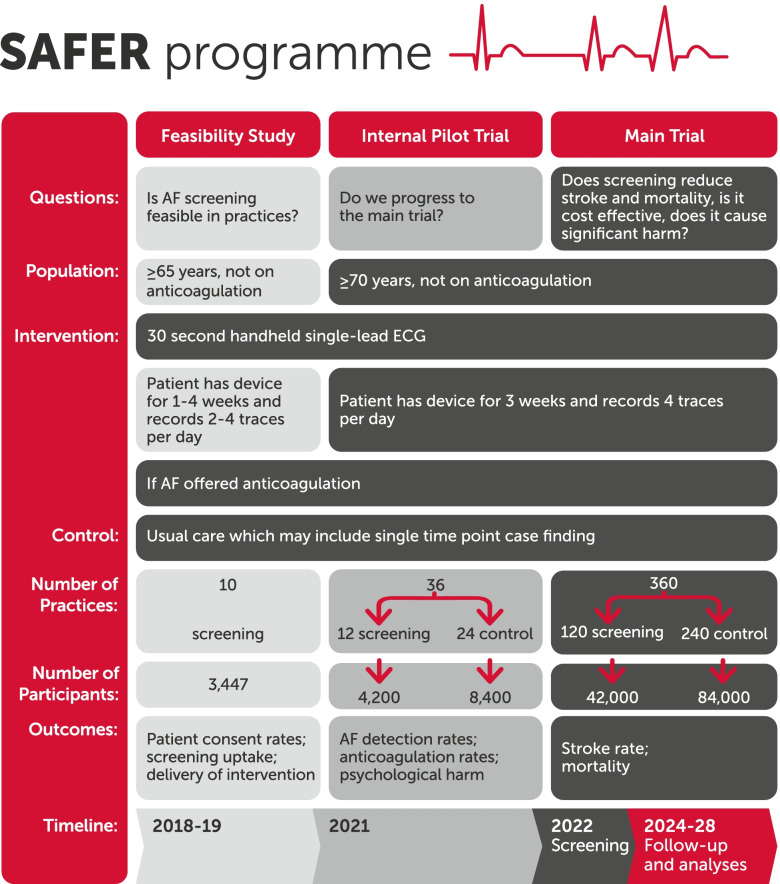
Qualitative research can enhance the design, conduct and interpretation of trials. Despite this, few trials incorporate qualitative methods, and those that do may not realise their full potential. In this commentary, we highlight how qualitative research can contribute to the design, conduct and day-to-day running of a trial, outlining the working arrangements and relationships that facilitate these contributions. In doing so, we draw on (i) existing frameworks on the role of qualitative research alongside trials and (ii) our experience of integrated qualitative research conducted as part of the feasibility study of the SAFER trial (Screening for Atrial Fibrillation with ECG to Reduce stroke), a cluster randomised controlled trial of screening people aged 70 and above for atrial fibrillation in primary care in England. The activities and presence of the qualitative team contributed to important changes in the design, conduct and day-to-day running of the SAFER feasibility study, and the subsequent main trial, informing diverse decisions concerning trial documentation, trial delivery, timing and content of measures and the information given to participating patients and practices. These included asking practices to give screening results to all participants and not just to 'screen positive' participants, and greater recognition of the contribution of practice reception staff to trial delivery. These changes were facilitated by a 'one research team' approach that underpinned all formal and informal working processes from the outset and maximised the value of both qualitative and trial coordination expertise. The challenging problems facing health services require a combination of research methods and data types. Our experience and the literature show that the benefits of embedding qualitative research in trials are more likely to be realised if attention is given to both structural factors and relationships from the outset. These include sustained and sufficient funding for qualitative research, embedding qualitative research fully within the trial programme, providing shared infrastructure and resources and committing to relationships based on mutual recognition of and respect for the value of different methods and perspectives. We outline key learning for the planning of future trials.Trial registration: Screening for atrial fibrillation with ECG to reduce stroke ISRCTN16939438 (feasibility study); Screening for atrial fibrillation with ECG to reduce stroke - a randomised controlled trial ISRCTN72104369 .
定性研究可以增强试验的设计、实施和解释。尽管如此,很少有试验采用定性方法,而那些采用定性方法的试验可能并没有充分发挥其潜力。在这篇评论中,我们强调了定性研究如何为试验的设计、实施和日常运行做出贡献,概述了促进这些贡献的工作安排和关系。在这样做的过程中,我们借鉴了(i)定性研究在试验中的作用的现有框架,以及(ii)我们在 SAFER 试验(心电图筛查心房颤动以降低中风风险)可行性研究中进行的综合定性研究的经验,这是一项在英格兰初级保健中对 70 岁及以上人群进行心房颤动筛查的整群随机对照试验。定性研究团队的活动和存在促进了 SAFER 可行性研究以及随后的主要试验的重要设计、实施和日常运行的改变,为试验文件、试验交付、措施的时间和内容以及向参与患者和实践提供的信息做出了各种决定。这些决定包括要求实践向所有参与者而不仅仅是“筛查阳性”参与者提供筛查结果,并更多地认识到实践接待人员对试验交付的贡献。这些变化是通过一种“一个研究团队”的方法实现的,从一开始就为所有正式和非正式的工作流程提供了支持,并最大限度地发挥了定性和试验协调专业知识的价值。卫生服务面临的挑战性问题需要多种研究方法和数据类型的结合。我们的经验和文献表明,如果从一开始就关注结构因素和关系,将定性研究嵌入试验中更有可能实现其益处。这些包括为定性研究提供持续和充足的资金,将定性研究完全嵌入试验计划中,提供共享的基础设施和资源,并承诺建立基于相互承认和尊重不同方法和观点价值的关系。我们概述了未来试验规划的关键学习。试验注册:心电图筛查心房颤动以降低中风风险 ISRCTN16939438(可行性研究);心电图筛查心房颤动以降低中风 - 一项随机对照试验 ISRCTN72104369。