Ngo Son Tung, Thu Phung Huong Thi, Vu Khanh B, Vu Van V
Laboratory of Theoretical and Computational Biophysics, Ton Duc Thang University Ho Chi Minh City Vietnam
Faculty of Applied Sciences, Ton Duc Thang University Ho Chi Minh City Vietnam.
RSC Adv. 2018 Dec 13;8(73):41705-41712. doi: 10.1039/c8ra07615d. eCollection 2018 Dec 12.
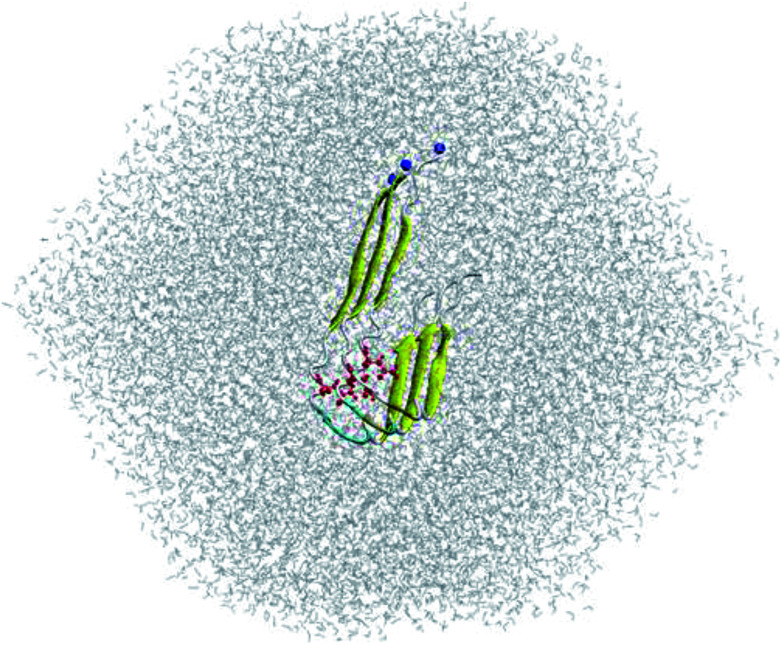
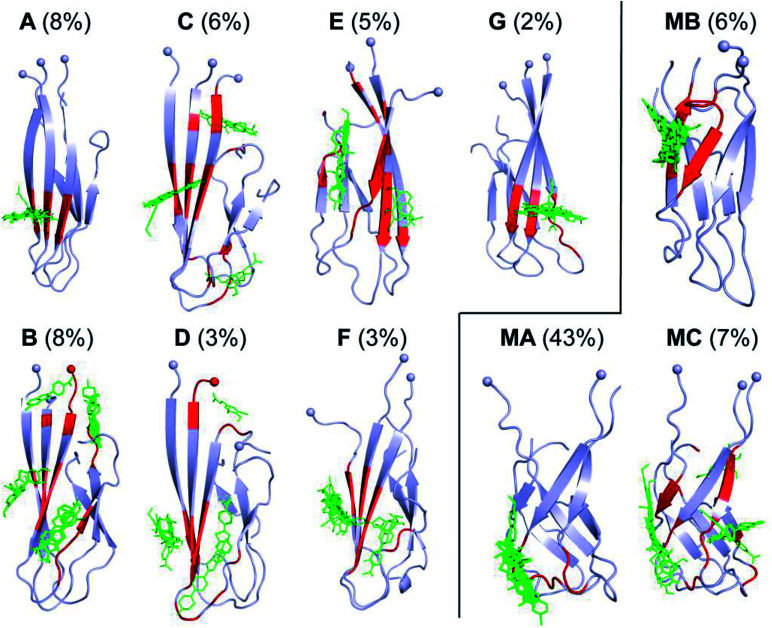
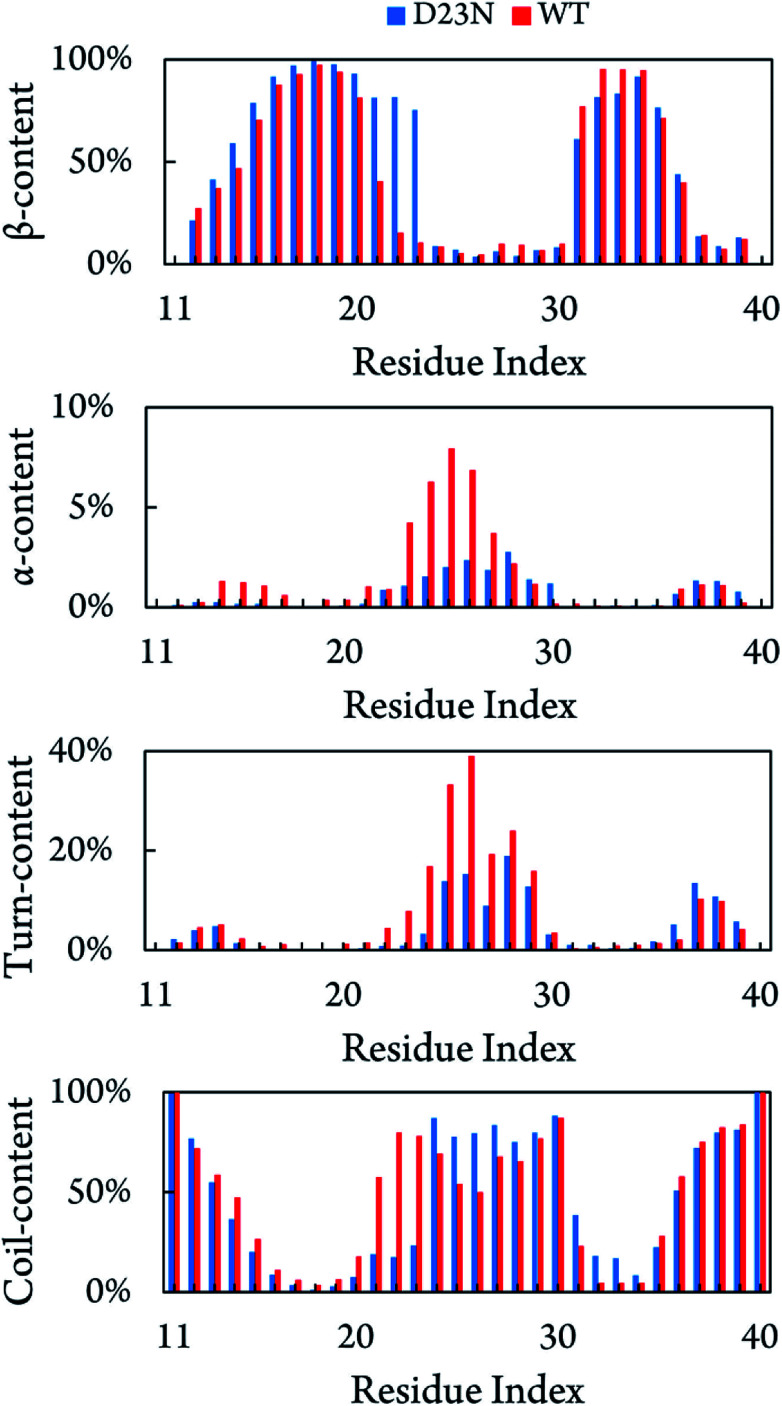
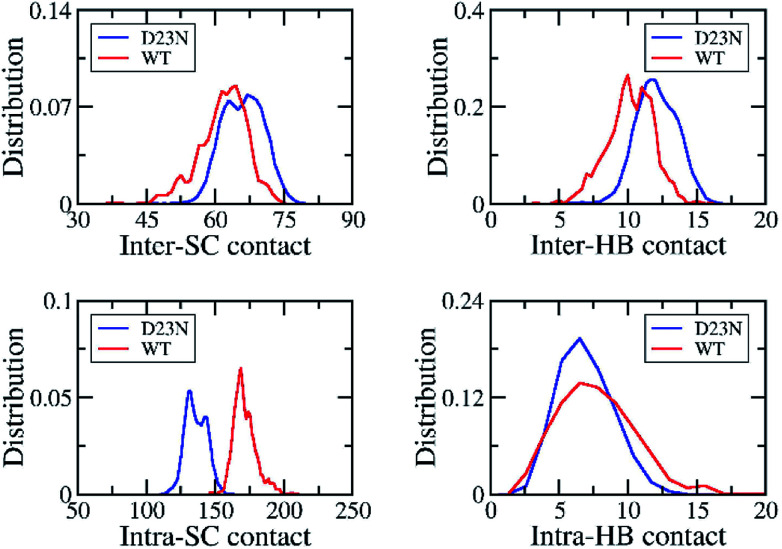
The self-assembly of Amyloid beta (Aβ) peptides are widely accepted to associate with Alzheimer's disease (AD) several proposed mechanisms. Because Aβ oligomers exist in a complicated environment consisting of various forms of Aβ, including oligomers, protofibrils, and fibrils, their structure has not been well understood. The negatively charged residue D23 is one of the critical residues of the Aβ peptide as it is located in the central hydrophobic domain of the Aβ N-terminal and forms a salt-bridge D23-K28, which helps stabilize the loop domain. In the familial Iowa (D23N) mutant, the total net charge of Aβ oligomers decreases, resulting in the decrease of electrostatic repulsion between D23N Aβ monomers and thus the increase in their self-aggregation rate. In this work, the impact of the D23N mutation on 3Aβ trimer was characterized utilizing temperature replica exchange molecular dynamics (REMD) simulations. Our simulation reveals that D23N mutation significantly enhances the affinity between the constituting chains in the trimer, increases the β-content (especially in the sequence 21-23), and shifts the β-strand hydrophobic core from crossing arrangement to parallel arrangement, which is consistent with the increase in self-aggregation rate. Molecular docking indicates that the Aβ fibril-binding ligands bind to the D23N and WT forms at different poses. These compounds prefer to bind to the N-terminal β-strand of the D23N mutant trimer, while they mostly bind to the N-terminal loop region of the WT. It is important to take into account the difference in the binding of ligands to mutant and wild type Aβ peptides in designing efficient inhibitors for various types of AD.
淀粉样β(Aβ)肽的自组装与阿尔茨海默病(AD)的多种发病机制相关,这一观点已被广泛接受。由于Aβ寡聚体存在于由各种形式的Aβ组成的复杂环境中,包括寡聚体、原纤维和纤维,其结构尚未得到很好的理解。带负电荷的残基D23是Aβ肽的关键残基之一,因为它位于Aβ N端的中央疏水结构域,形成盐桥D23-K28,有助于稳定环结构域。在家族性爱荷华州(D23N)突变体中,Aβ寡聚体的总净电荷减少,导致D23N Aβ单体之间的静电排斥力降低,从而使其自聚集速率增加。在这项工作中,利用温度复制交换分子动力学(REMD)模拟表征了D23N突变对3Aβ三聚体的影响。我们的模拟表明,D23N突变显著增强了三聚体中组成链之间的亲和力,增加了β含量(特别是在序列21-23中),并将β链疏水核心从交叉排列转变为平行排列,这与自聚集速率的增加一致。分子对接表明,Aβ纤维结合配体以不同的构象与D23N和野生型形式结合。这些化合物更喜欢与D23N突变体三聚体的N端β链结合,而它们大多与野生型的N端环区域结合。在设计针对各种类型AD的有效抑制剂时,考虑配体与突变型和野生型Aβ肽结合的差异非常重要。