Information Technology Service Center, National YangMing ChiaoTung University, Taipei 112, Taiwan.
Department of Physical Medicine and Rehabilitation, Mackay Memorial Hospital, Taipei 104, Taiwan.
Int J Environ Res Public Health. 2022 Apr 30;19(9):5470. doi: 10.3390/ijerph19095470.
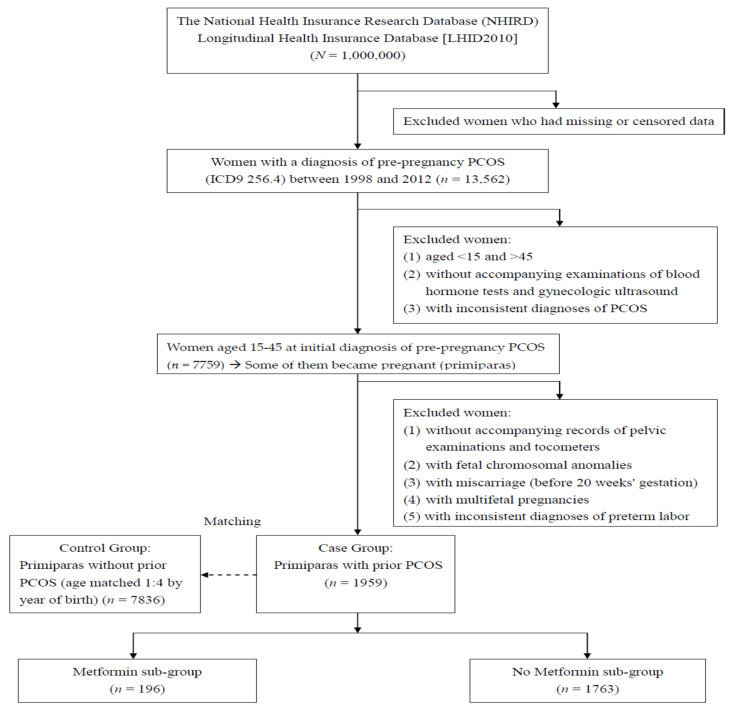
Background: Preterm labor and the following preterm births, which account for most of the perinatal deaths, are an important issue in public health. The study aims to assess the risk of subsequent preterm labor in pregnant females who have prepregnancy polycystic ovary syndrome (PCOS). Methods: This study has enrolled 1,000,000 randomly sampled females retrieved from the Taiwan National Health Insurance Research Database (NHIRD) during 1998−2012. The study excluded prepregnancy PCOS females who were initially diagnosed at age <15 or >45, and those who had inconsistent diagnoses. Moreover, the medical records of blood hormone tests, gynecologic ultrasonography, pelvic examinations, and tocometers were verified to confirm the accuracy of both diagnoses of PCOS and preterm labor. Among the prepregnancy PCOS females who became pregnant (the case group), each was age-matched to four females without prepregnancy PCOS (the control group). Results: Pregnant females in the case group (n = 1959) had a higher incidence of preterm labor than those in the control group (n = 7836) (42.98% vs. 21.99%, p < 0.0001). Analyzed by using logistic regression, the risk of preterm labor was significantly higher in the case group compared with the control group (crude OR: 2.674; 95% CI: 2.410−2.968, p < 0.0001). After adjustment with covariates, further analysis revealed a similar trend (adjusted OR: 2.405; 95% CI: 2.158−2.680, p < 0.0001). Among 1959 PCOS females in the case group, 196 had undergone metformin treatment. Compared with females without metformin treatment (the non-metformin subgroup), the metformin users (metformin subgroup) presented a reduced risk for preterm labor (adjusted OR: 2.238; 95% CI: 1.657−3.023). The risk of subsequent preterm labor was reduced by about 10% for the metformin subgroup compared with the non-metformin subgroup. Conclusions: Prepregnancy PCOS is an independent and significant risk factor of subsequent preterm labor. Among prepregnancy PCOS females, the risk of preterm labor is lowered by about 10% in metformin users compared with non-metformin females.
早产和随后的早产分娩是围产期死亡的主要原因之一,这是公共卫生领域的一个重要问题。本研究旨在评估患有孕前多囊卵巢综合征(PCOS)的孕妇发生后续早产的风险。方法:本研究纳入了 100 万例 1998 年至 2012 年期间从台湾全民健康保险研究数据库(NHIRD)中随机抽取的女性。研究排除了年龄<15 岁或>45 岁时首次诊断为 PCOS 的孕前 PCOS 女性,以及诊断不一致的女性。此外,还对血液激素检测、妇科超声、盆腔检查和胎心监护仪的医疗记录进行了核实,以确认 PCOS 和早产的诊断准确性。在怀孕的孕前 PCOS 女性(病例组)中,每位女性都与 4 名没有孕前 PCOS 的女性(对照组)进行年龄匹配。结果:病例组(n=1959)孕妇的早产发生率高于对照组(n=7836)(42.98% vs. 21.99%,p<0.0001)。采用逻辑回归分析,病例组早产的风险明显高于对照组(粗比值比:2.674;95%置信区间:2.410-2.968,p<0.0001)。在调整了协变量后,进一步的分析显示出相似的趋势(调整比值比:2.405;95%置信区间:2.158-2.680,p<0.0001)。在病例组的 1959 名 PCOS 女性中,有 196 名接受了二甲双胍治疗。与未接受二甲双胍治疗的女性(非二甲双胍亚组)相比,二甲双胍使用者(二甲双胍亚组)发生早产的风险较低(调整比值比:2.238;95%置信区间:1.657-3.023)。与非二甲双胍亚组相比,二甲双胍亚组的后续早产风险降低了约 10%。结论:孕前 PCOS 是后续早产的独立且显著的危险因素。在孕前 PCOS 女性中,与非二甲双胍女性相比,二甲双胍使用者发生早产的风险降低了约 10%。