Charles University, Faculty of Pharmacy in Hradec Králové, Hradec Králové, Czech Republic.
Department of Dermatology, Vanderbilt University Medical Center, Nashville, TN, USA.
J Lipid Res. 2022 Jun;63(6):100226. doi: 10.1016/j.jlr.2022.100226. Epub 2022 May 12.
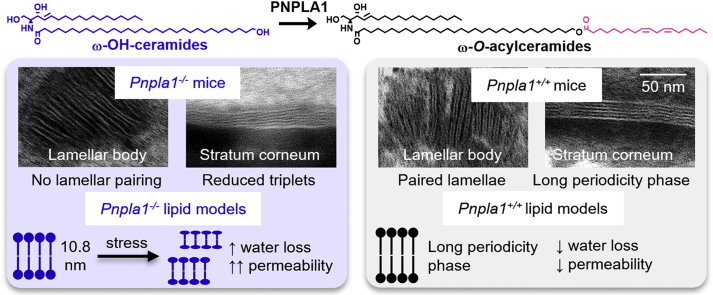
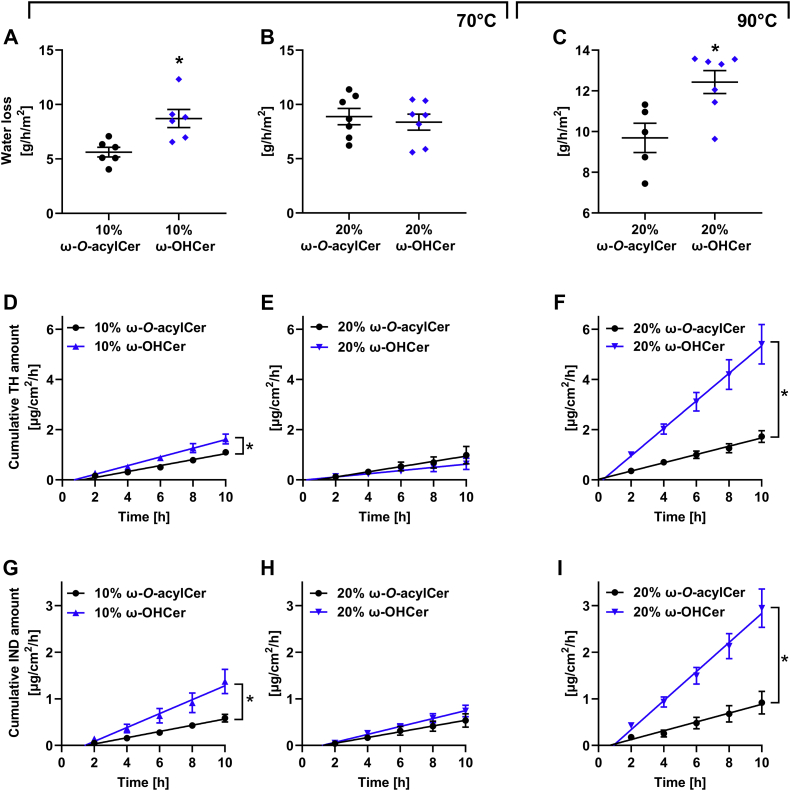
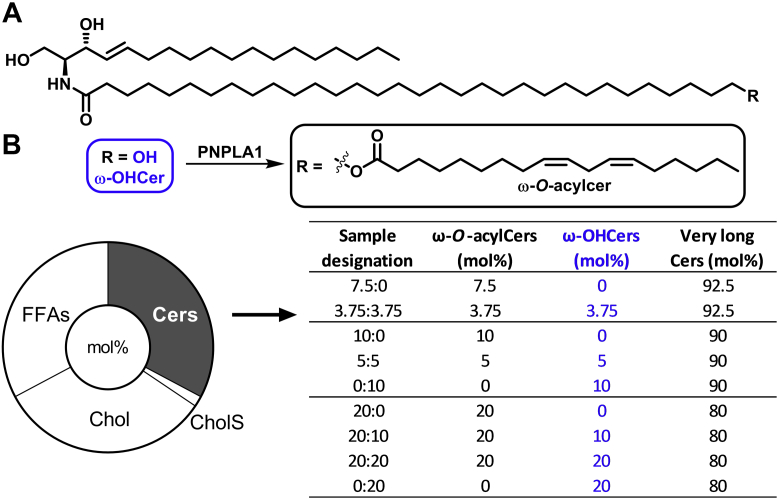
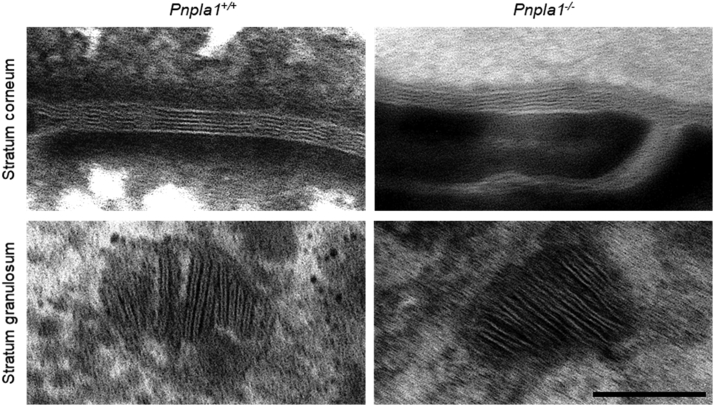
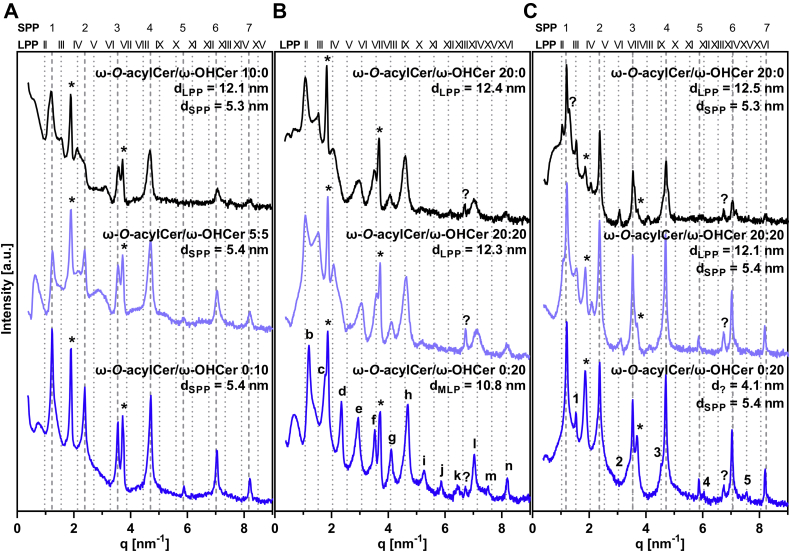
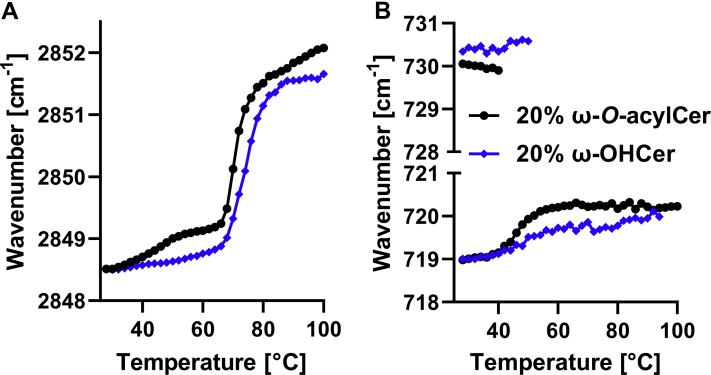
Epidermal omega-O-acylceramides (ω-O-acylCers) are essential components of a competent skin barrier. These unusual sphingolipids with ultralong N-acyl chains contain linoleic acid esterified to the terminal hydroxyl of the N-acyl, the formation of which requires the transacylase activity of patatin-like phospholipase domain containing 1 (PNPLA1). In ichthyosis with dysfunctional PNPLA1, ω-O-acylCer levels are significantly decreased, and ω-hydroxylated Cers (ω-OHCers) accumulate. Here, we explore the role of the linoleate moiety in ω-O-acylCers in the assembly of the skin lipid barrier. Ultrastructural studies of skin samples from neonatal Pnpla1 and Pnpla1 mice showed that the linoleate moiety in ω-O-acylCers is essential for lamellar pairing in lamellar bodies, as well as for stratum corneum lipid assembly into the long periodicity lamellar phase. To further study the molecular details of ω-O-acylCer deficiency on skin barrier lipid assembly, we built in vitro lipid models composed of major stratum corneum lipid subclasses containing either ω-O-acylCer (healthy skin model), ω-OHCer (Pnpla1 model), or combination of the two. X-ray diffraction, infrared spectroscopy, and permeability studies indicated that ω-OHCers could not substitute for ω-O-acylCers, although in favorable conditions, they form a medium lamellar phase with a 10.8 nm-repeat distance and permeability barrier properties similar to long periodicity lamellar phase. In the absence of ω-O-acylCers, skin lipids were prone to separation into two phases with diminished barrier properties. The models combining ω-OHCers with ω-O-acylCers indicated that accumulation of ω-OHCers does not prevent ω-O-acylCer-driven lamellar stacking. These data suggest that ω-O-acylCer supplementation may be a viable therapeutic option in patients with PNPLA1 deficiency.
表皮ω-O-酰基神经酰胺(ω-O-acylCers)是具有完整皮肤屏障的必需成分。这些含有超长酰基链的非典型神经酰胺,其中 linoleic 酸酯化在 N-酰基的末端羟基上,其形成需要 patatin 样磷脂酶结构域包含 1(PNPLA1)的转酰基酶活性。在 PNPLA1 功能障碍性鱼鳞病中,ω-O-酰基神经酰胺水平显著降低,ω-羟化神经酰胺(ω-OHCers)积累。在这里,我们探索了 ω-O-酰基神经酰胺中 linoleate 部分在皮肤脂质屏障组装中的作用。对来自新生 Pnpla1 和 Pnpla1 小鼠的皮肤样本进行超微结构研究表明,ω-O-酰基神经酰胺中的 linoleate 部分对于板层小体中的板层配对以及角质层脂质组装成长周期性板层相是必需的。为了进一步研究 ω-O-酰基神经酰胺缺乏对皮肤屏障脂质组装的分子细节,我们构建了包含主要角质层脂质亚类的体外脂质模型,这些亚类包含 ω-O-酰基神经酰胺(健康皮肤模型)、ω-OHCer(Pnpla1 模型)或两者的组合。X 射线衍射、红外光谱和渗透性研究表明,ω-OHCer 不能替代 ω-O-acylCers,尽管在有利条件下,它们形成具有 10.8nm 重复距离的中板层相,并且具有与长周期性板层相相似的渗透性屏障特性。在缺乏 ω-O-acylCers 的情况下,皮肤脂质容易分离成两个具有降低的屏障特性的相。结合 ω-OHCers 和 ω-O-acylCers 的模型表明,ω-OHCers 的积累并不能阻止 ω-O-acylCer 驱动的板层堆积。这些数据表明,ω-O-acylCer 补充可能是 PNPLA1 缺乏症患者的可行治疗选择。