Department of Neurosurgery and Spine Surgery, University Hospital Essen, University of Duisburg-Essen, 45147, Essen, Germany.
Department of Diagnostic and Interventional Radiology and Neuroradiology, University Hospital Essen, University of Duisburg-Essen, Essen, Germany.
Sci Rep. 2022 May 14;12(1):8006. doi: 10.1038/s41598-022-11903-4.
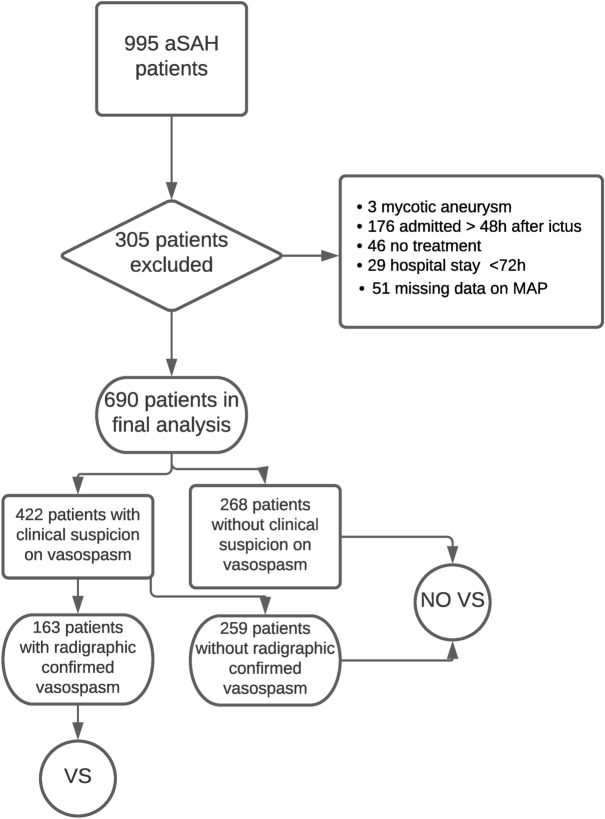
Blood pressure management is crucial in the treatment of patients with aneurysmal subarachnoid hemorrhage (aSAH). Possible association between the blood pressure increase and the risk of delayed cerebral ischemia (DCI) and different systemic complications after aSAH is still a matter of debate. This study aims to elucidate the influence of blood pressure levels on the outcome of aSAH. All consecutive aSAH patients (n = 690) treated between 01/2003 and 06/2016 were included. The mean value of the mean arterial pressure (MAP) during 14 days after ictus was calculated for each individual. According to the institutional standards of vasospasm management, the mean 14 days MAP ≥ 95 mmHg was referred as increased (IMAP) and the patients with and without vasospasm were analyzed separately. Study endpoints were the occurrence of DCI on computed tomography scans, development of cardiac and nephrological complications, and poor outcome 6 months after aSAH (mRS > 2). Associations were tested in univariable/multivariable binary logistic regression analysis. IMAP was documented in 474 (68.7%) cases and was more common in individuals with poor neurological conditions at admission (p < 0.001), severe amount of intracranial blood (p = 0.001) and premorbid hypertension (p < 0.001). IMAP was independently associated with the occurrence of DCI (p = 0.014; aOR = 2.97; 95% CI 1.25-7.09) and poor functional outcome (p = 0.020; aOR = 3.14; 95% CI 1.20-8.22) in patients with vasospasm, but not in counterparts without vasospasm (p = 0.113/p = 0.086). IMAP had no influence on cardiac or nephrological complications. In aSAH individuals with cerebral vasospasm, sustained increase of blood pressure exceeding the therapeutic targets is strongly associated with the risk of DCI and poor outcome. Therefore, such an intrinsic increase of blood pressure might reflect the autoregulatory mechanisms against the impending cerebral ischemia in patients with cerebral vasospasm.Trial registration number: German clinical trial registry (DRKS, Unique identifier: DRKS00008749, 06/09/2015).
血压管理在治疗颅内动脉瘤性蛛网膜下腔出血(aSAH)患者中至关重要。血压升高与迟发性脑缺血(DCI)和 aSAH 后不同的全身并发症之间的可能关联仍存在争议。本研究旨在阐明血压水平对 aSAH 结局的影响。所有连续的 aSAH 患者(n = 690)于 2003 年 1 月至 2016 年 6 月期间接受治疗。计算了每个个体发病后 14 天的平均动脉压(MAP)的平均值。根据血管痉挛管理的机构标准,将 14 天 MAP ≥ 95mmHg 定义为升高(IMAP),并分别分析伴有和不伴有血管痉挛的患者。研究终点为计算机断层扫描上发生 DCI、出现心脏和肾脏并发症以及 aSAH 后 6 个月预后不良(mRS>2)。使用单变量/多变量二元逻辑回归分析测试关联。474 例(68.7%)存在 IMAP,且入院时神经状态较差(p < 0.001)、颅内血容量严重(p = 0.001)和合并高血压(p < 0.001)的个体中更常见。IMAP 与 DCI 的发生独立相关(p = 0.014;优势比 = 2.97;95%可信区间 1.25-7.09)和伴有血管痉挛的患者的功能预后不良相关(p = 0.020;优势比 = 3.14;95%可信区间 1.20-8.22),但在无血管痉挛的患者中则没有(p = 0.113/p = 0.086)。IMAP 对心脏或肾脏并发症没有影响。在伴有脑血管痉挛的 aSAH 患者中,持续超过治疗目标的血压升高与 DCI 和不良预后的风险密切相关。因此,这种固有血压升高可能反映了脑血管痉挛患者即将发生脑缺血的自身调节机制。试验注册编号:德国临床试验注册处(DRKS,唯一标识符:DRKS00008749,2015 年 6 月 9 日)。