Department of Pathology, Molecular Pathology Research Centre, Peking Union Medical College Hospital, Chinese Academy of Medical Science and Peking Union Medical College, No.1 Shuaifuyuan street, Dongcheng District, Beijing, China.
Department of Breast Surgery, Union Medical College Hospital, Chinese Academy of Medical Science and Peking Union Medical College, PekingBeijing, China.
BMC Cancer. 2022 May 14;22(1):548. doi: 10.1186/s12885-022-09656-4.
This study was conducted to evaluate the prognostic significance of different molecular typing methods and immune status based on RNA sequencing (RNA-seq) in hormone receptor (HR)-positive and human epidermal growth factor receptor 2 (HER2)-negative (HR + /HER2-) early-stage breast cancer and develop a modified immunohistochemistry (IHC)-based surrogate for intrinsic subtype analysis.
The gene expression profiles of samples from 87 HR + /HER2- early-stage breast cancer patients were evaluated using the RNA-seq of Oncotype Dx recurrence score (RS), PAM50 risk of recurrence (ROR), and immune score. Intrinsic tumor subtypes were determined using both PAM50- and IHC-based detection of estrogen receptor, progesterone receptor, Ki-67, epidermal growth factor receptor, and cytokeratins 14 and 5/6. Prognostic variables were analyzed through Cox regression analysis of disease-free survival (DFS) and distant metastasis-free survival (DMFS).
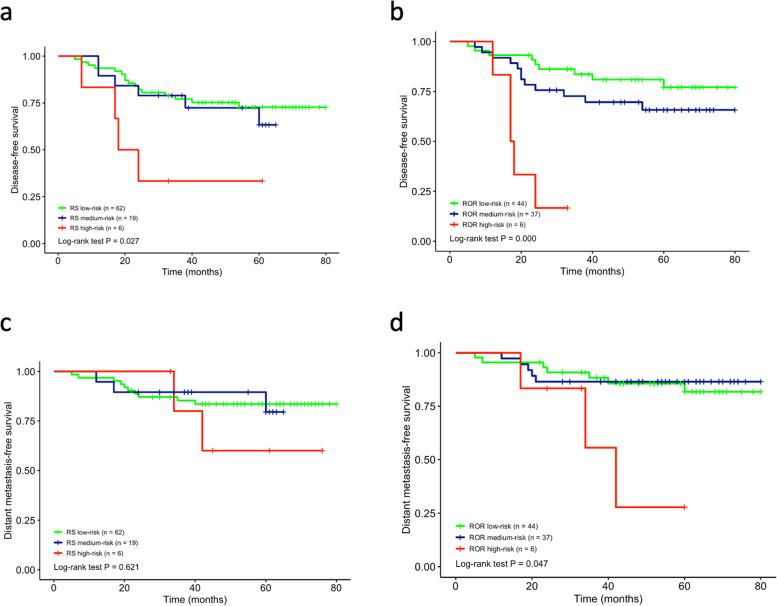
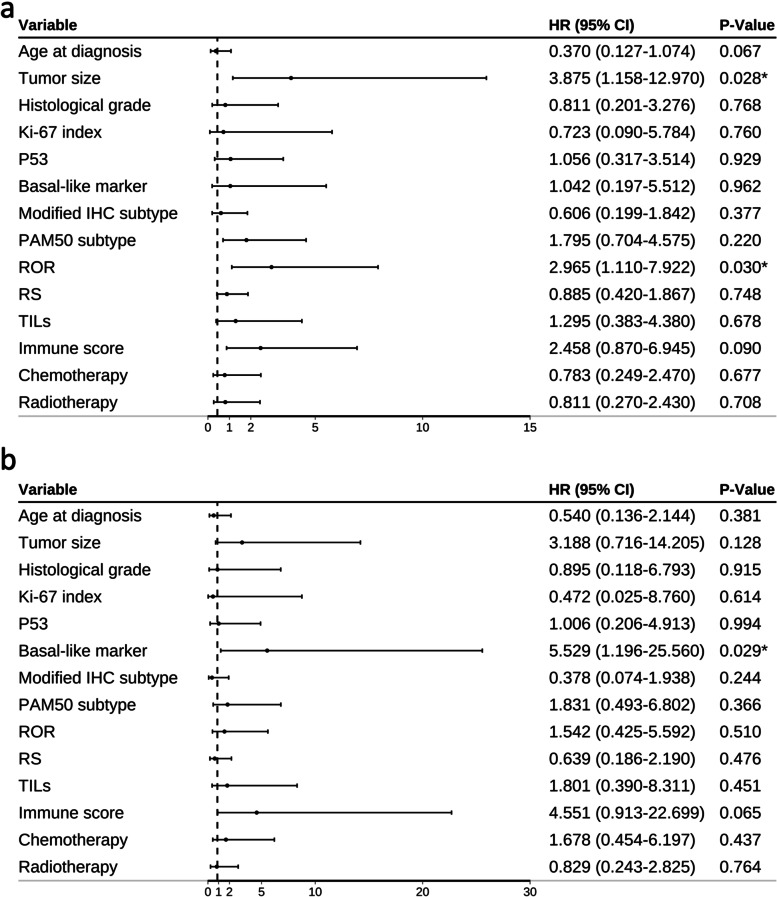
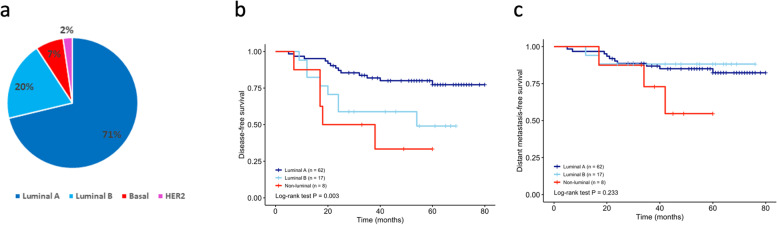
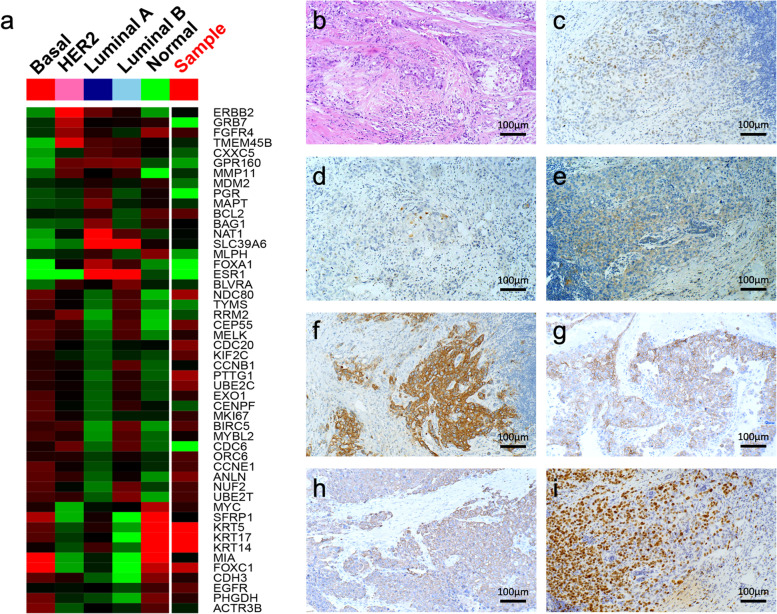
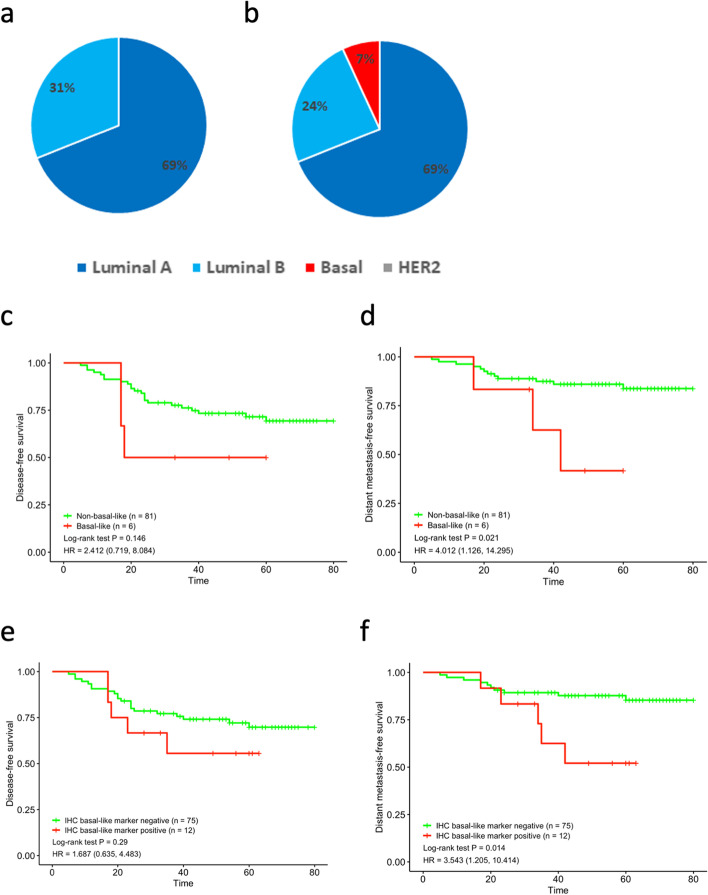
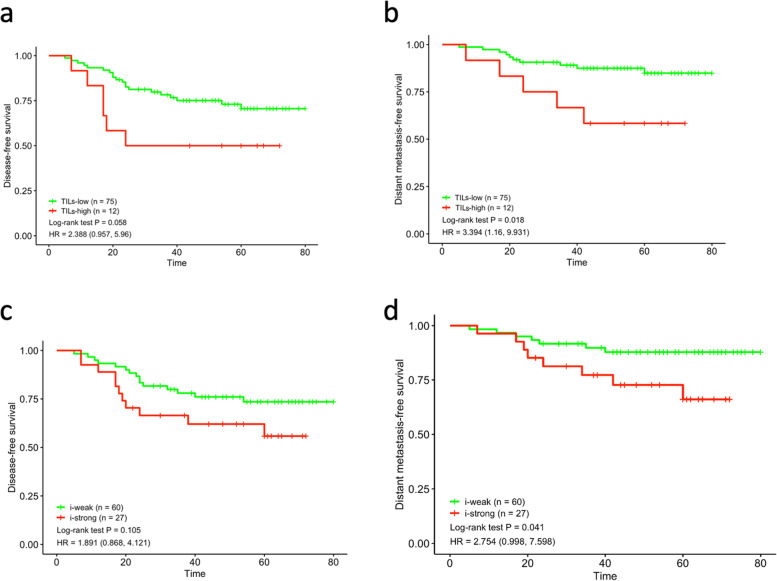
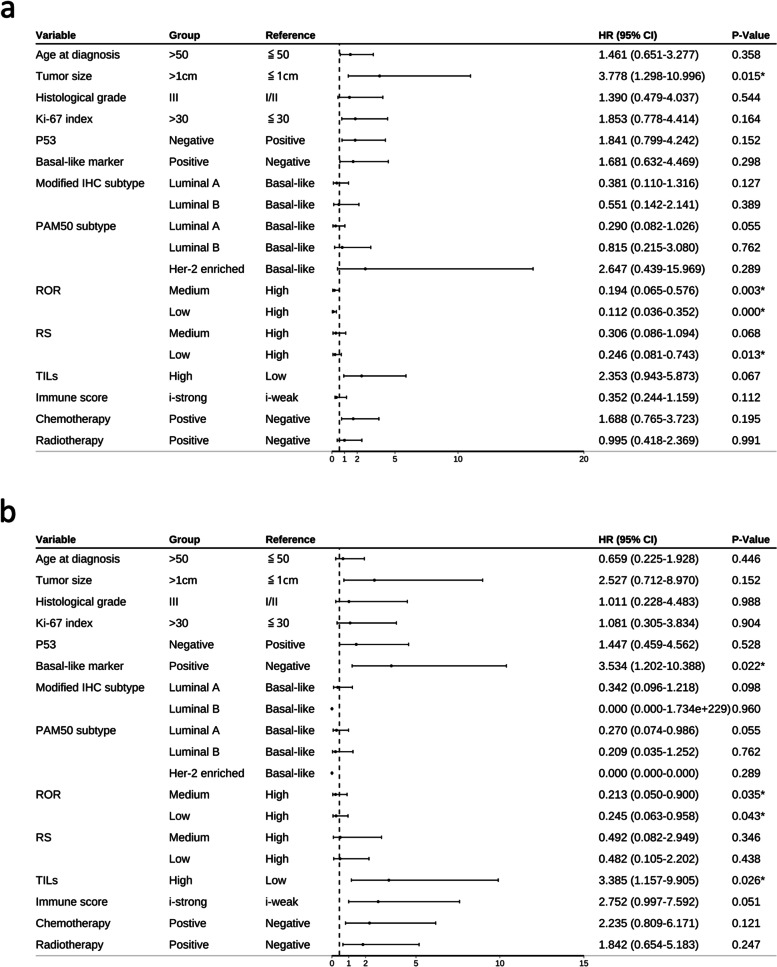
Survival analysis showed that ROR better predicted recurrence and distant metastasis compared to RS (for DFS: ROR, P = 0.000; RS, P = 0.027; for DMFS, ROR, P = 0.047; RS, P = 0.621). Patients with HR + /HER2- early-stage breast cancer was classified into the luminal A, luminal B, HER2-enriched, and basal-like subtypes by PAM50. Basal-like subgroups showed the shortest DFS and DMFS. A modified IHC-based surrogate for intrinsic subtype analysis improved the concordance with PAM50 from 66.7% to 73.6%, particularly for basal-like subtype identification. High level of TILs and high expression of immune genes predicted poor prognosis. Multi-factor Cox analysis showed that IHC-based basal-like markers were the only independent factors affecting DMFS.
Prognosis is better evaluated by PAM50 ROR in early-stage HR + /HER2- breast cancer and significantly differs among intrinsic subtypes. The modified IHC-based subtype can improve the basal-like subtype identification of PAM50. High immunity status and IHC-based basal-like markers are negative prognostic factors.
本研究旨在评估基于 RNA 测序(RNA-seq)的不同分子分型方法和免疫状态在激素受体(HR)阳性和人表皮生长因子受体 2(HER2)阴性(HR+/HER2-)早期乳腺癌中的预后意义,并建立一种改良的免疫组织化学(IHC)替代物用于内在亚型分析。
采用 Oncotype Dx 复发评分(RS)、PAM50 复发风险(ROR)和免疫评分的 RNA-seq 评估 87 例 HR+/HER2-早期乳腺癌患者的基因表达谱。采用 PAM50 和 IHC 检测雌激素受体、孕激素受体、Ki-67、表皮生长因子受体以及细胞角蛋白 14 和 5/6 来确定肿瘤的内在亚型。通过无病生存(DFS)和远处无转移生存(DMFS)的 Cox 回归分析来评估预后变量。
生存分析显示,ROR 比 RS 更能预测复发和远处转移(DFS:ROR,P=0.000;RS,P=0.027;DMFS:ROR,P=0.047;RS,P=0.621)。采用 PAM50 将 HR+/HER2-早期乳腺癌患者分为 luminal A、luminal B、HER2 富集和基底样亚型。基底样亚组的 DFS 和 DMFS 最短。改良的基于 IHC 的内在亚型分析替代物可将与 PAM50 的一致性从 66.7%提高到 73.6%,特别是对基底样亚型的识别。高水平的 TILs 和免疫基因的高表达预示着不良预后。多因素 Cox 分析显示,基于 IHC 的基底样标志物是唯一影响 DMFS 的独立因素。
在 HR+/HER2-早期乳腺癌中,PAM50 ROR 可更好地评估预后,且不同内在亚型的预后明显不同。改良的基于 IHC 的亚型可提高 PAM50 中基底样亚型的识别。高免疫状态和基于 IHC 的基底样标志物是负预后因素。