Department of Human Anatomy, Histology and Embryology, School of Basic Medical Sciences, Xi'an Jiao Tong University Health Science Center, Xi'an, Shaanxi, China.
Department of Clinical Research, The First Affiliated Hospital of Jinan University, Guangzhou, Guangdong, China.
BMC Womens Health. 2022 May 14;22(1):175. doi: 10.1186/s12905-022-01739-5.
Uterine sarcoma (US) is a rare malignant uterine tumor with aggressive behavior and rapid progression. The purpose of this study was to constructa comprehensive nomogram to predict cancer-specific survival (CSS) of patients with US-based on the Surveillance, Epidemiology, and End Results (SEER) database.
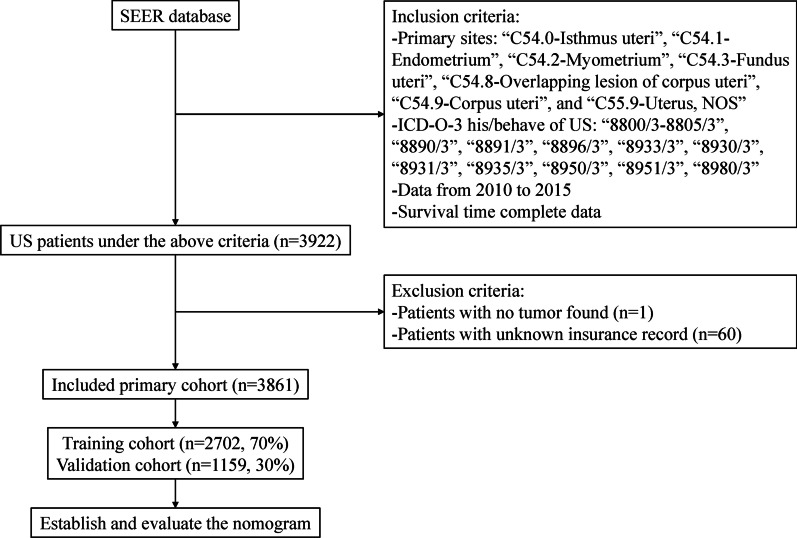
A retrospective population-based study was conducted using data from patients with US between 2010 and 2015 from the SEER database. They were randomly divided into a training cohort and a validation cohort ata 7-to-3 ratio. Multivariate Cox analysis was performed to identify independent prognostic factors. Subsequently, a nomogram was established to predict patient CSS. The discrimination and calibration of the nomogram were evaluated by the concordance index (C-index) and the area under the curve (AUC). Finally, net reclassification improvement (NRI), integrated discrimination improvement (IDI), calibration plotting, and decision-curve analysis (DCA) were used to evaluate the benefits of the new prediction model.
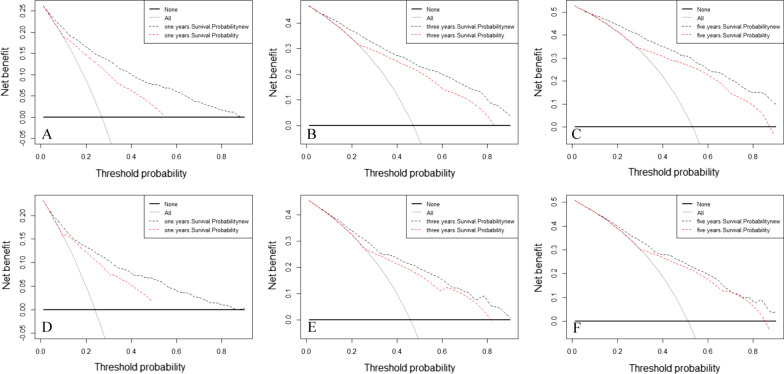
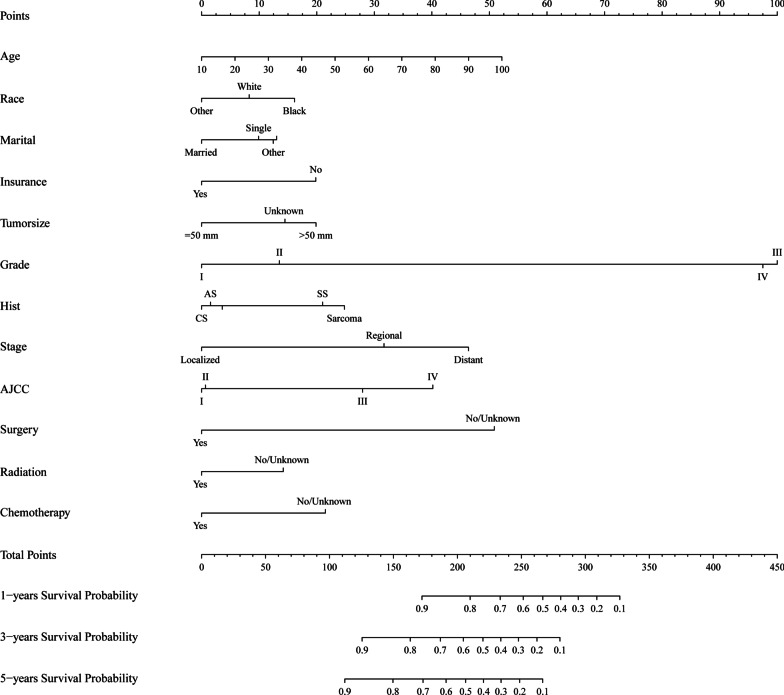
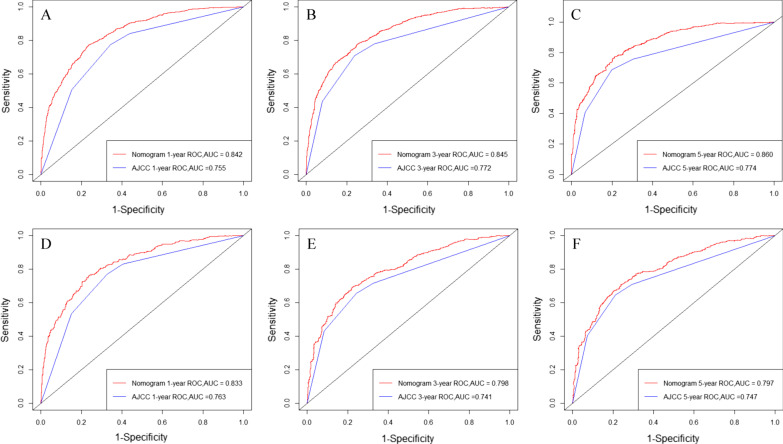
A total of 3861 patients with US were included in our study. As revealed in multivariate Cox analysis, age at diagnosis, race, marital status, insurance record, tumor size, pathology grade, histological type, SEER stage, AJCC stage, surgery status, radiotherapy status, and chemotherapy status were found to be independent prognostic factors. In our nomogram, pathology grade had strongest correlation with CSS, followed by age at diagnosis and surgery status. Compared to the AJCC staging system, the new nomogram showed better predictive discrimination with a higher C-index in the training and validation cohorts (0.796 and 0.767 vs. 0.706 and 0.713, respectively). Furthermore, the AUC value, calibration plotting, NRI, IDI, and DCA also demonstrated better performance than the traditional system.
Our study validated the first comprehensive nomogram for US, which could provide more accurate and individualized survival predictions for US patients in clinical practice.
子宫肉瘤(US)是一种罕见的恶性子宫肿瘤,具有侵袭性和快速进展的特点。本研究旨在基于监测、流行病学和最终结果(SEER)数据库构建一个全面的列线图,以预测 US 患者的癌症特异性生存(CSS)。
本研究采用回顾性基于人群的研究方法,使用 SEER 数据库中 2010 年至 2015 年期间 US 患者的数据。将患者随机分为训练队列和验证队列,比例为 7:3。采用多变量 Cox 分析确定独立的预后因素。随后,建立列线图预测患者 CSS。通过一致性指数(C 指数)和曲线下面积(AUC)评估列线图的区分度和校准度。最后,使用净重新分类改善(NRI)、综合判别改善(IDI)、校准绘图和决策曲线分析(DCA)评估新预测模型的获益。
本研究共纳入 3861 例 US 患者。多变量 Cox 分析显示,诊断时的年龄、种族、婚姻状况、保险记录、肿瘤大小、病理分级、组织学类型、SEER 分期、AJCC 分期、手术状态、放疗状态和化疗状态是独立的预后因素。在我们的列线图中,病理分级与 CSS 相关性最强,其次是诊断时的年龄和手术状态。与 AJCC 分期系统相比,新的列线图在训练和验证队列中具有更高的预测区分度(C 指数分别为 0.796 和 0.767,而 AJCC 分期系统为 0.706 和 0.713)。此外,AUC 值、校准绘图、NRI、IDI 和 DCA 也显示出优于传统系统的性能。
本研究验证了首个用于 US 的全面列线图,可为临床实践中 US 患者提供更准确和个体化的生存预测。