International Institute for Population Sciences, Govandi Station Road, Deonar, Mumbai, 400088, India.
BMC Public Health. 2022 May 15;22(1):979. doi: 10.1186/s12889-022-13392-6.
In India, there is currently a lack of data on socioeconomic inequalities in HIV testing on a national scale; thus, understanding socioeconomic inequalities in response to expanded HIV testing is critical for assessing and ensuring equity of HIV programmes in accordance with the Sustainable Development Goals. The specific objective of the study was to determine the factor associated with HIV testing during antenatal care and assess the socio-economic inequalities in HIV testing during antenatal care (ANC) among Indian women aged 15-49 years with a live birth in the two years preceding the survey.
The results drawn from the state module of women data file of fourth round of National Family Health Survey (NFHS-4, 2015-16), considering HIV testing during antenatal care among women aged 15-49 who gave live birth in the two years preceding the survey and received the result of HIV test as a matter of fact. Method, such as, descriptive statistics, binary ogistic regression, concentration index were used in the analysis.
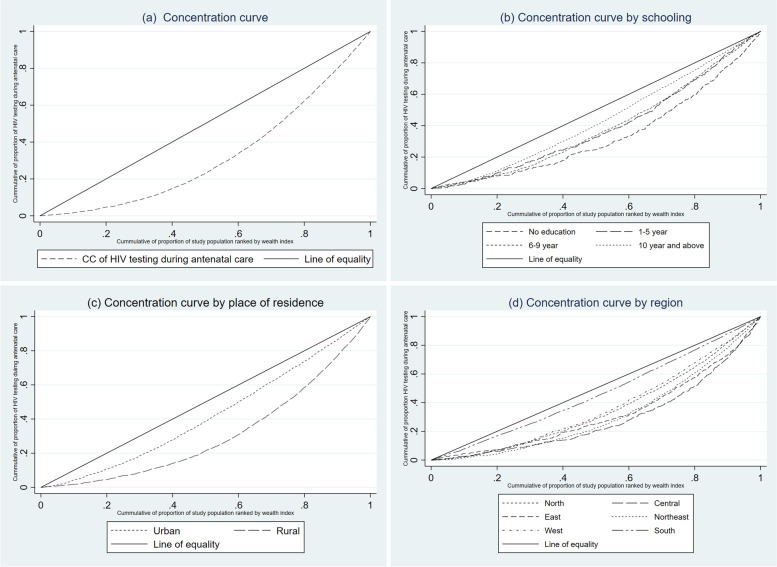
The findings of the study show that HIV testing during antenatal care was low (30%) among women in India. Our findings reveal that there were significant inequalities exist in HIV testing during ANC between richer and poorer quintile of women. Education, place of residence, comprehensive knowledge of HIV/AIDS, and regular exposure of mass media were substantially contributing to socioeconomic inequality in HIV testing during ANC among women in India.
The socioeconomic inequities in HIV testing during pregnancy should be monitored and addressed in order to ensure an equitable distribution of the benefits specially among children and accomplishments of HIV programs in India.
在印度,目前缺乏全国范围内艾滋病毒检测的社会经济不平等数据;因此,了解扩大艾滋病毒检测方面的社会经济不平等对于根据可持续发展目标评估和确保艾滋病毒规划的公平性至关重要。本研究的具体目标是确定与产前保健中艾滋病毒检测相关的因素,并评估在印度,15-49 岁有活产且在调查前两年内分娩的妇女中,产前保健期间艾滋病毒检测的社会经济不平等。
本研究结果来自第四轮全国家庭健康调查(NFHS-4,2015-16 年)的邦模块中妇女数据文件,考虑了在调查前两年内分娩且实际接受了艾滋病毒检测结果的 15-49 岁妇女的产前保健期间艾滋病毒检测情况。分析中使用了描述性统计、二项逻辑回归、集中指数等方法。
研究结果表明,印度妇女的产前保健中艾滋病毒检测率较低(30%)。我们的研究结果表明,在印度,产前保健期间的艾滋病毒检测在较富裕和较贫困五分位数的妇女之间存在显著的不平等。教育、居住地、对艾滋病毒/艾滋病的综合认识以及大众媒体的定期接触,对印度妇女产前保健期间艾滋病毒检测的社会经济不平等有很大的影响。
应监测和解决怀孕期间艾滋病毒检测方面的社会经济不平等问题,以确保公平分配利益,特别是在儿童和印度艾滋病毒规划的完成方面。