Department of Pathology, College of Medicine, Kaohsiung Medical University, Kaohsiung, Taiwan.
Department of Pathology, Kaohsiung Medical University Hospital, Kaohsiung, Taiwan.
Pathol Oncol Res. 2022 Apr 28;28:1610230. doi: 10.3389/pore.2022.1610230. eCollection 2022.
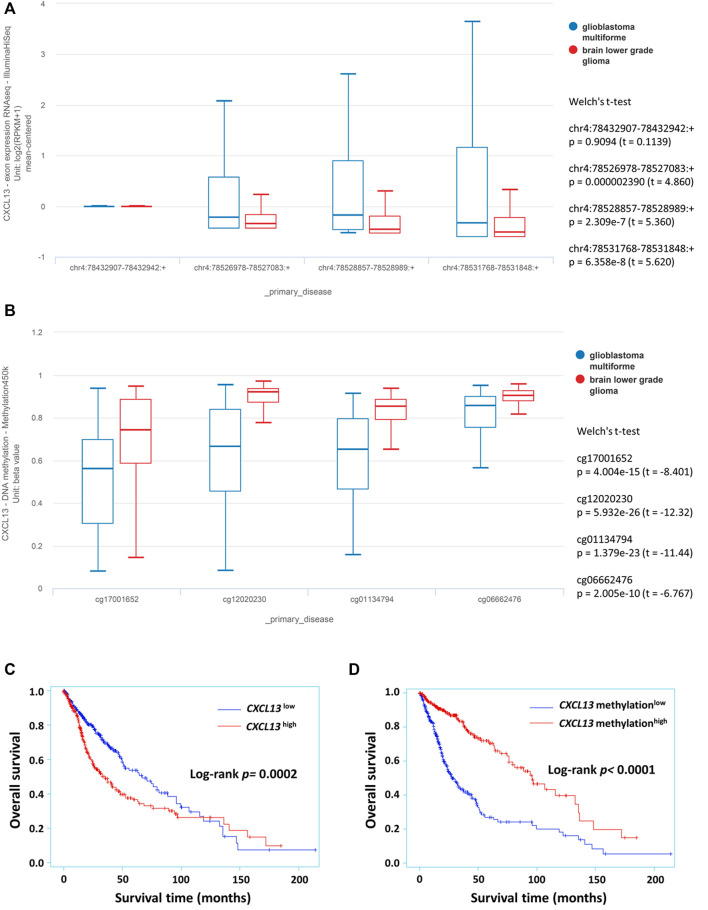
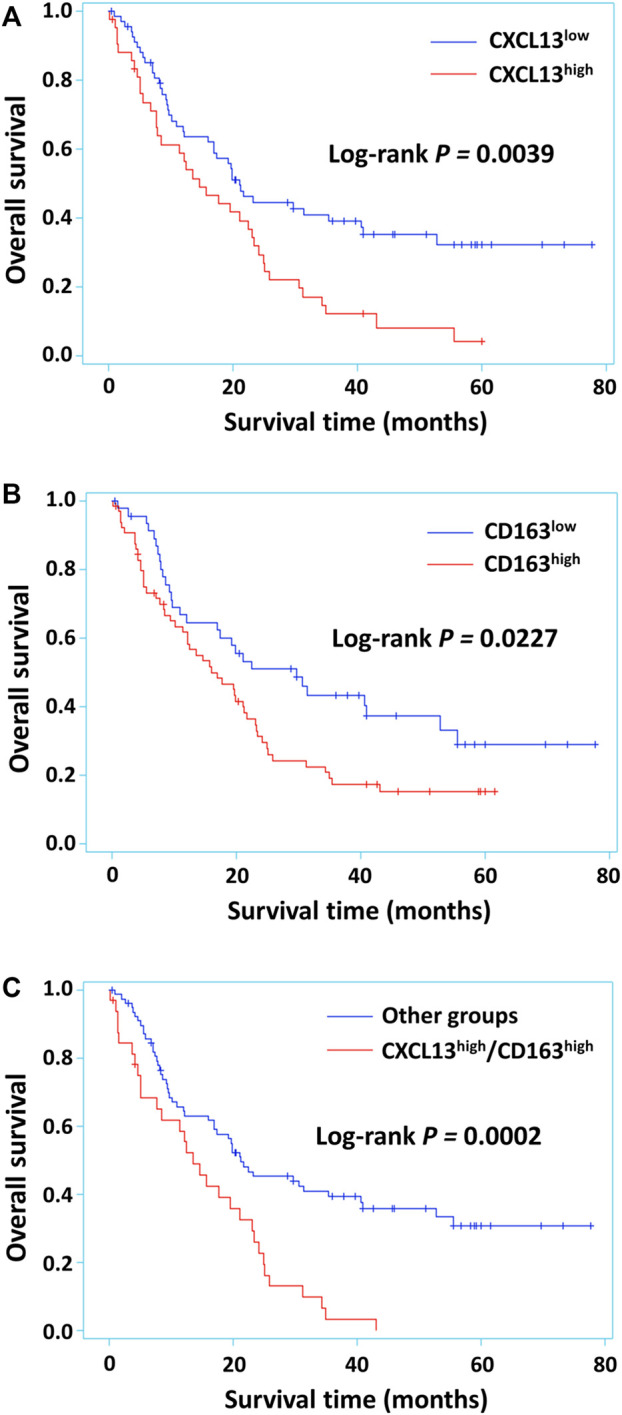
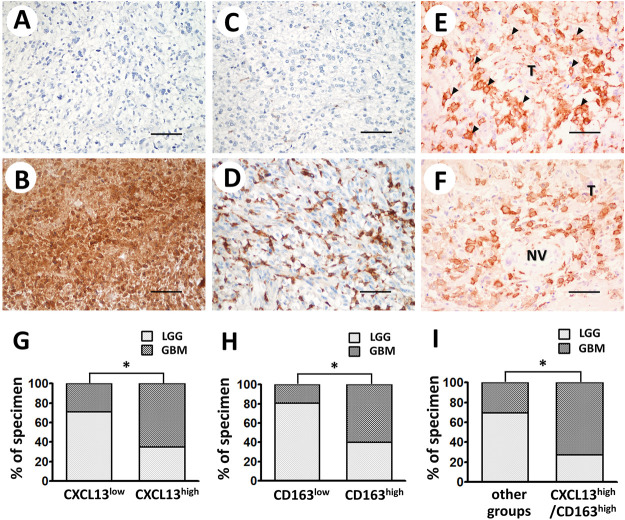
CXCL13 may act as a mediator of tumor-associated macrophage immunity during malignant progression. The present study clarifies the clinicopathological significances of CXCL13 and its corresponding trend with M2 macrophage in human astrocytoma. The predictive potential of CXCL13 was performed using 695 glioma samples derived from TCGA lower-grade glioma and glioblastoma (GBMLGG) dataset. CXCL13 and M2 biomarker CD163 were observed by immunohistochemistry in 112 astrocytoma tissues. An in-depth analysis showed that expression was related to the poor prognosis of glioma patients ( = 0.0002) derive from TCGA analysis. High level of CXCL13 was detected in 43 (38.39%) astrocytoma and CXCL13/CD163 coexpression was expressed in 33 (29.46%) cases. The immunoreactivities of CXCL13 and CXCL13/CD163 were found in the malignant lesions, which were both significantly associated with grade, patient survival, and IDH1 mutation. Single CXCL13 and CXCL13/CD163 coexpression predicted poor overall survival in astrocytoma ( = 0.0039 and = 0.0002, respectively). Multivariate Cox regression analyses manifested CXCL13/CD163 phenotype was a significant independent prognostic indicator of patient outcome in astrocytoma (CXCL13, = 0.0642; CXCL13/CD163, = 0.0368). CXCL13 overexpression is strongly linked to CD163+ M2 infiltration in malignant astrocytoma. CXCL13/CD163 coexpression would imply M2c-related aggressive characteristics existing in astrocytoma progression could also provide predictive trends of patient outcomes.
CXCL13 可能在恶性进展过程中作为肿瘤相关巨噬细胞免疫的介质。本研究阐明了 CXCL13 及其在人类星形细胞瘤中与 M2 巨噬细胞的相应趋势的临床病理意义。使用来自 TCGA 低级别胶质瘤和胶质母细胞瘤 (GBMLGG) 数据集的 695 个神经胶质瘤样本进行了 CXCL13 的预测潜力分析。通过免疫组织化学观察了 112 例星形细胞瘤组织中的 CXCL13 和 M2 生物标志物 CD163。深入分析表明,TCGA 分析得出,表达与胶质瘤患者的不良预后相关(=0.0002)。在 43 例星形细胞瘤中检测到高水平的 CXCL13(38.39%),CXCL13/CD163 共表达在 33 例(29.46%)病例中表达。在恶性病变中检测到 CXCL13 和 CXCL13/CD163 的免疫反应性,它们均与分级、患者生存和 IDH1 突变显著相关。CXCL13 和 CXCL13/CD163 的单表达预测星形细胞瘤的总体生存不良(=0.0039 和=0.0002)。多变量 Cox 回归分析表明,CXCL13/CD163 表型是星形细胞瘤患者结局的显著独立预后指标(CXCL13,=0.0642;CXCL13/CD163,=0.0368)。CXCL13 过表达与恶性星形细胞瘤中 CD163+M2 浸润密切相关。CXCL13/CD163 共表达可能意味着 M2c 相关的侵袭性特征存在于星形细胞瘤进展中,也可以提供患者结局的预测趋势。