División de Genética, Centro de Investigación Biomédica de Occidente (CIBO), Instituto Mexicano del Seguro Social (IMSS), Guadalajara, Jalisco, México.
División de Medicina Molecular, Centro de Investigación Biomédica de Occidente (CIBO), Instituto Mexicano del Seguro Social (IMSS), Guadalajara, Jalisco, México.
PeerJ. 2022 May 10;10:e13379. doi: 10.7717/peerj.13379. eCollection 2022.
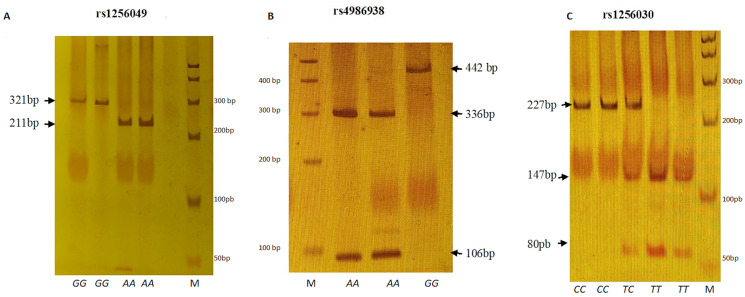
Variants of the estrogen receptor b () gene have been associated with different types of cancer. However, these associations have been inconsistent. We genotyped the variants (rs1256049, rs4986938, and rs1256030) in breast cancer (BC) patients and in healthy women.
The variants rs1256049 and rs4986938 in the gene were not associated with risk susceptibility in BC patients. However, the rs1256030 variant had an association as a risk factor for BC patients when compared with controls and BC patients for the genotype (odds ratio (OR) 1.86, 95% confidence intervals (CI) [1.05-3.28], = 0.042). In addition, differences were observed in patients and controls carrying the genotype under 50 years of age (OR 1.85, 95% CI [1.05-3.27], = 0.043). Thus, evident differences showed the rs1256030 variant in patients with , TC, and TC genotypes with: (1) Stage IV (OR 1.60, 95% CI [1.06-2.54], = 0.033), and (2) Luminal A (OR 1.60, 95% CI [0.47-0.21], = 0.041), as well as in BC carriers of the genotype with indices of cellular proliferative (Ki-67) elevated (>20%) and overweight (OR 1.67, 95% CI [0.85-3.28], = 0.041), respectively. In BC HER2 with lymph node metastasis, the genotype was a protective factor (OR 0.38, 95% CI [0.18-0.78], = 0.005). The identification of haplotypes included two common as risk factors (OR 3.1, 95% CI [1.31-7.72], = 0.011) and as a protective factor (OR 0.7, 95% CI [0.60-0.97], = 0.034). The haplogenotype was a risk factor (OR 2.5, 95% CI [1.28-5.0], = 0.008).
The variant rs1256030 () of the gene and haplotype were associated with susceptibility to BC as risk factors in this sample from the Mexican population.
雌激素受体 b () 基因的变异与不同类型的癌症有关。然而,这些关联并不一致。我们对乳腺癌 (BC) 患者和健康女性的 基因的 rs1256049、rs4986938 和 rs1256030 变异进行了基因分型。
基因中的 rs1256049 和 rs4986938 变异与 BC 患者的易感性无关。然而,与对照组和 BC 患者相比,rs1256030 变异是 BC 患者的一个风险因素,携带 基因型的患者(比值比 (OR) 1.86,95%置信区间 (CI) [1.05-3.28], = 0.042)。此外,在年龄在 50 岁以下的患者和对照组中,观察到携带 基因型的患者存在差异(OR 1.85,95% CI [1.05-3.27], = 0.043)。因此,rs1256030 变异在患者中的明显差异表现为:(1)IV 期(OR 1.60,95% CI [1.06-2.54], = 0.033),(2)Luminal A(OR 1.60,95% CI [0.47-0.21], = 0.041),以及 BC 患者的 基因型与细胞增殖(Ki-67)指数升高(>20%)和超重(OR 1.67,95% CI [0.85-3.28], = 0.041)相关。在 BC HER2 伴淋巴结转移的患者中, 基因型是一个保护因素(OR 0.38,95% CI [0.18-0.78], = 0.005)。鉴定的单倍型包括两个常见的 作为风险因素(OR 3.1,95% CI [1.31-7.72], = 0.011)和 作为保护因素(OR 0.7,95% CI [0.60-0.97], = 0.034)。单倍型 是一个风险因素(OR 2.5,95% CI [1.28-5.0], = 0.008)。
在来自墨西哥人群的样本中, 基因的 rs1256030() 变异和单倍型 与乳腺癌的易感性相关,是风险因素。