Du Wei, Cai Jing, Zheng Feixue, Yan Chao, Zhou Ying, Guo Yishuo, Chu Biwu, Yao Lei, Heikkinen Liine M, Fan Xiaolong, Wang Yonghong, Cai Runlong, Hakala Simo, Chan Tommy, Kontkanen Jenni, Tuovinen Santeri, Petäjä Tuukka, Kangasluoma Juha, Bianchi Federico, Paasonen Pauli, Sun Yele, Kerminen Veli-Matti, Liu Yongchun, Daellenbach Kaspar R, Dada Lubna, Kulmala Markku
Aerosol and Haze Laboratory, Beijing Advanced Innovation Center for Soft Matter Science and Engineering, Beijing University of Chemical Technology, Beijing 100089, China.
Institute for Atmospheric and Earth System Research/Physics, Faculty of Science, University of Helsinki, Helsinki 00014, Finland.
Environ Sci Technol Lett. 2022 May 10;9(5):375-382. doi: 10.1021/acs.estlett.2c00159. Epub 2022 Apr 12.
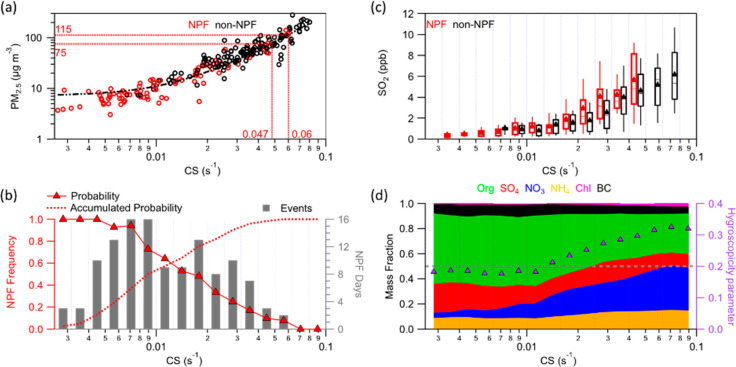
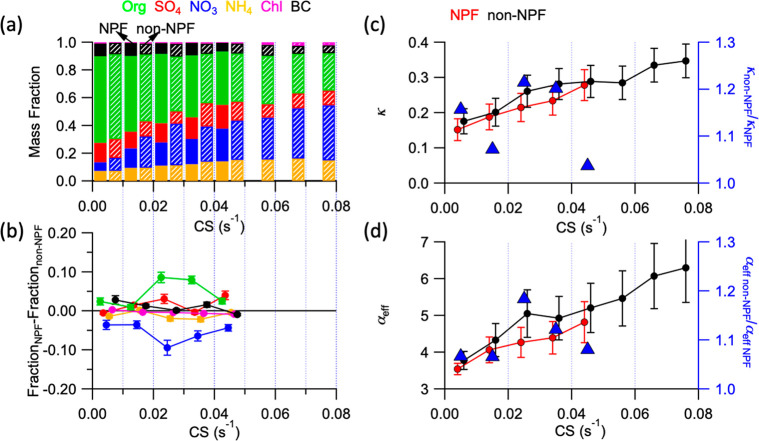
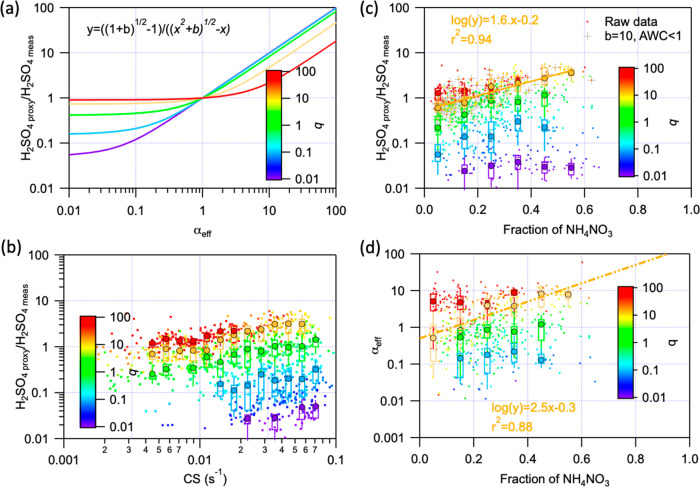
Relatively high concentrations of preexisting particles, acting as a condensation sink (CS) of gaseous precursors, have been thought to suppress the occurrence of new particle formation (NPF) in urban environments, yet NPF still occurs frequently. Here, we aim to understand the factors promoting and inhibiting NPF events in urban Beijing by combining one-year-long measurements of particle number size distributions and PM chemical composition. Our results show that indeed the CS is an important factor controlling the occurrence of NPF events, with its chemical composition affecting the efficiency of the background particles in removing gaseous HSO (effectiveness of the CS) driving NPF. During our observation period, the CS was found to be more effective for ammonium nitrate-rich (NHNO-rich) fine particles. On non-NPF event days, particles acting as CS contained a larger fraction of NHNO compared to NPF event days under comparable CS levels. In particular, in the CS range from 0.02 to 0.03 s, the nitrate fraction was 17% on NPF event days and 26% on non-NPF event days. Overall, our results highlight the importance of considering the chemical composition of preexisting particles when estimating the CS and their role in inhibiting NPF events, especially in urban environments.
相对高浓度的预先存在的颗粒物作为气态前体的凝结核(CS),被认为会抑制城市环境中新粒子形成(NPF)的发生,但NPF仍频繁出现。在此,我们旨在通过结合对粒子数粒径分布和PM化学成分的为期一年的测量,来了解促进和抑制北京城市地区NPF事件的因素。我们的结果表明,CS确实是控制NPF事件发生的一个重要因素,其化学成分影响背景粒子去除气态HSO的效率(CS的有效性),进而驱动NPF。在我们的观测期内,发现CS对富含硝酸铵(NHNO丰富)的细颗粒物更有效。在非NPF事件日,与在可比CS水平下的NPF事件日相比,充当CS的粒子含有更大比例的NHNO。特别是,在CS范围为0.02至0.03 s时,NPF事件日的硝酸盐比例为17%,非NPF事件日为26%。总体而言,我们的结果突出了在估计CS及其在抑制NPF事件中的作用时考虑预先存在粒子化学成分的重要性,尤其是在城市环境中。