Grigoryan Karine R, Shilajyan Hasmik A, Zatikyan Ashkhen, Aleksanyan Iskuhi, Hambardzumyan Lilit
Laboratory of Physical Chemistry, Chemistry Research Center, YSU, Yerevan, Armenia.
Laboratory of Organic Chemistry, Chemistry Research Center, YSU, Yerevan, Armenia.
Monatsh Chem. 2022;153(5-6):507-515. doi: 10.1007/s00706-022-02919-7. Epub 2022 May 9.
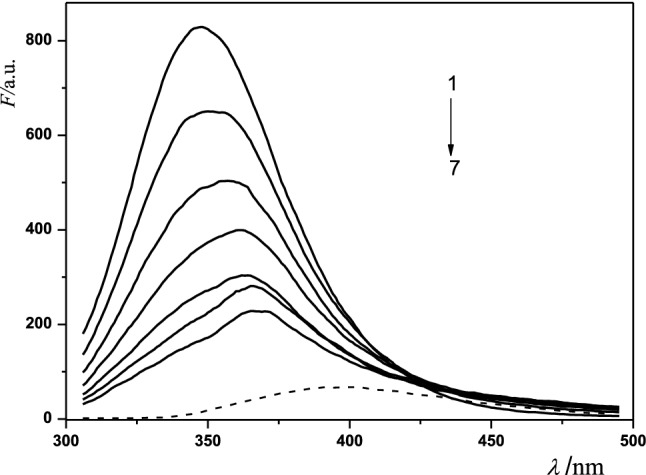
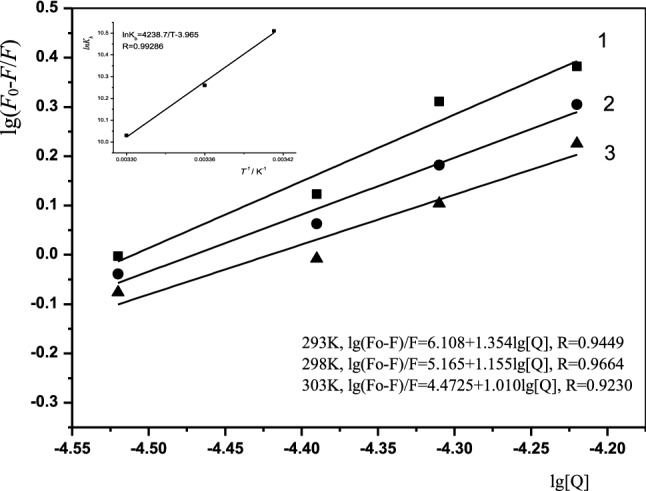
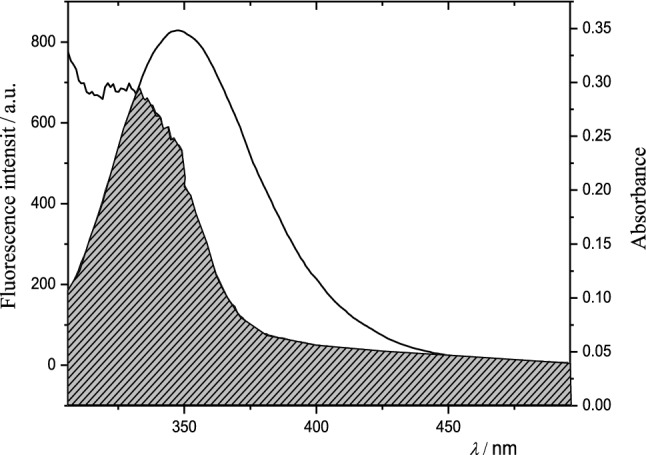
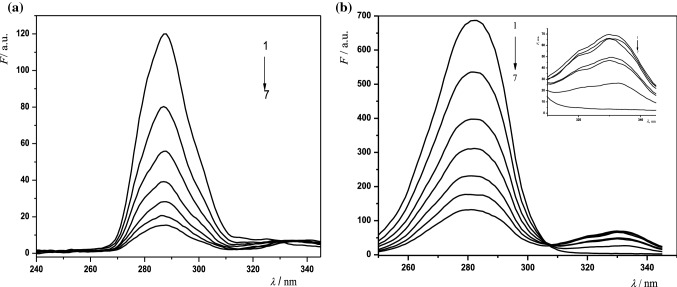
Binding of 2-(5-mercapto-1,3,4-oxadiazol-2-yl)-6-methylquinolin-4-ol (C1), a biologically active substance, to bovine blood plasma albumin (BSA) at 293, 298, and 303 K was studied using fluorescence (steady state, synchronous, excitation/emission matrix) and FT-IR spectroscopy methods. The experimental results showed that C1 causes fluorescence quenching of BSA through both static and dynamic quenching mechanisms. The thermodynamic parameters, enthalpy and entropy change, for the static quenching were calculated to be - 35.73 kJ mol and - 35.34 J mol K, which indicated that hydrogen bonding and van der Waals interactions were the predominant intermolecular forces regulating C1-BSA interactions. Distance between donor and acceptor (2.14, 2.26, and 2.30 nm) depending on the temperature, obtained from intrinsic Förster resonance energy transfer calculations, revealed the static quenching mechanism of BSA fluorescence in 0-3.0 × 10 mol/dm concentration range of C1. The micro-environmental and conformational changes in BSA structure, established by synchronous, excitation/emission matrices and FT-IR spectra showed the changes in the BSA secondary structure.
采用荧光(稳态、同步、激发/发射矩阵)和傅里叶变换红外光谱法研究了生物活性物质2-(5-巯基-1,3,4-恶二唑-2-基)-6-甲基喹啉-4-醇(C1)在293、298和303 K下与牛血浆白蛋白(BSA)的结合。实验结果表明,C1通过静态和动态猝灭机制导致BSA的荧光猝灭。计算得出静态猝灭的热力学参数,即焓变和熵变分别为-35.73 kJ/mol和-35.34 J/(mol·K),这表明氢键和范德华相互作用是调节C1与BSA相互作用的主要分子间作用力。根据本征福斯特共振能量转移计算得出的供体与受体之间的距离(2.14、2.26和2.30 nm)随温度变化,揭示了在C1浓度为0 - 3.0×10 mol/dm范围内BSA荧光的静态猝灭机制。由同步、激发/发射矩阵和傅里叶变换红外光谱确定的BSA结构的微环境和构象变化表明了BSA二级结构的变化。