Poos Jackie M, van den Berg Esther, Papma Janne M, van der Tholen Fleur C, Seelaar Harro, Donker Kaat Laura, Kievit J Anneke, Tibben Aad, van Swieten John C, Jiskoot Lize C
Department of Neurology and Alzheimer Center Erasmus MC, Erasmus MC University Medical Center, Rotterdam, Netherlands.
Department of Clinical Genetics, Erasmus MC University Medical Center, Rotterdam, Netherlands.
Front Psychiatry. 2022 Apr 27;13:864391. doi: 10.3389/fpsyt.2022.864391. eCollection 2022.
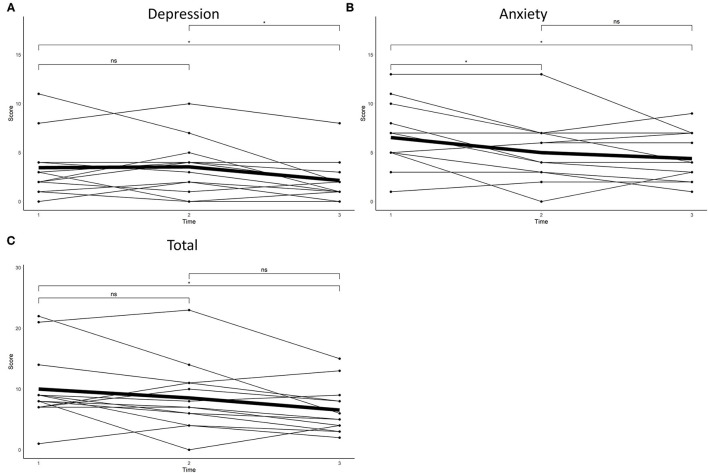
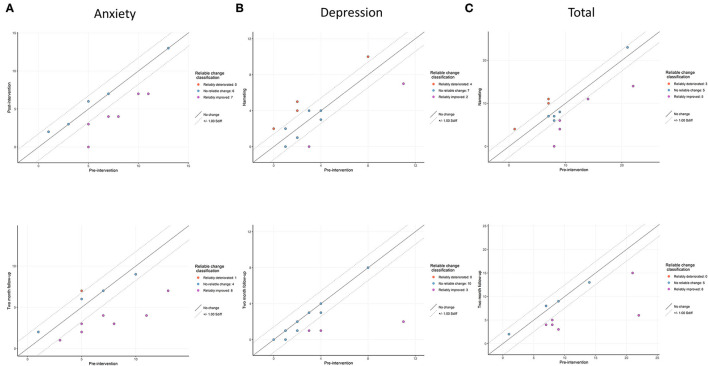
Pre-symptomatic frontotemporal dementia (FTD) mutation carriers and first-degree family members that are 50% at-risk for FTD may experience symptoms of anxiety and depression as a result of the ambiguity of when or if symptoms of the disease will manifest. We conducted a pilot study to investigate the use of an online mindfulness-based stress reduction (MBSR) course to reduce symptoms of anxiety and depression in presymptomatic frontotemporal dementia (FTD) mutation carriers and individuals 50% at-risk. Seven known mutation carriers and six individuals 50% at-risk completed a standardized 8-week MBSR course, and filled out pre- and post and two-month follow-up questionnaires. The primary outcome measure was the Hospital Anxiety and Depression Scale (HADS). Measures of psychological distress (SCL-90-R), coping style (UCL), quality of life (SF-36) and mindfulness skills (FFMQ) were administered as secondary outcome. Group effects were analyzed with repeated measures ANOVA or Friedman's test, and the individual reliability change index (RCI) was calculated per participant for each outcome measure. Semi-quantitative data included an evaluation and process measure post-intervention. Significant decline was found on the HADS-A post-intervention and after 2 months ( = 0.01), with 54% and 62% of participants demonstrating a clinically significant RCI, respectively. On the HADS-D, significant decline was found 2 months post-intervention ( = 0.04), which was driven by 23% of participants whom had a clinically significant RCI. Additional changes were found between baseline and post-intervention on the seeking distraction and reassuring thoughts subscales of the UCL, the depression and interpersonal sensitivity subscales of the SCL, the observe subscale of the FFMQ, and on physical role limitations of the SF-36 (all < 0.05). The process evaluation form indicated that the course was found beneficial by participants, and that they applied it in a wide range of everyday situations. This exploratory pilot study indicates the feasibility of MBSR in reducing anxiety and depression in presymptomatic FTD mutation carriers and 50% at-risk individuals. A randomized controlled trial is necessary to replicate these results.
症状前额颞叶痴呆(FTD)突变携带者以及有50%患FTD风险的一级家庭成员,可能会因疾病症状何时出现或是否会出现的不确定性而出现焦虑和抑郁症状。我们开展了一项初步研究,以调查基于正念减压疗法(MBSR)的在线课程对症状前额颞叶痴呆(FTD)突变携带者以及有50%风险的个体焦虑和抑郁症状的缓解作用。7名已知突变携带者和6名有50%风险的个体完成了为期8周的标准化MBSR课程,并填写了干预前、干预后及两个月随访问卷。主要结局指标是医院焦虑抑郁量表(HADS)。心理困扰量表(SCL-90-R)、应对方式量表(UCL)、生活质量量表(SF-36)和正念技能量表(FFMQ)作为次要结局指标进行测量。采用重复测量方差分析或弗里德曼检验分析组间效应,并为每个结局指标计算每位参与者的个体可靠性变化指数(RCI)。半定量数据包括干预后的评估和过程测量。干预后及2个月时,HADS-A量表得分显著下降(P = 0.01),分别有54%和62%的参与者表现出具有临床意义的RCI。在HADS-D量表上,干预后2个月得分显著下降(P = 0.04),这是由23%具有临床意义RCI的参与者推动的。在UCL量表的寻求分心和安慰性想法分量表、SCL量表的抑郁和人际敏感分量表、FFMQ量表的观察分量表以及SF-36量表的身体角色限制方面,基线与干预后之间还发现了其他变化(均P < 0.05)。过程评估表表明,参与者认为该课程有益,并将其应用于广泛的日常情境中。这项探索性初步研究表明,MBSR在减轻症状前FTD突变携带者和50%风险个体的焦虑和抑郁方面具有可行性。有必要进行一项随机对照试验来重复这些结果。