Kim Christopher, Zhu Shao, Kouros-Mehr Hosein, Khaldoyanidi Sophia
Center for Observational Research, Amgen Inc., Thousand Oaks, USA.
Biostatistics, Simulstat Inc., San Diego, USA.
Cureus. 2022 Apr 11;14(4):e24053. doi: 10.7759/cureus.24053. eCollection 2022 Apr.
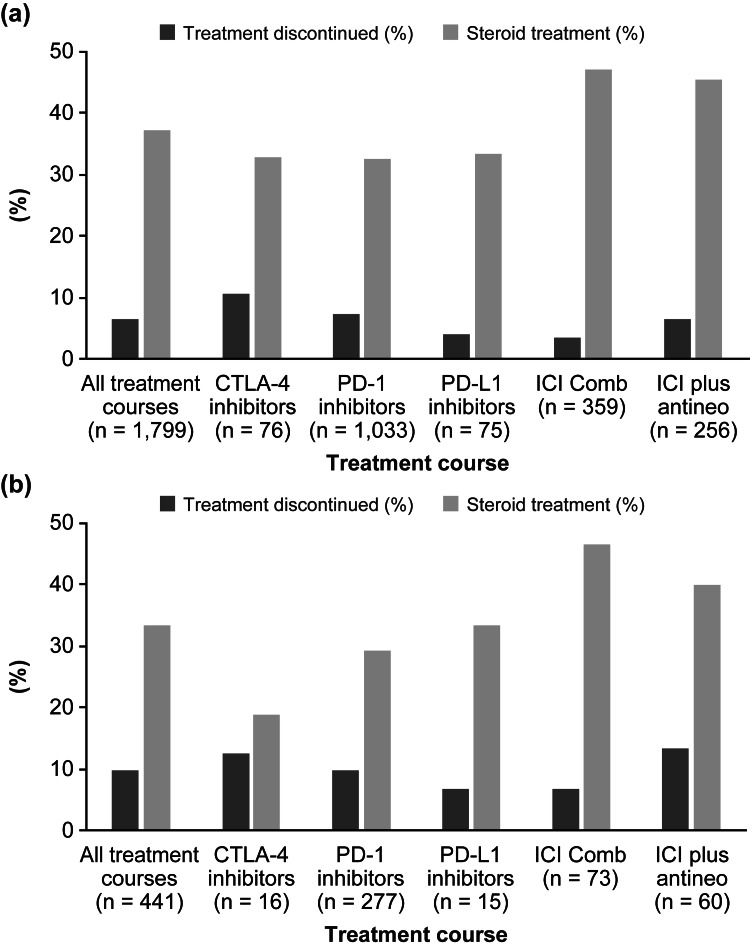
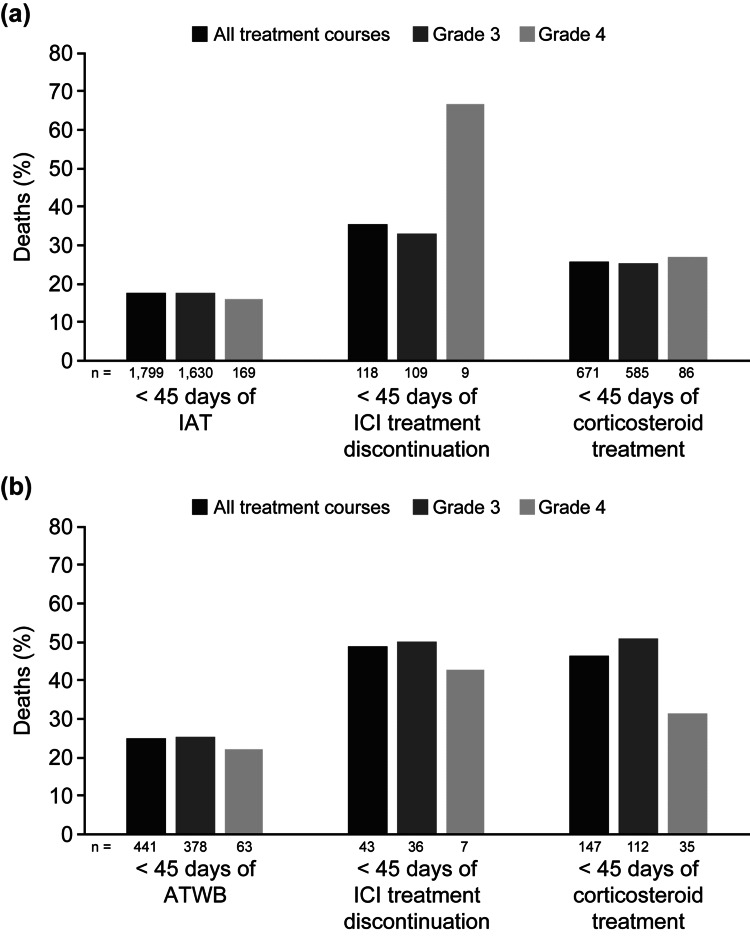
Introduction The elevation of aminotransferase levels is regarded as an indicator of hepatocellular injury. The objective of this study was to describe real-world incidence of elevated aminotransferase levels with or without bilirubin elevation among patients treated with immune checkpoint inhibitors (ICIs) for solid tumors. Methods This retrospective cohort study used an electronic health record database representing > 1.5 million active United States (US) cancer patients and included patients diagnosed with any cancer between January 1, 2014 and March 31, 2019, and treated with one or more ICIs such as ipilimumab, tremelimumab, nivolumab, pembrolizumab, atezolizumab, durvalumab, and avelumab. The frequency, onset, duration, management of grade ≥ 3 elevation of aminotransferase levels with or without bilirubin elevation events, progression rate from isolated elevation of aminotransferase levels (IAT) to elevated aminotransferase levels with elevated bilirubin (ATWB), and mortality were described. Results Overall, 69,140 patients received 85,433 treatment courses. A total of 1,799 (2.11%) IAT and 441 (0.52%) ATWB events were observed during treatment courses. The median onset was 51 and 42 days for IAT and ATWB, respectively, across treatment courses, and the median duration of both was approximately seven days. Approximately 5% (n=96) of IAT events progressed to ATWB in a median time of 11 days. The proportion of patients who received corticosteroids after elevated aminotransferase levels with or without bilirubin was ~37% (n=671/1,799 of IAT and n=147/441 of ATWB) and ~8% discontinued ICI treatment (n=118/1,799 of IAT and n=43/441 of ATWB). About 46% (n=68/147) of ATWB and and 25% (n=172/671) of IAT events treated with steroids led to death within 45 days. Similarly, 49% (n=21/43) of ATWB and 35% (n=42/118) of IAT events leading to treatment discontinuation led to death within 45 days. Conclusions Real-world data from oncology clinics in US suggest low incidence of grade ≥ 3 elevated aminotransferase levels with or without bilirubin elevation following treatment with ICIs. In most cases, ICI treatment was not discontinued and management of elevated aminotransferases consisted of corticosteroid treatment in one-third of cases.
引言 转氨酶水平升高被视为肝细胞损伤的指标。本研究的目的是描述接受免疫检查点抑制剂(ICI)治疗实体瘤的患者中,伴或不伴有胆红素升高的转氨酶水平升高的真实世界发病率。方法 这项回顾性队列研究使用了一个电子健康记录数据库,该数据库代表了超过150万美国活跃癌症患者,纳入了2014年1月1日至2019年3月31日期间被诊断患有任何癌症并接受一种或多种ICI(如伊匹木单抗、曲美木单抗、纳武利尤单抗、帕博利珠单抗、阿特珠单抗、度伐利尤单抗和阿维鲁单抗)治疗的患者。描述了≥3级转氨酶水平升高伴或不伴胆红素升高事件的频率、发病时间、持续时间、管理情况,从单纯转氨酶水平升高(IAT)进展为转氨酶水平升高伴胆红素升高(ATWB)的进展率以及死亡率。结果 总体而言,69140名患者接受了85433个疗程的治疗。在治疗疗程中,共观察到1799例(2.11%)IAT事件和441例(0.52%)ATWB事件。在各个治疗疗程中,IAT和ATWB的中位发病时间分别为51天和42天,两者的中位持续时间均约为7天。约5%(n = 96)的IAT事件在中位时间11天内进展为ATWB。转氨酶水平升高伴或不伴胆红素升高后接受皮质类固醇治疗的患者比例约为37%(IAT为n = 671/1799,ATWB为n = 147/441),约8%的患者停止了ICI治疗(IAT为n = 118/1799,ATWB为n = 43/441)。接受类固醇治疗的ATWB事件中约46%(n = 68/147)和IAT事件中约25%(n = 172/671)在45天内导致死亡。同样,导致治疗中断的ATWB事件中49%(n = 21/43)和IAT事件中35%(n = 42/118)在45天内导致死亡。结论 来自美国肿瘤诊所的真实世界数据表明,ICI治疗后≥3级转氨酶水平升高伴或不伴胆红素升高的发病率较低。在大多数情况下,未停止ICI治疗,三分之一的转氨酶水平升高患者采用皮质类固醇治疗。