Okazaki Tetsuya, Kawaguchi Tatsuya, Saiki Yusuke, Aoki Chisako, Kasagi Noriko, Adachi Kaori, Saida Ken, Matsumoto Naomichi, Nanba Eiji, Maegaki Yoshihiro
Division of Clinical Genetics, Tottori University Hospital, Yonago, Japan.
Division of Child Neurology, Department of Brain and Neurosciences, Faculty of Medicine, Tottori University, Yonago, Japan.
Hum Genome Var. 2022 May 17;9(1):14. doi: 10.1038/s41439-022-00194-w.
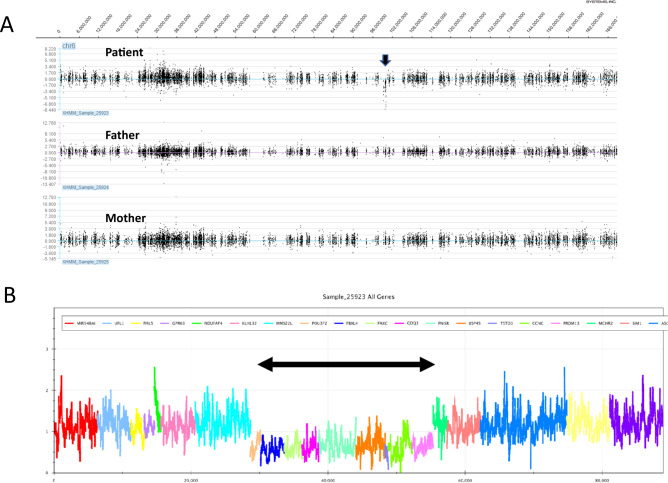
There is only one report of patients with developmental delay due to a 6q16.1 deletion that does not contain the SIM1 gene. A 3-year-old female showed strabismus, cleft soft palate, hypotonia at birth, and global developmental delay. Exome sequencing detected a de novo 6q16.1 deletion (chr6: 99282717-100062596) (hg19). The following genes were included in this region: POU3F2, FBXL4, FAXC, COQ3, PNISR, USP45, TSTD3, CCNC, and PRDM13.
仅有一份关于因6q16.1缺失(不包含SIM1基因)导致发育迟缓患者的报告。一名3岁女性出生时表现出斜视、软腭裂、肌张力减退和全面发育迟缓。外显子组测序检测到一个新发的6q16.1缺失(chr6: 99282717 - 100062596)(hg19)。该区域包含以下基因:POU3F2、FBXL4、FAXC、COQ3、PNISR、USP45、TSTD3、CCNC和PRDM13。