Bungaro Maristella, Buttigliero Consuelo, Tucci Marcello
Medical Oncology, University of Turin, San Luigi Gonzaga Hospital, Orbassano, Turin 10043, Italy.
Medical Oncology, Cardinal Massaia Hospital, Asti 14100, Italy.
Cancer Drug Resist. 2020 Sep 12;3(4):726-741. doi: 10.20517/cdr.2020.42. eCollection 2020.
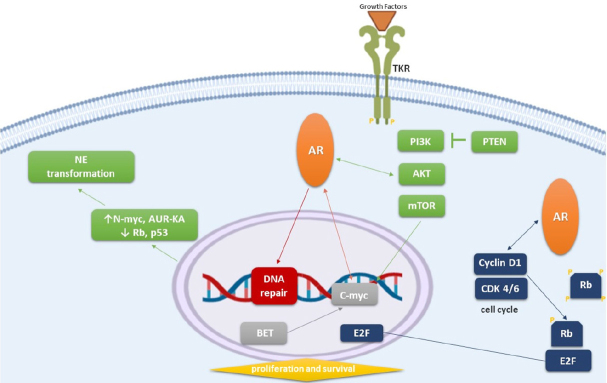
In recent years, many therapeutic advances have been made in the management of castration-resistant prostate cancer, with the development and approval of many new drugs. The androgen receptor (AR) is the main driver in prostate cancer growth and progression and the most effective therapeutic agents are still directed against this pathway. Among these, new generation hormonal agents (NHA) including enzalutamide, abiraterone acetate, apalutamide, and darolutamide have shown to improve overall survival and quality of life of prostate cancer patients. Unfortunately, despite the demonstrated benefit, not all patients respond to treatment and almost all are destined to develop a resistant phenotype. Although the resistance mechanisms are not fully understood, the most studied ones include the activation of both dependent and independent AR signalling pathways. Recent findings about multiple growth-promoting and survival pathways in advanced prostate cancer suggest the presence of alternative mechanisms involved in disease progression, and an interplay between these pathways and AR signalling. In this review we discuss the possible mechanisms of primary and acquired resistance to NHA with a focus on AR independent pathways.
近年来,随着多种新药的研发和获批,去势抵抗性前列腺癌的治疗取得了许多进展。雄激素受体(AR)是前列腺癌生长和进展的主要驱动因素,最有效的治疗药物仍然针对这一途径。其中,新一代激素药物(NHA),包括恩杂鲁胺、醋酸阿比特龙、阿帕鲁胺和达罗他胺,已显示出可改善前列腺癌患者的总生存期和生活质量。不幸的是,尽管已证明有获益,但并非所有患者都对治疗有反应,而且几乎所有患者最终都会产生耐药表型。虽然耐药机制尚未完全明确,但研究最多的机制包括依赖和独立的AR信号通路的激活。关于晚期前列腺癌中多种促生长和生存途径的最新研究结果表明,疾病进展涉及其他机制,且这些途径与AR信号之间存在相互作用。在本综述中,我们将讨论对NHA产生原发性和获得性耐药的可能机制,重点关注AR非依赖途径。